Anatomy of a .covar configuration
A .covar file is TOML with config_version, an analysis name, a method, shared input/scope, engine-specific sections, numerics, and output policy. The minimal useful file can contain [input] and [covariates]; defaults fill the rest. A full qualification file records every setting that could alter a number instead of relying on memory or future defaults.
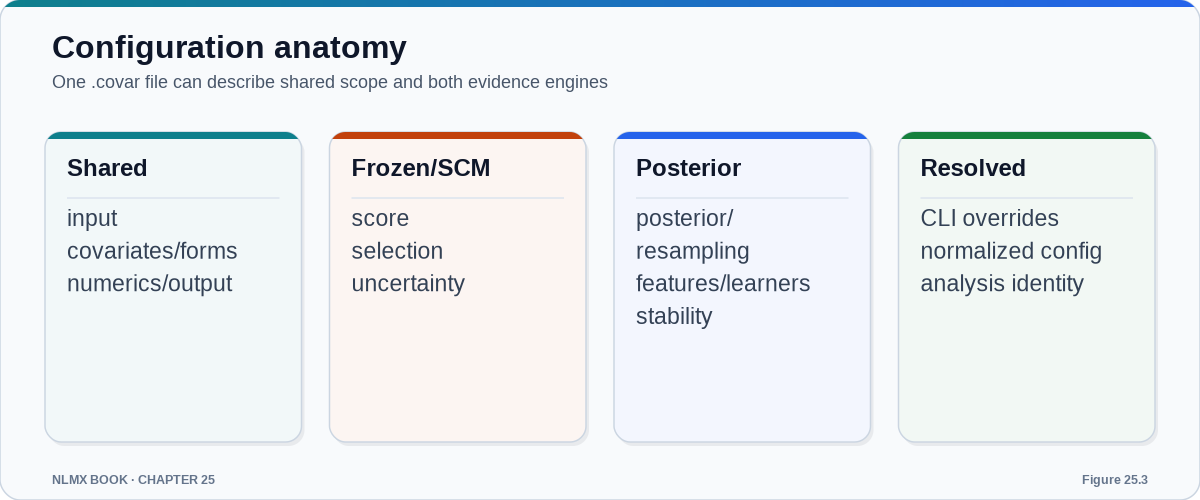
Shared tables include [execution], [input], [input.files], [covariates], [covariate_options], detailed [[covariates]], [[relationships]], [numerics], [output], and [[competition_groups]]. Frozen/SCM use [score], [selection], and [uncertainty]. Posterior uses [posterior], [variance_consistency], [resampling], [posterior_sampling], [features], [learners] and learner-specific subtables, plus [stability].
Unknown keys are rejected. Tables belonging to an unselected engine are accepted and ignored so one reviewed configuration can drive frozen, posterior, and both. Relative paths resolve against the configuration file's directory. Preserve both the source configuration and normalized_config.covar: the latter exposes defaults, CLI overrides, normalized tokens, and the actual resolved analysis.
Common mistakes
- Changing the scientific question after seeing the result while presenting it as the original run.
- Reading one engine's summary without checking its prerequisites, failures, normalized settings, and fitted endpoint.
- Treating a generated draft, comparison label, or completed checkpoint as a substitute for model diagnostics and reference-software confirmation.
Page checklist
- The exact command, version, inputs, resolved settings, and output directory are identifiable.
- Engine-specific evidence is interpreted on its own scale before cross-method comparison.
- Recovery state, final refit, diagnostics, and remaining confirmation work are explicit.