15.3 Doses, occasions, and profile selection
The output unit is a profile, not automatically a subject. Each dose starts a dosing interval and receives an occasion number. A subject with three doses may therefore yield three rows in nca_parameters.csv when [analysis] intervals = "all".
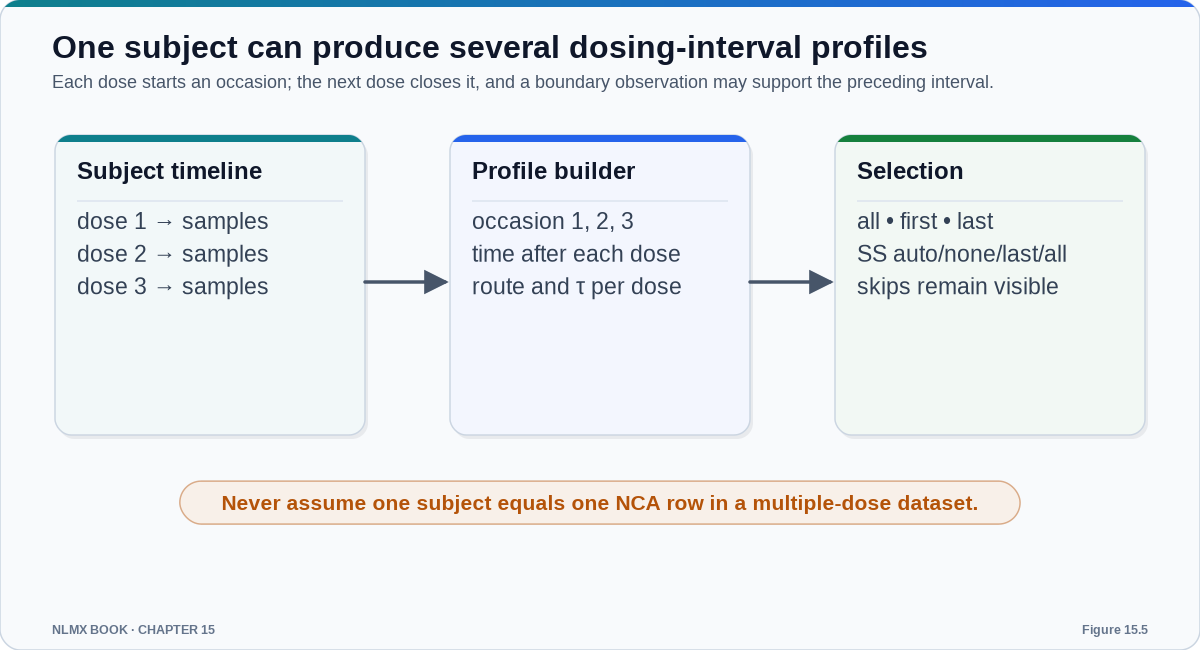
Interval construction
Times within a profile are measured after its dose. The next dose normally closes the current interval. A concentration at the next-dose boundary may support the previous profile's endpoint while the dose itself starts the next occasion. The builder avoids treating that single sample as two independent measurements.
ADDL records are expanded into dose occasions using II. An SS dose with II can supply a steady-state interval. When no usable II is present, [analysis] tau or --tau can provide the intended interval for steady-state calculations.
Selecting profiles
--nca-intervals all|first|last controls which dose intervals are analysed per subject. all is the default and preserves every constructed profile. first is useful for first-dose exposure; last can focus on the latest interval, but it does not by itself prove steady state.
Steady-state classification is separate:
autouses SS plus II information;nonetreats no interval as steady state;lastlabels the last interval for each subject;alllabels every interval.
Do not use last as a shortcut when the study has not reached pharmacokinetic steady state. It is a classification instruction, not a biological test.
Profiles with fewer usable observations than min_observations remain in nca_parameters.csv with SKIPPED rather than disappearing. The default minimum is 3. [analysis] max_time can exclude samples after a postdose limit; this is configuration-only and should be justified because it can remove terminal support.
Common mistakes
- Expecting one row per subject in a repeated-dose study.
- Calling the last interval steady state without regimen evidence.
- Losing a boundary sample through incorrect sort/order assumptions.
- Dropping skipped rows before counting endpoint availability.
Checklist
- Reconstruct each subject's dose timeline.
- Verify occasion numbering and postdose times.
- Separate interval selection from steady-state classification.
- Confirm tau and boundary samples.
- Report analysed and skipped profile counts.
Further reading
Continue with analysis interval settings, steady-state worked evidence, and the theory of profile construction.