38.18 sims output dictionary
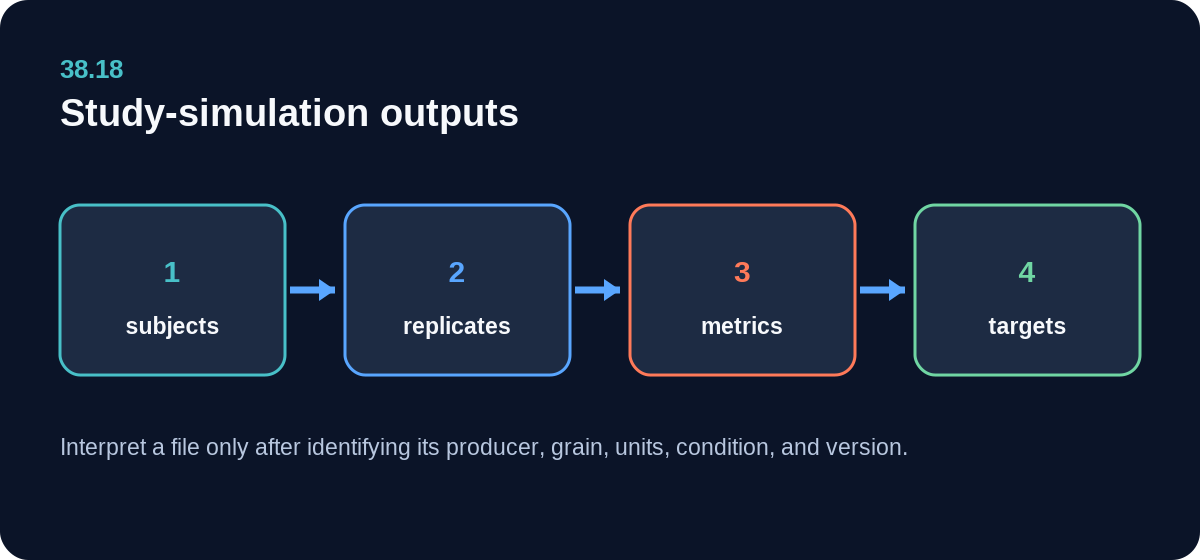
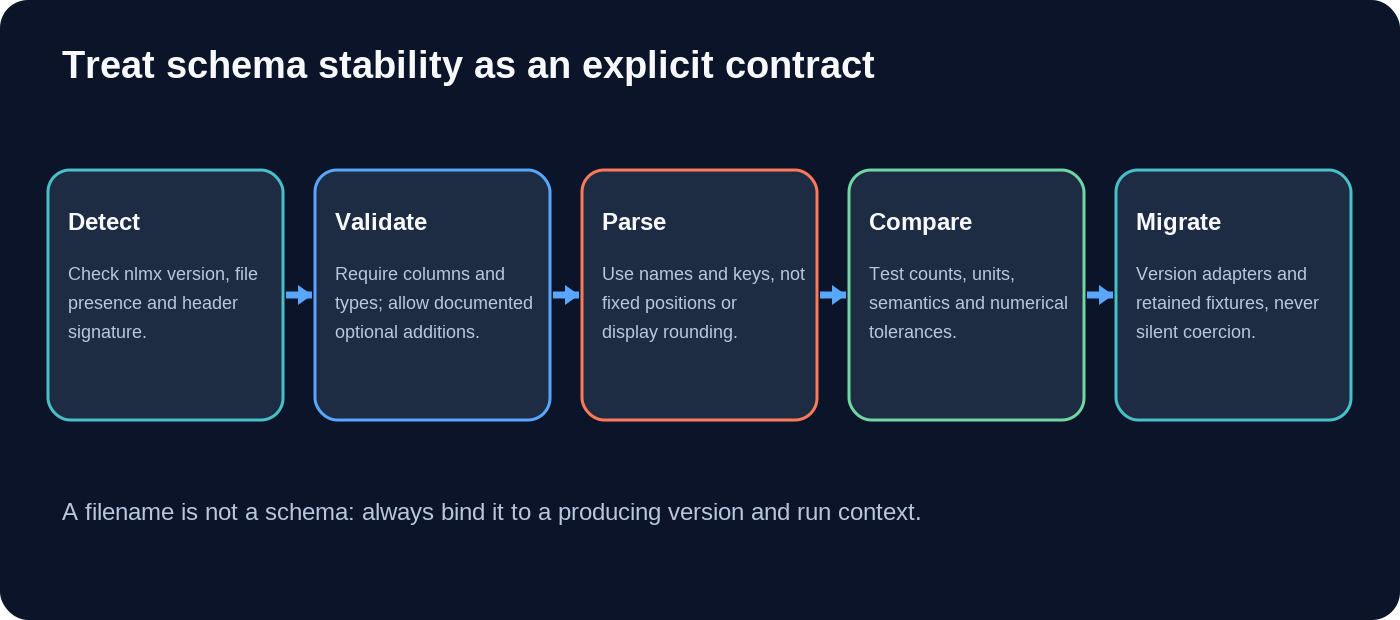
Simulation outputs stack multiple simulation and subject grains. SIM is part of the primary key whenever subproblems exceed one. Distinguish the observation schedule from the dense metric profile, and distinguish residual variability from parameter uncertainty and between-subject variability.
Files produced by sims
The table is a versioned contract for nlmx 4.16.2. “When present” is part of the schema: absence can mean disabled, not applicable, no qualifying rows, an earlier failure, or a defect. Distinguish those states with the summary/log and expected configuration.
| File or pattern | Format | When present | Row/object grain | Purpose | Key fields or structure | Units | Role |
|---|---|---|---|---|---|---|---|
<stem>_data.csv |
delimited text | generated population; omitted with --data | one row per generated NONMEM record | generated dataset in $INPUT layout | control-stream input columns | model/data-specific | primary |
<stem>_sim.csv / <stem>_sim.tab |
delimited / NONMEM table | simulated output; .tab only when requested | one row per replicate × source record | stacked simulated DV and requested table variables | SIM plus dataset/table columns | model/data-specific | primary |
<stem>_subjects.csv |
delimited text | subject output enabled | one row per simulation × subject | population, dose, bins, interval, ETA and covariates | SIM,ID,ARM,POP,AGE,SEX,SEX_LABEL,WEIGHT,CDC_Z,DOSE,bins,START,TAU,ETA*,covariates | age/weight/dose/time/ETA-specific | primary |
<stem>_metrics.csv |
delimited text | metrics enabled | one row per simulation × subject | subject-level exposure metrics | subject columns + CMAX,TMAX,CMIN,CTROUGH,CAVG,AUCTAU,...,COVERED | concentration/time/AUC/clearance-specific | primary |
<stem>_summary.csv |
delimited text | summary enabled | one row per group × level × metric | configured statistics of exposure metrics | group,level,metric,statistics | metric-specific | primary |
<stem>_summary_simulations.csv |
delimited text | multiple simulations | one row per group × metric × statistic | distribution of each summary statistic across simulations | group,metric,statistic,median,interval | metric-specific | primary |
<stem>_targets.csv |
delimited text | targets configured | one row per group × target | target attainment and simulation interval | group,target,n,attainment,interval | percent/fraction | primary |
<stem>_profiles.csv |
delimited text | --write-profiles | one row per subject × dense profile time (first simulation) | concentration-time profiles used for metrics | subject identifiers,time,concentration and grouping | time/concentration | primary |
<stem>_summary.json / sims_summary.txt |
JSON / text | enabled / always | one run summary | notes, parameters, metrics, summaries, targets, and warnings | format-dependent | mixed | machine summary |
<stem>_settings.sims |
TOML | settings output enabled | one resolved recipe | every effective default and absolute path | all sims settings | setting-specific | reproduction |
sims_report.html / plots/** |
HTML / PNG / SVG | enabled | one report or figure | settings, summaries, targets, box/scatter/profile figures | visual/table document | axis-specific | presentation |
Reading sequence
- Confirm the command, nlmx version, exit status, output root and settings/CLI overrides.
- Open the text/JSON summary to understand status, warnings, counts and conditional branches.
- Validate the primary table headers and expected row grain before parsing values.
- Reconcile row counts and identifiers across related files.
- Trace important estimates, classifications or decisions to the native model/data evidence.
- Inspect HTML and figures after verifying their source tables.
- Verify checksums and retain the complete tree, including failures relevant to denominators.
Common parsing mistakes
- treating an optional missing file as an empty successful result;
- grouping at subject level when the table is subject-by-occasion, replicate or simulation;
- using displayed text/plot rounding as the analytical value;
- joining dynamic files by row position;
- losing exclusions, failed fits or warnings while copying only the selected result;
- assuming units from a familiar column name rather than the run's data/model/settings;
- parsing a cache/checkpoint as if it were a stable final-results API.
Review questions
- Does every row have a clearly stated grain and candidate primary key?
- Are denominators and failure states retained?
- Are units and transformations traceable?
- Is the file a primary result, reproduction recipe, presentation, or operational state?
- Can a second analyst reproduce the reported value from retained inputs and settings?
Navigation
See the previous page, next page, and complete output reference.