19.25 When to use SAEM instead of FOCE-I
FOCE-I is attractive when conditional modes are smooth, variability is moderate, residual interaction is important but manageable, and fast deterministic screening is needed. SAEM becomes attractive with strong nonlinearity, sparse/high-dimensional ETAs, difficult conditional shapes, censoring/user likelihoods, or persistent linearization sensitivity.
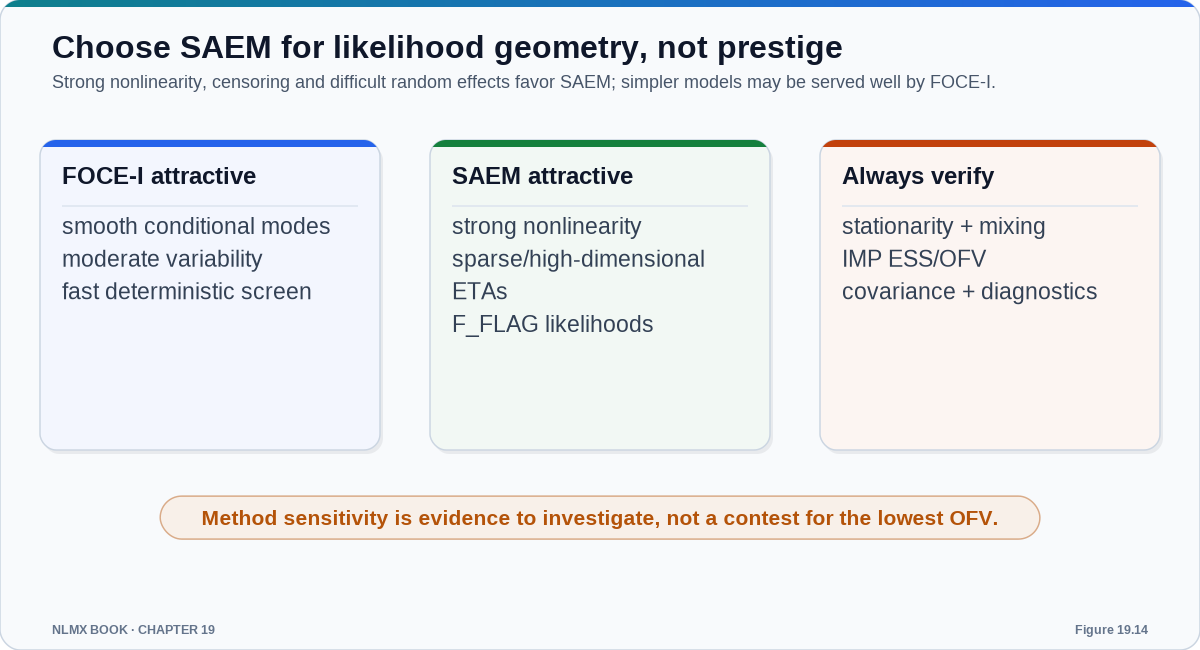
Method choice should follow a prespecified decision. A practical path is FOCE-I for supported exploratory models, then SAEM sensitivity/final estimation where simulation/diagnostics indicate approximation risk. Laplace is another option for general likelihood records.
Do not choose by the lowest numeric OFV across methods: FOCE-I and IMP represent different objective approximations/estimators. Compare parameter conclusions, diagnostics and validation evidence.
SAEM costs more and needs stochastic diagnostics. It is not automatically safer when chains mix poorly or ESS is low.
Practical interpretation
Use a decision record with four columns: model feature, expected FOCE-I risk, expected SAEM risk, and validation evidence. For example, M3 censoring rules out linearized Gaussian FOCE, while high-dimensional multimodal ETA targets can also challenge SAEM mixing. Choose the method whose assumptions and diagnostics can be supported.
If FOCE-I and SAEM disagree, cross-evaluate predictions, modes and aligned marginal objectives rather than selecting the more plausible estimate by intuition. The disagreement is a finding requiring investigation and perhaps simulation.
For final inference, require method-specific convergence and uncertainty evidence. A successfully terminated FOCE-I and a stationary SAEM run answer different numerical questions until their likelihood objectives are aligned.
Common mistakes
Do not reserve SAEM only for failed FOCE-I, or switch methods after seeing favorable results without disclosure. Method robustness is not model validity.
Checklist
- Assess nonlinearity, sparsity, ETA dimension and censoring.
- Review method-specific validation.
- Predeclare primary/sensitivity methods.
- Require mixing, stationarity and ESS evidence.
- Keep comparison objectives aligned.
Further reading
Review Chapter 18 method comparison and proceed to the worked example/limits.