12.28 Limits and validation of the checker
qc-nm is a static and data-aware quality-control layer. It can find many malformed records, inconsistent declarations, risky numerical expressions, missing options, and common source defects quickly. It cannot prove that the model is scientifically correct or reproduce every behavior of NM-TRAN, NONMEM, PsN, Monolix, or another pharmacometric system.
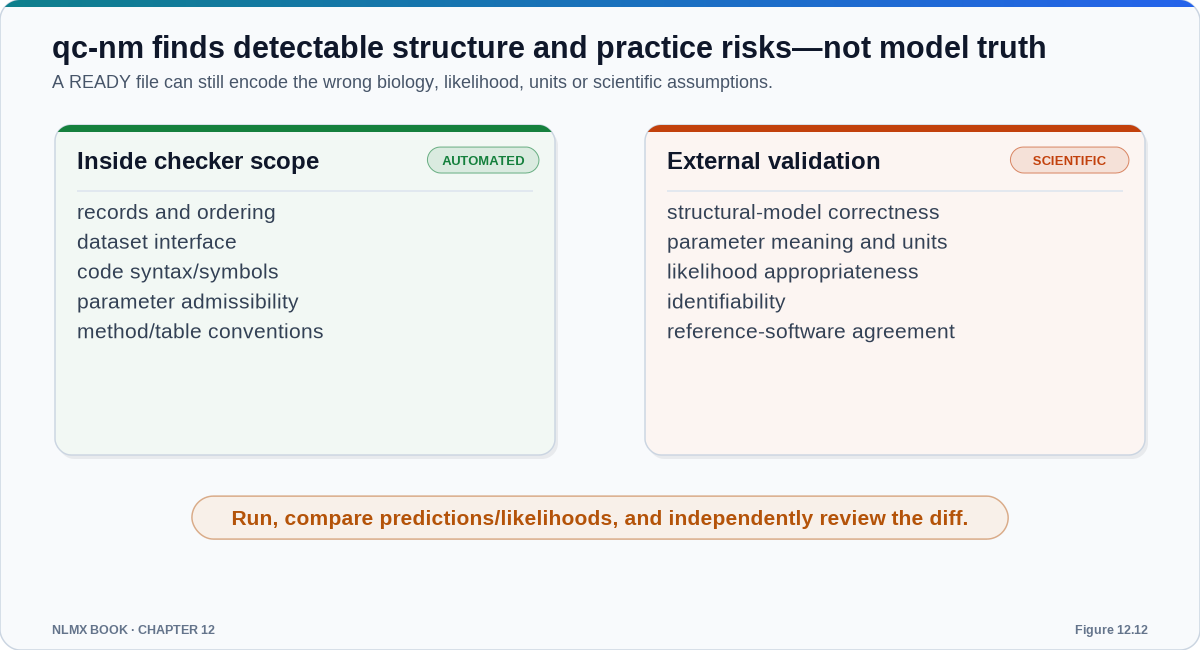
What remains outside the verdict
A READY result does not prove successful translation, minimization, covariance, identifiability, unbiased estimates, an appropriate likelihood, correct units, or adequate predictive performance. Static code analysis can also be conservative around generated code, includes, version-specific syntax, conditional paths, and specialized NONMEM features. False positives and false negatives should be captured as versioned test cases.
Corrections carry an additional boundary. They resolve recognizable patterns and make changes reviewable; they do not reconstruct author intent. Any edit affecting selected data, parameters, estimation methods, or output schemas must be tested as a model change.
Building a credible validation matrix
Use small fixtures for every FIL/REC/INP/DAT/SUB/COD/PAR/EST/TAB/DOC check, including pass, fail, warning, not-applicable, and correction transitions. Add real-world control streams spanning ADVANs, user-written $DES, multiple problems, likelihood models, EM/Bayesian methods, block covariance structures, includes, and varied table designs. Compare results across pinned nlmx and NONMEM versions.
For corrected models, compare original and candidate translation behavior, selected row counts, parameter maps, objective values, estimates, gradients, covariance results, and table schemas. Define tolerances before observing results. Benchmark speed separately from accuracy: a faster checker is valuable only when its detection and correction behavior is characterized.
Common mistakes
- Calling an 81-check pass “NONMEM validated.”
- Testing only known-good files and omitting negative fixtures.
- Comparing rounded report values instead of machine-readable outputs.
- Changing tolerances after seeing disagreements.
Checklist
- State the exact scope and nonclaims of qc-nm.
- Validate every check and correction with frozen fixtures.
- Include diverse real models and target software versions.
- Predefine numerical and structural acceptance criteria.
- Preserve disagreements as regression tests and release evidence.
Further reading
See what is checked and in what order, Chapter 9 accuracy and reproducibility, and the remaining validation chapter plan.