13A.34 Limits, performance, validation, and good practice
custom is a descriptive rendering and table engine. It handles one input file, row-wise derivation, filtering and selection, 19 geoms, six table kinds, and reproducible output. It does not join files, reshape wide/long data, compute profile-derived PK quantities, fit statistical/pharmacometric models, run hypothesis tests, or provide regulatory validation by itself.
Performance guardrails
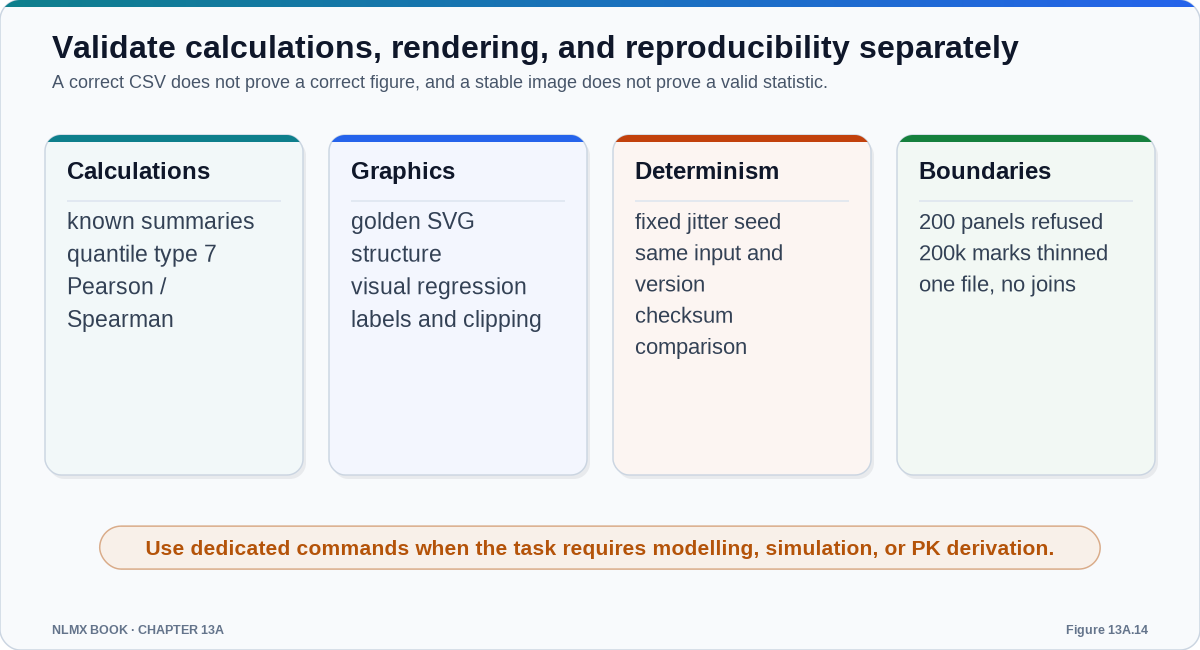
Panels with more than 200,000 marks are thinned evenly and the summary notes it. More than 200 facet panels are refused, as are excessively categorical axes. These limits protect rendering but do not decide a scientifically appropriate sample. Large files should be summarized at the correct grain, not arbitrarily truncated for speed.
Validation layers
Calculation validation needs known-answer fixtures for means, SD, geometric statistics, type-7 quantiles, percentages, pivot cells, Pearson, and Spearman. Graphics validation needs structural SVG checks and visual review for mappings, legends, labels, clipping, and missing values. Reproducibility needs a fixed jitter seed, executable version, input/settings hashes, requested inventory, and checksum comparison.
Comparison with R/Python must align algorithms: local-linear tricube loess differs from R's default local-quadratic loess; density bandwidth and quantile type must match; categorical ordering and missing rules must match. Small differences are not automatically errors, and visual similarity is not numerical equivalence.
Record every accepted difference with its cause and tolerance.
Common mistakes
- Treating a rendered figure as validated science.
- Benchmarking unlike formats, dimensions, or workloads.
- Ignoring thinning or missing-row notes.
- Using descriptive output for inferential claims.
Checklist
- Test known answers for every statistic used.
- Inspect machine-readable and visual artifacts.
- Freeze seed, version, inputs, settings, and output inventory.
- Compare equivalent algorithms and denominators.
- Escalate modelling questions to dedicated commands.
Further reading
Return to the Chapter overview, output provenance, worked evidence, and remaining chapters.