40.18 Migrating a PopED design evaluation
What you will learn
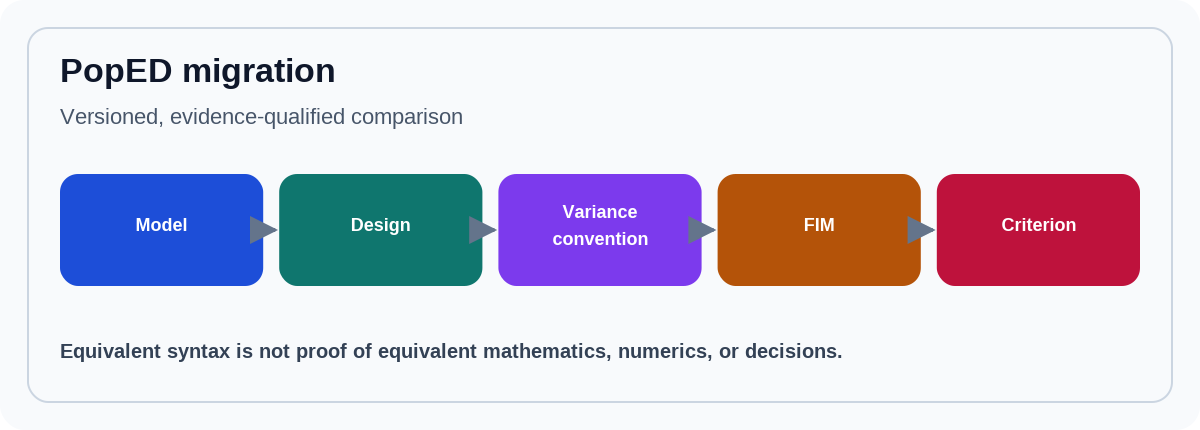
- Translate model, design, and variance conventions
- Align full/reduced FIM and optimality criterion
- Use SSE to confirm a proposed design
Prerequisites: Chapter 39 troubleshooting, Chapter 36 command reference, and Chapter 38 output reference.
This page is scoped to nlmx 4.16.2 and an external-documentation snapshot of 2026-11-10. Product names describe different system boundaries; a blank or “outside role” is not a quality ranking. Treat every migration as a new implementation until model semantics, analysis population, objective definition, numerical behavior, outputs, and decisions have been independently reconciled.
Freeze the PopED version/database creation code, model functions, population/random/residual parameters, uncertainty distributions, design/groups/times/doses/covariates, design space, fixed/free flags, FIM calculation type, approximation, optimality criterion, seed, and optimization settings.
Translate the same model into an nlmx control stream and declared power scenarios. Pay special attention to variance versus standard deviation and residual parameterization. PopED documents full and reduced FIM choices; nlmx's default reduced FIM may be aligned only after parameter order and zeroed blocks are confirmed.
First compare predictions/sensitivities at design points. Then compare FIM matrices, eigenvalues/condition, expected SE/RSE, and power under identical formulas. nlmx does not replace poped_optim: it does not search sample times or design variables. Instead, bring the selected PopED design into nlmx for FIM/SSE evaluation and stress scenarios such as dropout, BLQ, uncertainty, and fit failures.
An optimal design is conditional on model/parameter/design-space assumptions. Report efficiency/robustness and practical constraints, not only optimal times.
FIM reconciliation fields
Store parameter order, natural/transformed scale, fixed flags, full/reduced type, fixed–random cross-block treatment, OMEGA/SIGMA convention, residual derivative parameterization, design group weights, sampling times/model switches, and prior/parameter uncertainty. Compare raw matrices before determinant-based criteria: two matrices can yield similar log-determinants while placing information in different parameter directions.
Primary source note: See the official htmlPopED introduction for design optimization and the htmlFIM reference for full/reduced variants.
Review checklist
- Are the exact product versions, task boundaries, inputs, methods, and settings named?
- Were semantics and frozen-parameter results aligned before optimized outputs?
- Is the comparison using a method-appropriate deterministic or stochastic tolerance?
- Are unsupported or analogous features described without implying equivalence?
- Can every claim be reproduced from retained primary evidence?
Navigation
See the previous page, next page, and complete comparison reference.