23.24 Conditional forward inclusion
Hierarchical conditional selection begins with always-included effects, or an empty active set when none are declared. Every eligible candidate is scored conditional on that active set. The candidate with the smallest conditional p-value enters when p < --alpha; the default forward alpha is 0.05. The active set is updated and all remaining candidates are rescored. The stage stops when no remaining candidate satisfies the threshold.
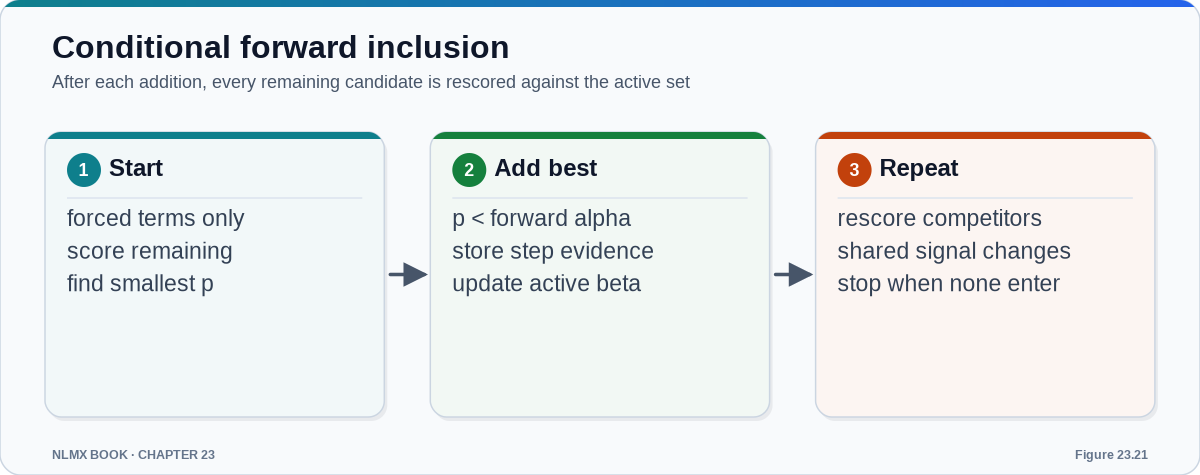
The selected candidate carries its conditional one-step coefficient into the working active set. This is still a local approximation, but it allows subsequent scores to reflect competition. Forward order can change when candidates share signal, so retain the complete trace rather than only the final set.
In the verified run, V–WT entered first with conditional p 7.20e-11. CL–WT then entered at 0.0142, followed by CL–EGFR at 0.0182. The next best candidate failed the 0.05 threshold. These p-values answer different conditional questions at different steps and are not a sorted univariate list.
Use strict inequality: equality with alpha does not enter. Avoid rounding a displayed p-value before applying the decision rule.
What to inspect at every step
Create a step table containing active terms, every candidate's conditional statistic and p-value, rank, beta, sign, warning, and the winning decision. Look for candidates whose evidence collapses after a competitor enters; that pattern often indicates shared biological or design signal. Also flag a coefficient whose sign reverses, because suppression or collinearity may be present. The smallest p-value is not sufficient if its matrix is unstable or subject modes fail. When two candidates are nearly tied, refit both paths or record a sensitivity rather than implying the observed ordering is uniquely determined by the data.
Common mistakes
- Sorting univariate p-values and calling that a forward path.
- Failing to rescore after each addition.
- Comparing step-specific p-values as if they share one null model.
- Applying thresholds to rounded values.
- Reporting active one-step coefficients as final estimates.
Checklist
- Verify the initial forced active set.
- Preserve every candidate evaluation at every step.
- Apply exact conditional p-values and strict inequality.
- Review changing signs, rank, and conditioning.
- Continue to the prespecified backward stage.
Further reading
Next read backward retention, thresholds, and the worked path.