38.24 Output stability policy and safe downstream parsing
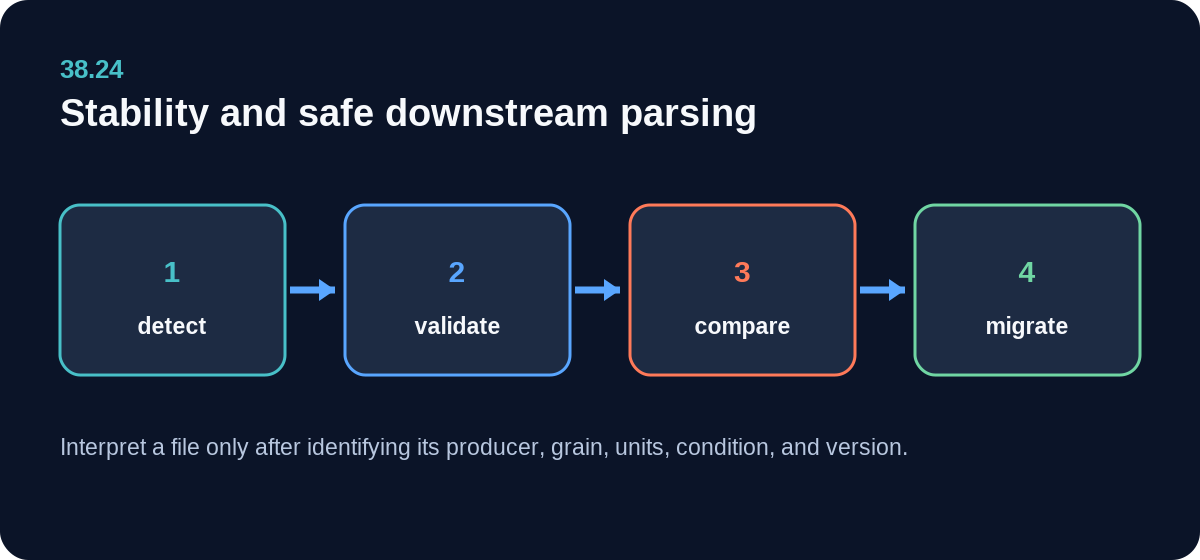
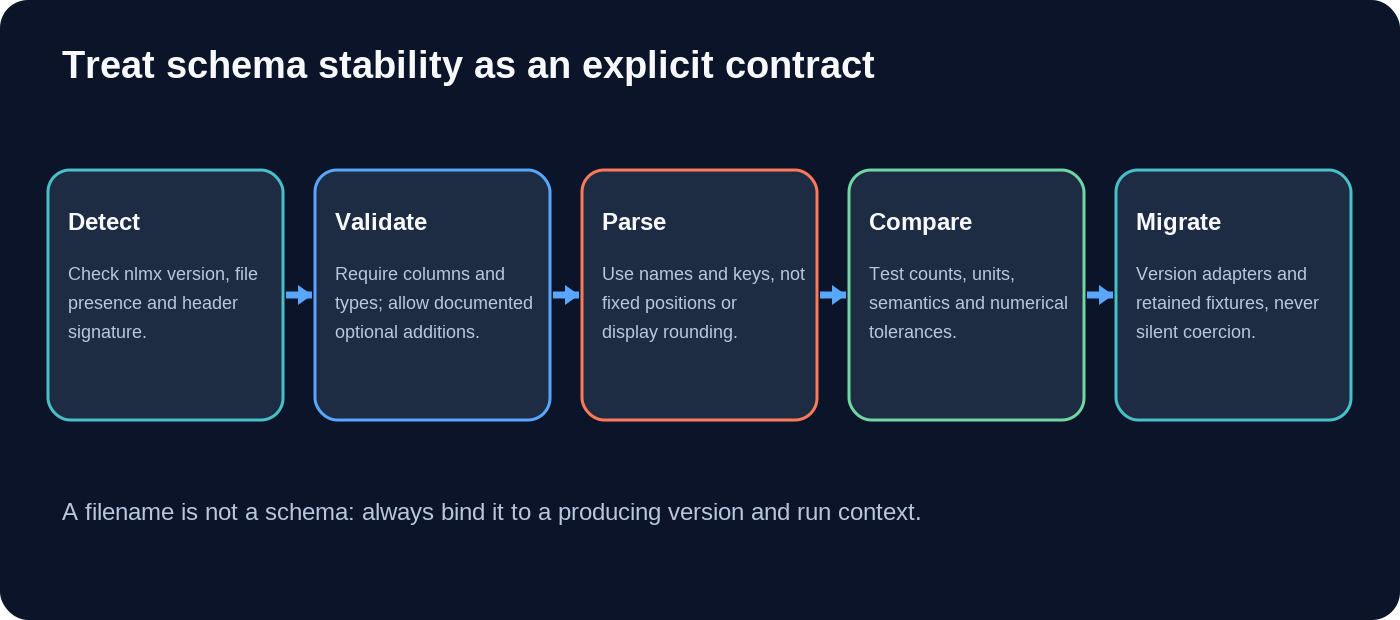
The output catalogue is version-scoped to nlmx 4.16.2. Unless a producer explicitly promises otherwise, filenames and columns are not an eternal API. New optional columns can appear, names can be clarified, defaults can alter which conditional files exist, and nested JSON can evolve.
Consumer compatibility policy
Pin the producing nlmx version in every automated pipeline. Maintain a schema adapter per supported version or version range. Require a small core of named columns, allow only reviewed optional additions, and reject missing/renamed required fields. Do not bind to column positions, formatted console text, plot filenames alone, or undocumented JSON object order.
Use header signatures and semantic checks together. A file named parameters.csv with the expected header can still belong to the wrong candidate or retry. Check its relative path, model/control-stream identity, run summary, counts and hash. For dynamic patterns, enumerate files from the output summary or checksum manifest rather than guessing names.
Change classification
- Additive: optional file/column/JSON field; older consumers may continue after an explicit allow-list update.
- Breaking syntactic: rename, removal, type/delimiter/grain change; requires a new adapter.
- Breaking semantic: same spelling but changed definition, denominator, unit, missingness or population; requires scientific requalification.
- Presentation-only: HTML/CSS/text/figure layout; still requires visual regression if released.
- Operational: checkpoint, cache, log or folder behavior; requires recovery/audit testing.
Qualification fixtures
For every consumed file keep a small frozen fixture, its producer version and hash, expected schema, primary-key assertion, missing-value examples and semantic totals. Test normal, optional-column, empty-table, failed/partial-run and large-file cases. For numerical fields define absolute/relative tolerances appropriate to the method; do not use one tolerance for OFV, probabilities, parameters and display rounding.
Migration sequence
Inventory the old output tree, generate the same controlled fixture with the new executable, compare file sets and headers, classify differences, run typed/schema checks, compare scientific totals and numerical values, inspect presentation targets, then approve the new adapter. Never silently coerce an unknown column or convert missing to zero merely to keep a pipeline running.
Archival minimum
Archive primary outputs, resolved settings/commands, input/model identities and hashes, log, checksum manifest, software version, parser version, review record and known limitations. Checkpoint/cache files are useful for forensic continuation but do not replace final primary outputs.
Navigation
See the previous page, next page, and complete output reference.