Worked both run and comparison
The teaching run uses seed 25048, 40 resamples, one posterior draw per resample, adaptive elastic net plus weighted GLS, frozen uncertainty disabled for a compact deterministic demonstration, and the same five-relationship scope. It produced 160 posterior learner fits with no failures and complete frozen/posterior child bundles.
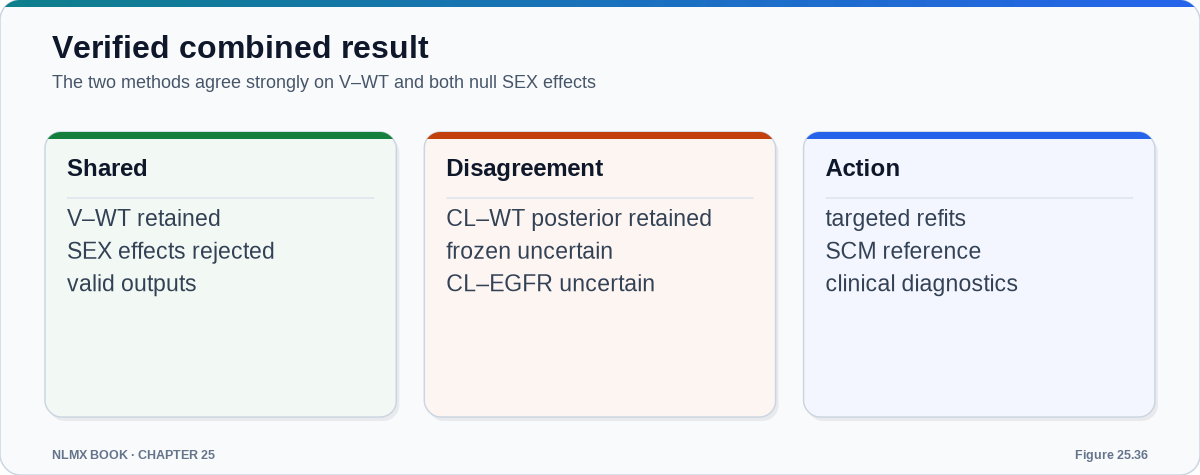
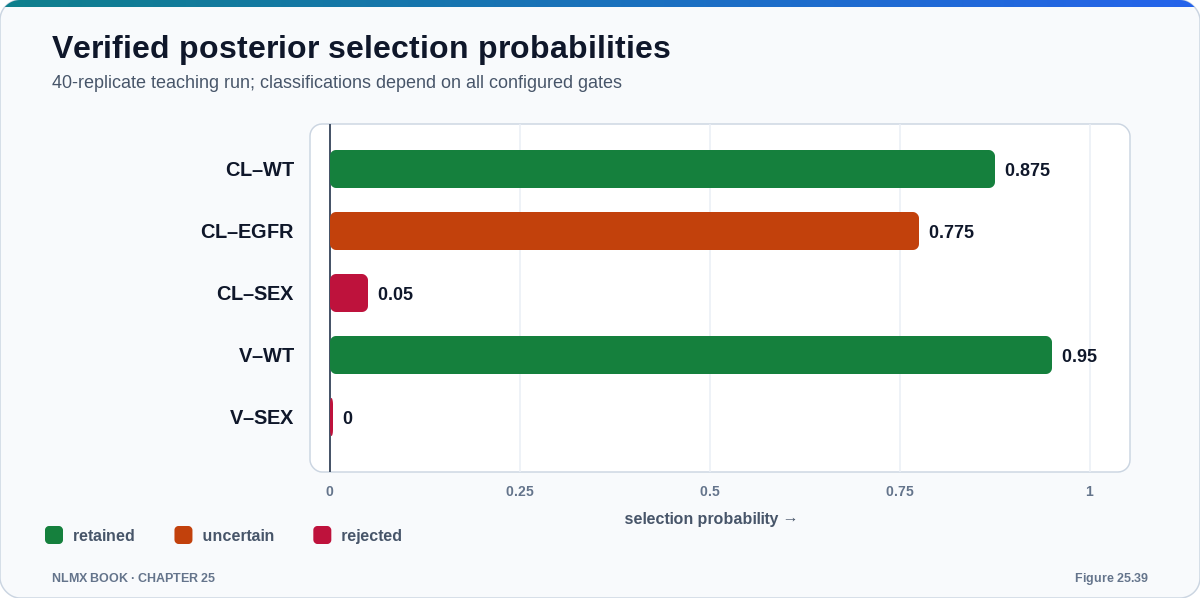
Both engines retained V–WT and rejected CL–SEX and V–SEX. CL–EGFR was uncertain in both. CL–WT was frozen-uncertain but posterior-retained (probability 0.875), illustrating why both is not a vote. Posterior probabilities were 0.875, 0.775, 0.05, 0.95, and 0.0 for CL–WT, CL–EGFR, CL–SEX, V–WT, and V–SEX respectively.
Forty replicates are intentionally pedagogical and yield broad intervals; they are not the Chapter 24 confirmatory schedule. The appropriate response is to inspect the frozen uncertainty reason, posterior interval/learner agreement, and targeted SCM/refit evidence—not to choose the retained label automatically.
Common mistakes
- Changing the scientific question after seeing the result while presenting it as the original run.
- Reading one engine's summary without checking its prerequisites, failures, normalized settings, and fitted endpoint.
- Treating a generated draft, comparison label, or completed checkpoint as a substitute for model diagnostics and reference-software confirmation.
Page checklist
- The exact command, version, inputs, resolved settings, and output directory are identifiable.
- Engine-specific evidence is interpreted on its own scale before cross-method comparison.
- Recovery state, final refit, diagnostics, and remaining confirmation work are explicit.