17.8 Lag-time candidates
A lag-time model delays the start of absorption by ALAG1, then applies the chosen absorption process. It can represent a consistent delay between administration and appearance of drug in the sampled compartment. --lag no excludes lag candidates, yes restricts the applicable family to lagged candidates, and both compares lagged and unlagged forms.
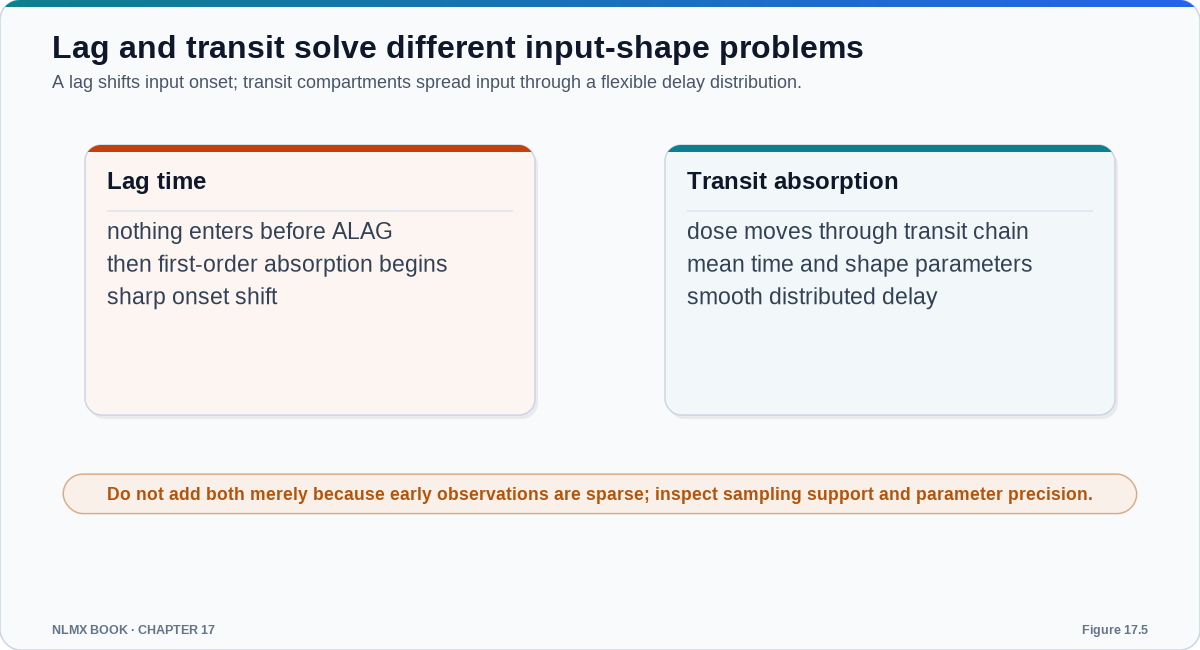
Lag is supported by observations around onset. If the first post-dose sample occurs after the entire delay, many lag values can fit similarly. If pre-dose concentrations or below-quantification observations are mishandled, an apparent delay can be an artifact. Dose and sample time synchronization is therefore a prerequisite.
In the frozen example, adding lag to the one-compartment oral model reduces OFV by about 352 with one additional parameter, and BICc strongly favors 1cmt_abs_lag. The two-compartment lag model has a slightly lower OFV but does not converge and is not eligible. The recommended lag model is itself severely ill-conditioned and shows high ETA shrinkage, so the correct lesson is “lag is strongly indicated, but uncertainty structure needs review,” not “the model is finished.”
A lag changes onset sharply. When the observed rise is gradually delayed or dispersed, transit absorption may be more plausible. Avoid placing lag and transit in the same candidate merely to chase early points unless the model and design justify both.
Common mistakes
Do not infer lag from a missing early sample, confuse nominal and actual sampling time, or ignore BLQ observations before quantification. An ALAG1 estimate at a bound is a warning about identifiability or timing.
Checklist
- Audit dose and early-sample timestamps.
- Include informative pre-onset/early observations.
- Compare lagged and unlagged parents under identical assumptions.
- Review
ALAG1precision, bounds and correlations. - Inspect shrinkage and condition number before accepting the result.
Further reading
See the worked lag example and eligibility gates.