Reference band and within/overlaps/outside classes
The default reference band is 0.8–1.25. --reference-band LOW,HIGH changes it and --no-band removes it. The band is a clinical communication threshold, not automatically a bioequivalence rule or dose-adjustment boundary; justify it for the parameter or exposure context.
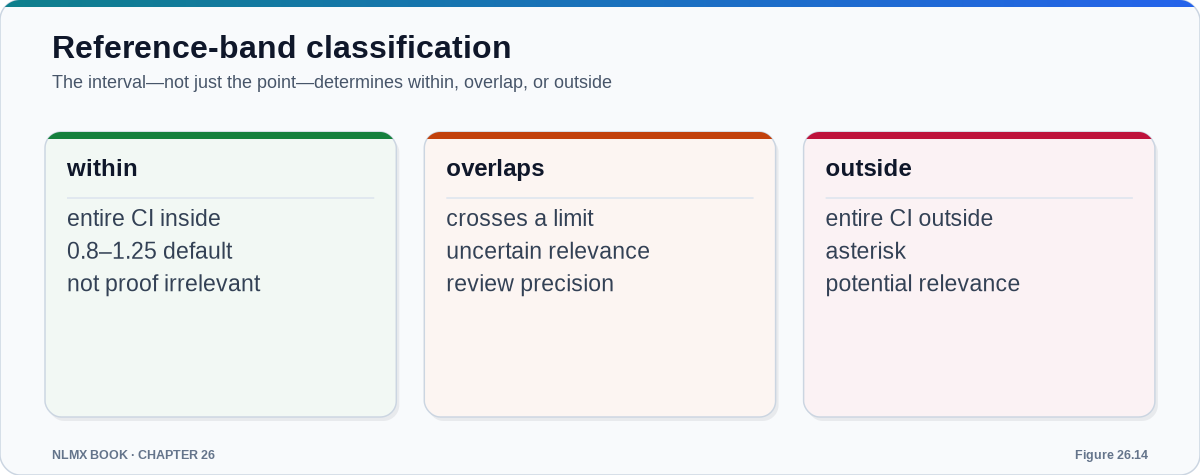
Classification uses the complete interval: within means both limits lie inside; overlaps means an interval crosses a boundary; outside means the entire interval lies beyond the band and receives an asterisk as potentially relevant. A point outside with an overlapping interval is not classified outside.
When uncertainty is disabled, band classification may be blank rather than pretending the point is an interval. Report actual ratio/limits with the class. Different metrics may need different clinical thresholds; one universal band can oversimplify.
Common mistakes
- Treating a forest ratio or reference-band class as covariate-selection evidence, causality, or an automatic dosing recommendation.
- Omitting the reference subject, uncertainty source, regimen, subgroup denominator, data support, or fitted-model diagnostics.
- Confusing parameter-uncertainty intervals, BSV ranges, and subject-bootstrap intervals because they share one graphic.
Page checklist
- The numerator, denominator, fitted model, covariate settings, and units are explicit.
- The interval source and clinical meaning are distinguished from BSV and selection uncertainty.
- Tables, resolved settings, commands, diagnostics, limitations, and confirmation evidence are retained.