19.6 Full-vector random-walk kernel
The full-vector kernel proposes
It moves all ETA coordinates together using OMEGA’s scale/correlation. The symmetric proposal makes acceptance depend on the full conditional objective difference: \(\min[1,\exp(-(J'-J)/2)]\).
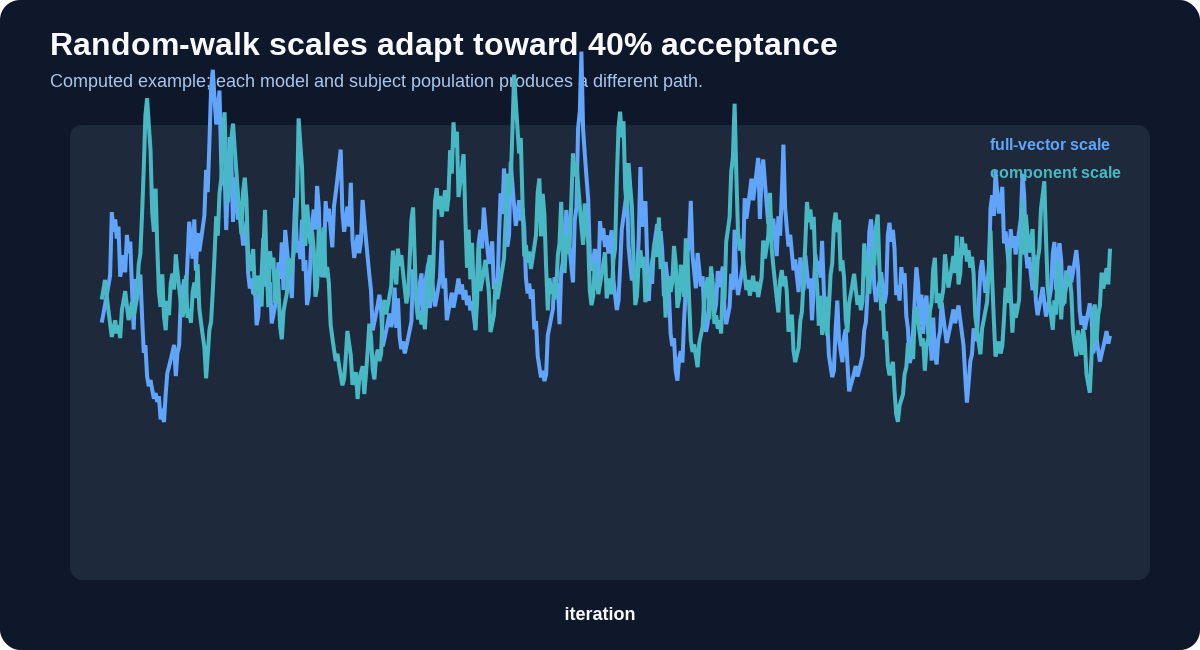
The scale \(s_2\) adapts toward IACCEPT=0.4 and is clamped to [0.01,10]. If acceptance is high, scale increases; if low, scale decreases. Two proposals per chain/iteration are default (ISAMPLE_M2=2).
Full moves can follow correlated population directions but may struggle when a subject posterior has a different correlation geometry or one coordinate is far tighter than others. The component kernel complements it.
Practical interpretation
Plot proposed full-vector moves on a two-ETA contour map. With OMEGA aligned to posterior, proposals follow the valley and accept well. With posterior rotated or much narrower, many moves cross steep contours. This visualization explains why adaptive scalar size cannot fix every geometry mismatch and why component moves, reparameterization or improved proposal covariance may be necessary.
Check the implementation by confirming forward and reverse proposal densities cancel exactly for the symmetric walk. Only the target difference should remain in the acceptance ratio.
When OMEGA contains a block, confirm (Lz) reproduces its covariance rather than multiplying coordinate SDs independently. A covariance-ordering mistake changes exploration while leaving each marginal proposal scale plausible.
Include both diagonal and correlated blocks in deterministic seed tests.
Common mistakes
Do not interpret 40% as a universal theoretical optimum, adapt without bounds, or pool acceptance with the prior kernel. A rate near target can coexist with slow exploration if steps are tiny.
Checklist
- Use current OMEGA Cholesky.
- Verify symmetric full-J acceptance.
- Track scale and acceptance over time.
- Inspect autocorrelation/movement, not rate alone.
- Test correlated ETA cases.
Further reading
See adaptive scaling and the generated adaptation graphic.