The cov command: complete operational sequence
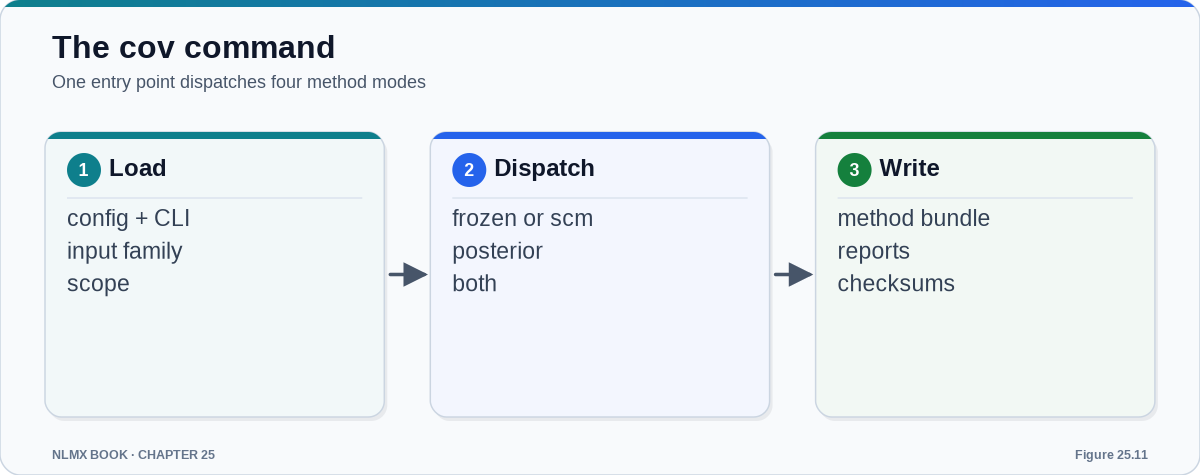
nlmx cov is the selection dispatcher. It loads/resolves configuration, prepares a fresh output directory, runs the chosen method, prints a structured summary, writes method-specific machine-readable evidence and human reports, and ends by reminding the analyst that retained relationships require an explicit NONMEM confirmation fit.
The normal sequence is: schema when authoring; inspect; validate or cov --dry-run; then cov -c analysis.covar --method ... -o run_dir. Use --threads for throughput, --seed for stochastic streams, --strict for qualified pipelines, and logging/privacy switches deliberately. Avoid --overwrite on an evidence directory.
The complete covariate-specific option set is indexed on this chapter's command-reference page and explained statistically in Chapters 22–24 and 23A. The operational responsibility here is consistency: one scope, known precedence, fresh destination, captured version/command, and a method whose prerequisites have passed.
Common mistakes
- Changing the scientific question after seeing the result while presenting it as the original run.
- Reading one engine's summary without checking its prerequisites, failures, normalized settings, and fitted endpoint.
- Treating a generated draft, comparison label, or completed checkpoint as a substitute for model diagnostics and reference-software confirmation.
Page checklist
- The exact command, version, inputs, resolved settings, and output directory are identifiable.
- Engine-specific evidence is interpreted on its own scale before cross-method comparison.
- Recovery state, final refit, diagnostics, and remaining confirmation work are explicit.