18.2 Three levels: population, individual, and observation
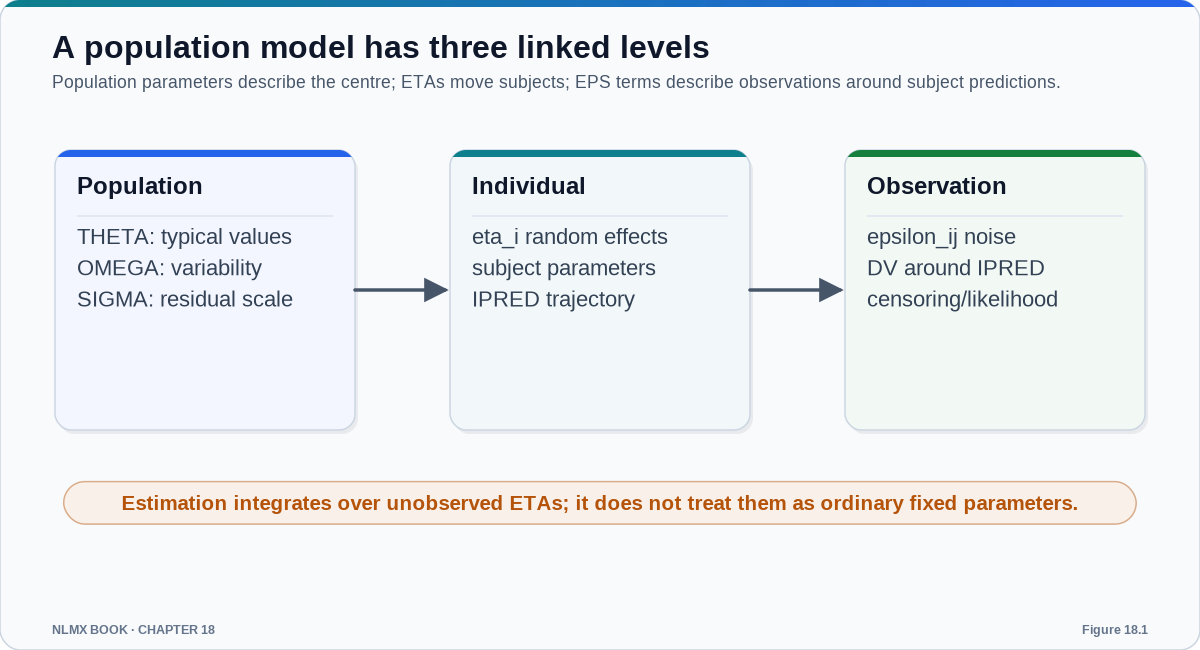
The nonlinear mixed-effects model has three linked levels. Population parameters describe typical values and variability across the target population. Individual random effects move each subject away from those typical values. Residual effects describe observations around the individual trajectory.
For clearance, a common exponential model is
CL_i = THETA_CL × exp(ETA_CL,i)
At ETA=0, the subject has typical clearance. An ETA of 0.2 multiplies clearance by \(e^{0.2}\), not by 1.2 exactly. OMEGA describes the distribution of these ETAs. The structural model converts subject parameters and dose history into a trajectory. EPS terms then generate observation-level variation according to $ERROR.
Repeated samples from one subject are not independent population replicates. They share the same ETA and dose history. This creates within-subject correlation after ETAs are integrated. The likelihood must preserve subject grouping; randomly shuffling records is harmless only if subject and event ordering semantics are reconstructed correctly.
Covariates act at the population-to-individual link. Weight may change typical clearance before ETA is applied. Occasion effects introduce additional random effects with their own block structure. Residual error is not a substitute for either level: increasing SIGMA can blur a wrong structural trajectory, while increasing OMEGA can mimic unmodelled subgroups.
Common mistakes
Do not call EPS “intra-individual variability” without stating its equation, because it also includes measurement and model error. Do not interpret an EBE as a directly observed subject parameter. Avoid using observation count as though every sample were an independent subject.
Checklist
- Map every THETA, ETA, and EPS to its role.
- Confirm which records share one ETA vector.
- State covariate order relative to random effects.
- Distinguish subject variability from residual variability.
- Preserve event history and subject grouping.
Further reading
Next read the structural model, OMEGA, and SIGMA.