Complete nlmx 4.16.2 cross-software comparison and known-limit reference
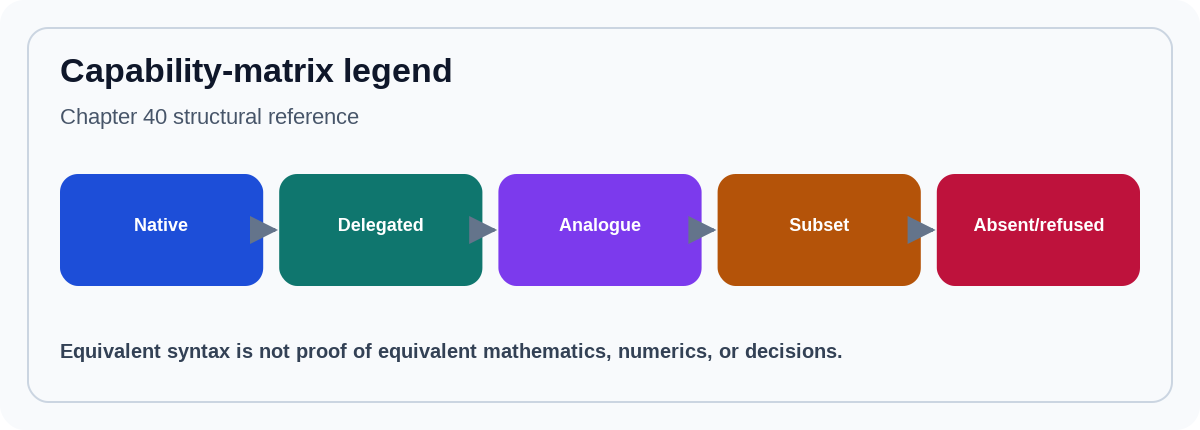
This reference is a task-oriented snapshot dated 2026-11-10, not a permanent claim about other products. The machine-readable jsoncomparison inventory stores 45 feature rows, 27 known-limit rows, the official-source ledger, and SHA-256 hashes for 22 local evidence files.
Reading the matrix
N = native; D = delegated; A = analogous but not definition-identical; S = supported subset; R = refused/absent; O = outside the product's primary role. Status text after a colon narrows the claim. “Delegated” is especially important for PsN: it generally coordinates NONMEM runs rather than replacing the NONMEM estimator. “Outside role” prevents a false negative. Verify external versions/configuration for each real project.
Feature matrix
| Area | Capability/task | nlmx 4.16.2 | NONMEM | PsN | PopED | Monolix |
|---|---|---|---|---|---|---|
| Role | Population NLME estimation | N | N | D: NONMEM | O: design tool | N: SAEM |
| Role | Workflow orchestration without another engine | N | S: batch engine | R: needs NONMEM | N: R package | N: integrated project |
| Model input | NM-TRAN control stream as executable model | S | N | D | R: R model functions | A: migrate to Mlxtran/project |
| Model input | $PRED models | N | N | D | A: user function | A: Mlxtran model |
| Model input | PREDPP ADVAN/TRANS | S | N | D | A: model function/library | A: Monolix libraries/Mlxtran |
| Structural | Analytic 1–3 compartment PK | N | N | D | N when encoded | N |
| Structural | General ODE models | N | N | D | N when encoded | N |
| Structural | User compiled/verbatim subroutines | R | N | D | A: R/compiled model path | A: distinct extension mechanisms |
| Variability | Diagonal/block OMEGA and correlations | N | N | D | N in model/FIM | N |
| Variability | IOV / tied BLOCK SAME | N | N | D | N when modeled | N |
| Variability | Mixture models | R: $MIX | N | D | Model-dependent | N |
| Likelihood | Gaussian continuous endpoints | N | N | D | Design-model dependent | N |
| Likelihood | Censored likelihood F_FLAG M3/M4 | N fit/VPC subset | N | D | Design-model dependent | N |
| Likelihood | Categorical/count/TTE NLME likelihood | S: $LIKELIHOOD code | N | D | Model-dependent | N |
| Estimation | FO | N | N | D | O: not fitting | R: SAEM only |
| Estimation | FOCE / FOCE-I | N | N | D | O: FIM approximations, not fitting | R: SAEM only |
| Estimation | Laplace | N | N | D | O: design calculations may use Laplace | R: SAEM only |
| Estimation | SAEM population estimation | N | N | D | O | N: sole population estimator |
| Estimation | Standalone IMP/IMPMAP estimation | R: warning then Laplace | N | D | O | R: IS is likelihood task, not estimator |
| Estimation | Bayesian MCMC / NUTS | R | N version-dependent | D | O | R in cited SAEM workflow |
| Estimation | Nonparametric population estimation | R | N | D via tools | O | Not treated as equivalent |
| Objective | FO/FOCE/Laplace OFV on NONMEM scale | N independent implementation | N reference | D | O | A: likelihood task has different workflow |
| Objective | Importance-sampling likelihood after SAEM | N | N via IMP | D | O | N likelihood task |
| Uncertainty | Observed curvature / R matrix | N | N | D | FIM for design | N linearization FIM |
| Uncertainty | Sandwich R^-1 S R^-1 | N default | N default covariance | D | Not same design FIM | Different FIM task |
| Uncertainty | Stochastic-approximation FIM | R | Method-dependent | D | A: expected design FIM | N |
| Diagnostics | Predictions/residuals/GOF | N | N tables; plots external/workflow | N workflows | O | N |
| Diagnostics | VPC / pcVPC / NPC | N | Simulation building block | N | O | N VPC |
| Diagnostics | Bootstrap parameter uncertainty | S: consume parameter rows; ER bootstrap | Engine building block | N | O | N current interface |
| Covariates | Forward/backward refit SCM | N | Manual building block | N | O | N |
| Covariates | Score-based frozen selection | N | Not direct analogue | Not direct analogue | O | Not direct analogue |
| Covariates | Posterior stability selection | N | Not direct analogue | Not direct analogue | O | A: conditional-distribution methods differ |
| Covariates | COSSAC / SAMBA | R | R | R | O | N |
| Simulation | Dataset simulation from NLME model | N | N | D | Design evaluation can call models | N suite workflow |
| Simulation | Thread-count-independent byte-identical streams | N | Not claimed here | Depends on NONMEM/PsN split | Not claimed here | Not claimed here |
| Trial design | Stochastic simulation and re-estimation power | N SSE | N building block | N SSE/mcmp workflows | O: optimal design instead | Suite-dependent, not compared |
| Trial design | FIM sample-size/power scenarios | N | Possible building block | Workflow-dependent | N FIM evaluation | Suite-dependent, not compared |
| Trial design | Optimize sample times/design variables | R | Not primary role | Not primary role | N | Not primary Monolix role |
| Workflow | Dataset/control-stream QC | N | Parser/runtime checks | S workflows | O | Integrated checks differ |
| Workflow | NCA | N limited | O | N tool listed | O | PKanalix is separate suite product |
| Workflow | EDA/custom publication plots | N | O | Workflow-dependent | O | N integrated diagnostics |
| Workflow | Markdown to DOCX/PDF/HTML report | N | O | R | O | Different reporting system |
| Workflow | Built-in guarded natural-language assistant | N | R | R | R | R in compared scope |
| Operation | Runs fitting without NONMEM installation | N | R | R | N | N |
| Operation | Text-first, command/replay evidence | N | N | N | N via R scripts | N project/R/CLI |
Known limits and qualified responses
| Area | Construct/task | nlmx 4.16.2 behavior | Qualified response |
|---|---|---|---|
| Control record | $MIX |
Refused | Mixture likelihood is not representable in nlmx 4.16.2; use NONMEM or a qualified Monolix mixture model. |
| Control record | $PRIOR |
Refused | Prior/Bayesian model semantics are not discarded; use an engine supporting the intended prior. |
| Control record | $LEVEL |
Refused | Do not flatten hierarchical levels without a new statistical specification. |
| Control record | $AES / $AESINITIAL |
Refused | Translate only with a validated equivalent event/model implementation. |
| Control record | $THETAP/$THETAPV, $OMEGAP/$OMEGAPD, $SIGMAP/$SIGMAPD |
Refused | Use the originating engine or a validated reparameterization. |
| Control record | $INCLUDE and $BIND |
Refused | Inline/rewrite only into a separately controlled model and verify identical behavior. |
| Control record | Verbatim Fortran and user subroutines |
Refused | Porting is software development and requires unit/profile validation. |
| Control record | $DESIGN, $NONPARAMETRIC, $INFN, $SIMULATION, $MSFI |
Noted and ignored by model fitting | Do not infer that their intended workflow ran; execute an appropriate nlmx command or another tool. |
| Data | DATE columns |
Refused | Convert to a prespecified numeric time scale with an audited derivation. |
| Data | L2/correlated within-subject residual structure |
Read with warning; observations treated conditionally independent | Use a model/engine that represents the correlation if scientifically material. |
| Model | Unsupported ADVAN/TRANS combination |
Refused | Use a supported mathematically equivalent model only after profile/likelihood validation. |
| Estimation | METHOD=IMP/IMPMAP as population estimator |
Not implemented; standalone request is evaluated with Laplace and warning | Use NONMEM for IMP/IMPMAP estimation; nlmx supports IS likelihood after SAEM/evaluation. |
| Estimation | BAYES/NUTS |
Not implemented; request is not a Bayesian fit | Use a qualified Bayesian engine and compare posterior definitions, not OFV alone. |
| Estimation | Nonparametric estimation |
Not implemented | Use NONMEM/PsN or another qualified method. |
| Covariates | PsN SCM configuration import/export |
Not implemented | Translate scope/equations/thresholds explicitly; validate the decision path. |
| Covariates | Time-varying covariates in posterior engine |
Reduced to first or mean per subject | Use frozen per-record effects or justify the summary; do not call it time-varying inference. |
| Covariates | ETA-to-parameter/effect-form detection |
Heuristic | Review inspect mapping for every model and override scope/type where needed. |
| VPC | Upper LOQ |
Not implemented | Use an external workflow or predeclared custom analysis. |
| VPC | Dropout/adaptive-design simulation |
Not implemented | Simulate the mechanism explicitly in a qualified study simulator. |
| VPC | Categorical-data VPC |
Only when model emits categories in ICALL=4 branch | Validate simulated categories and summaries; otherwise use another implementation. |
| NCA | Sparse/batch NCA |
Not implemented | Use a qualified sparse-NCA method. |
| NCA | Urine and PK/PD NCA parameters |
Not implemented | Use a tool with the required parameter definitions. |
| NCA | Complete bioequivalence analysis |
Not implemented | Use a validated BE workflow; nlmx NCA tables are not a BE conclusion. |
| Screen | Full mechanistic TMDD generation |
Not generated | Supply and fit a reviewed control stream; screen generates QSS/MM candidates only. |
| Simulation | M3 likelihood in simulate-study bootstrap calibration |
Not implemented | VPC can simulate through ICALL=4; use a qualified alternative for the unsupported calibration. |
| Trial design | Optimal sampling-time/design optimization |
Not implemented | Use PopED or another optimal-design tool; nlmx evaluates declared scenarios. |
| Performance | Universal speed advantage |
Not claimed | Benchmark the same estimand, accuracy gate, hardware, settings, and evidence. |
Official external-source ledger
| Product | Primary source | Used for |
|---|---|---|
| NONMEM | ICON NONMEM product page | Product role and batch engine scope |
| NONMEM | pdfNONMEM 7 technical guide | FOCE/Laplace, EM, IMP, ITS, SAEM, and nonparametric methods |
| NONMEM | pdfNONMEM 7.5 introduction | Versioned records, simulation, stochastic methods, and random-source behavior |
| PsN | Official PsN repository | PsN role as programs and modules aiding NONMEM workflows |
| PsN | PsN SCM implementation/help | Forward/backward SCM, configuration, criteria, retries, and delegation |
| PsN | PsN SCM user guide source | SCM relations, states, missing data, outputs, and linearization diagnostics |
| PsN | PsN command catalogue | Bootstrap, VPC/NPC, SSE, SCM variants, SIR, NCA, and other workflows |
| PsN | PsN VPC implementation/help | VPC simulation splitting, random-sequence, correction, and binning controls |
| PopED | Official PopED documentation | Population/individual optimal-design role and FIM basis |
| PopED | htmlPopED FIM and objective reference | Full/reduced FIM variants and D/ED families |
| PopED | htmlIntroduction to PopED | Design evaluation and sampling/design optimization |
| Monolix | Monolix SAEM documentation | SAEM as the population-parameter estimation algorithm |
| Monolix | Monolix standard-errors documentation | Linearization and stochastic-approximation FIM/SE tasks |
| Monolix | Monolix automatic covariate model building | SCM, COSSAC, and SAMBA behavior |
| Monolix | Monolix VPC documentation | Integrated VPC role |
| Monolix | From NONMEM to Monolix | Model/task mapping, likelihood, SE, diagnostics, and migration |
The NONMEM sources are ICON documentation; PsN sources are the official UUPharmacometrics repository and guides; PopED sources are its official documentation/reference; Monolix sources are the official MonolixSuite documentation. Claims are paraphrased and narrowly scoped. Recheck release-specific manuals before a regulated comparison.
Page index
| Page | Topic |
|---|---|
| 40.1 | How to read a cross-software comparison |
| 40.2 | Five layers of equivalence |
| 40.3 | Why correct implementations can give different numbers |
| 40.4 | OFV, likelihood, approximation, and constants |
| 40.5 | Optimizers, convergence, and solution basins |
| 40.6 | Random numbers, seeds, threads, and stochastic equivalence |
| 40.7 | ODE solvers, analytic propagation, and event semantics |
| 40.8 | Covariance matrices, standard errors, and parameter scales |
| 40.9 | Structural, variability, residual, and censoring support |
| 40.10 | Dataset, dosing, censoring, and population differences |
| 40.11 | Estimation-method comparison |
| 40.12 | Covariate model-building comparison |
| 40.13 | Diagnostics, VPC, NPC, and uncertainty |
| 40.14 | Simulation, SSE, FIM power, and optimal design |
| 40.15 | QC, NCA, EDA, reporting, and assistant scope |
| 40.16 | Migrating a NONMEM analysis to nlmx |
| 40.17 | Migrating a PsN workflow to nlmx |
| 40.18 | Migrating a PopED design evaluation |
| 40.19 | Migrating a Monolix project |
| 40.20 | Unsupported NM-TRAN records and constructs |
| 40.21 | Workarounds, alternate tools, and honest limits |
| 40.22 | Measuring speed without sacrificing accuracy |
| 40.23 | A cross-software validation framework |
| 40.24 | Roadmap, feature requests, and versioned claims |
Minimum cross-software acceptance record
- Product, exact version/build, platform, license/configuration, and command/project.
- Immutable model/data/settings and translation hashes.
- Reconciled analysis population, events, units, parameter scales, and method.
- Frozen-parameter predictions and objective/FIM comparison.
- Optimized/stochastic results with method-appropriate uncertainty.
- Workflow decision and material-warning reconciliation.
- Runtime/memory only after accuracy gates pass.
- Reviewer disposition, residual differences, and intended-use boundary.
Return to the chapter overview or begin with how to compare.