21.4 PRED, IPRED, and the two levels of fit
PRED and IPRED answer different questions. PRED is the model prediction at the typical random-effect value, conventionally η = 0, using the record’s covariates and event history. It describes the population model. IPRED evaluates the model at the subject’s conditional ETA estimate and describes the individual fit.
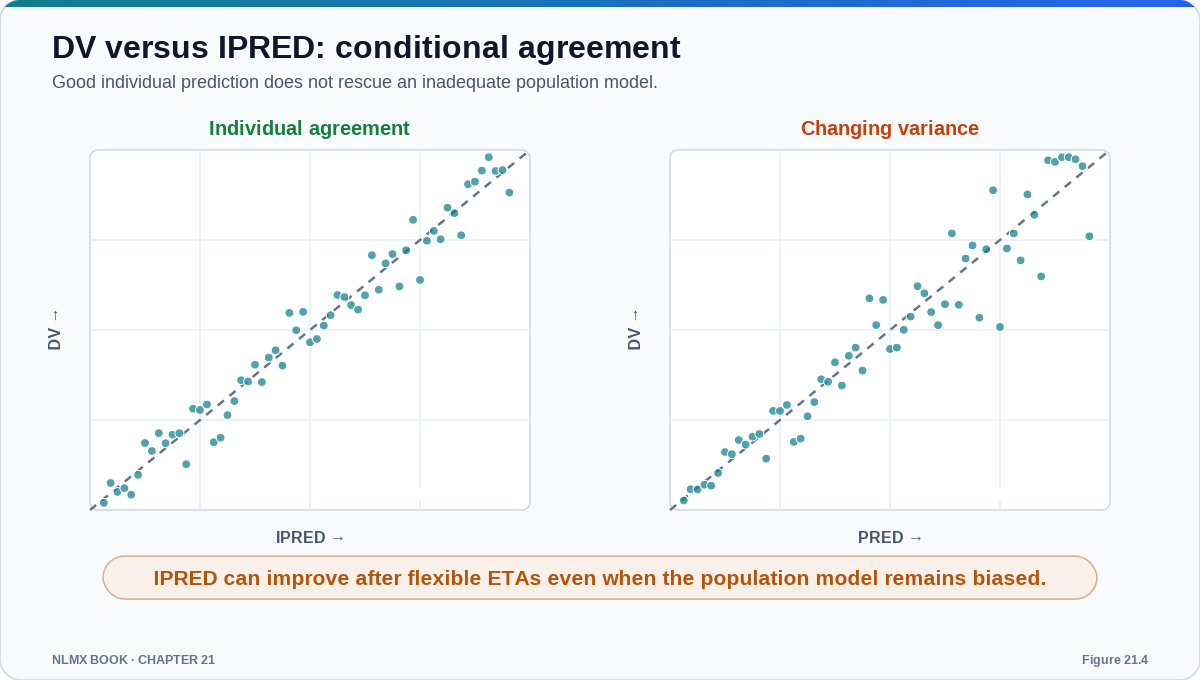
A large improvement from PRED to IPRED is expected when real between-subject variability exists. It is not automatically evidence of a good structural model. Flexible ETAs may compensate for a missing covariate, incorrect compartment structure, dose-history error, or systematic subgroup bias. Review the ETA magnitude and distribution alongside IPRED.
For a log-normal parameter such as CL = TVCL × exp(ETA1), η = 0 yields the typical clearance. A subject with ETA1 = 0.2 has clearance multiplied by exp(0.2), approximately 1.22. IPRED therefore incorporates a model-based individual adjustment, not an independently observed subject parameter.
DV–PRED primarily detects population trend and between-subject spread. DV–IPRED asks whether conditional profiles agree after estimating EBEs. A model may show broad DV–PRED scatter and tight DV–IPRED agreement while still having high shrinkage, implausible ETAs, or biased PRED in a subgroup. Conversely, sparse data can yield limited IPRED improvement even with a sound population model.
Predictions depend on the estimation approximation and conditional-mode calculation. For SAEM, PHI outputs may represent importance-sampling conditional means rather than classical modes, as documented by the run. Always compare like quantities when reproducing NONMEM or another implementation.
Common mistakes
- Calling PRED “the prediction” without stating population scale.
- Treating IPRED as an observed individual truth.
- Accepting a model solely because DV–IPRED is tight.
- Comparing EBEs or IPRED across different model structures as if unchanged.
- Ignoring shrinkage when interpreting individual predictions.
Checklist
- Define PRED and IPRED for the run’s method.
- Review PRED before IPRED.
- Relate IPRED improvement to ETA magnitude and shrinkage.
- Check subgroup and time patterns at both levels.
- Avoid causal or subject-truth language for EBEs.
Further reading
Continue with DV versus PRED, DV versus IPRED, and shrinkage.