Chapter 42 — Validation and testing
What you will learn
- Separate software validation from model qualification and from the scientific decision, and say which one a passing test suite supports.
- Read, run and extend the validation package that accompanies the program: requirements, risk register, installation, operational and performance qualification, and data-integrity tests.
- Choose an expected value that is independent of the program under test, and give every tolerance a written origin.
- Recompute a result by hand—an exact marginal likelihood, a nearly flat AUC, a Wald power, a tamper check—so that "it passed" becomes "I can see why it should pass".
- Turn the cross-software framework of Chapter 40 into an acceptance matrix with difference classes and decision margins.
- Decide what to re-test after a change, and keep a release evidence bundle an inspector can follow.
Prerequisites: Chapter 36 command reference, Chapter 38 output reference, Chapter 39 troubleshooting, and Chapter 40 cross-software comparison. Chapters 18 (estimation theory) and 30 (trial-design theory) help with the numerical pages but are not required.
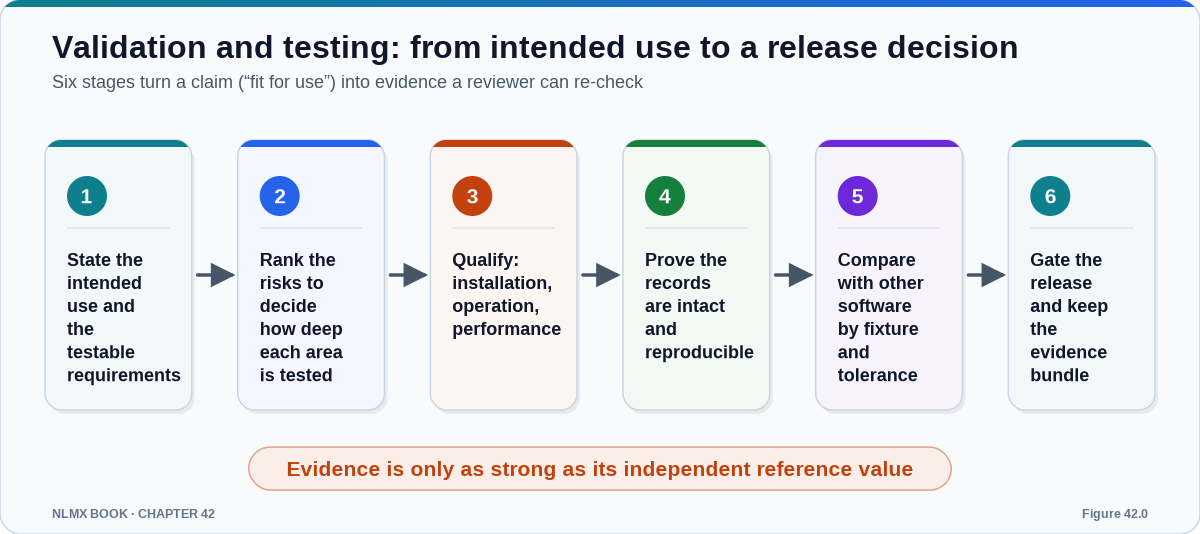
Chapter 40 ended with a promise: that its five-layer comparison framework would be turned into executable fixtures, tolerance policies and release evidence. This chapter keeps that promise. It is written for four readers at once. A validation lead needs the lifecycle, the acceptance criteria and the records. A tester needs to know exactly what to run, what a pass means and what to do with a failure. A pharmacometrician wants to understand what the tests do and do not say about a model. A reviewer or inspector wants to follow any claim back to a retained file.
Every number in this chapter has one of three origins, and the text says which: it is a definition taken from the validation package that ships with the program (for example, 90 requirements, 42 risks, 118 tests); it is recomputed here with independent arithmetic (closed forms, quadrature, 80-digit decimals, standard-library statistics); or it is an executed value from a frozen evidence folder elsewhere in this book (for example the Chapter 31 power tables). Nothing is quoted from memory of a run.
The package in one table
| Component | Count | What it is |
|---|---|---|
| User requirements (URS) | 90 | Numbered, testable statements in 23 areas, each with a criticality (45 High, 31 Medium, 14 Low) |
| Risk register | 42 | Severity × probability × detectability scores that set test depth (25 High, 13 Medium, 4 Low) |
| Installation qualification (IQ) | 8 | Right program, intact, able to write, plot and use threads |
| Operational qualification (OQ) | 96 | Every command and feature against independent reference values, in 20 areas |
| Performance qualification (PQ) | 3 | A twelve-command workflow, a closed-loop truth recovery, a 600-subject scale test |
| Data-integrity tests (DI) | 11 | Transcripts, checksums, tamper detection, overwrite and input protection, reproducibility, resume |
| Tests in total | 118 | 51 High-risk, 41 Medium-risk, 26 Low-risk |
| Independent calculators | 20+ | Standard-library scripts that recompute AUC, IPRED, Cox, Wald power, VPC bins and more |
Start here
- New to validation? Read 42.1, 42.2 and 42.5, then run the package once with 42.16.
- Writing a validation plan? 42.3, 42.4, 42.8 and 42.17.
- Writing or reviewing tests? 42.5, 42.6, 42.9, 42.10 and 42.11.
- Preparing an inspection? 42.13, 42.16 and the Part 11 position described there.
- Comparing with NONMEM, PsN, PopED or Monolix? 42.15, after Chapter 40.
Pages in this chapter
| Page | Topic | Figure |
|---|---|---|
| 42.1 | What validation does and does not cover | three layers |
| 42.2 | The lifecycle: plan, seal, execute, report | lifecycle |
| 42.3 | Requirements that can be tested | counts by area |
| 42.4 | Risk scoring and test depth | risk distribution |
| 42.5 | Where an expected value may come from | four sources |
| 42.6 | A tolerance with a reason | tolerance ladder |
| 42.7 | Reference data sets and fixtures | four data sets |
| 42.8 | Installation qualification | four moves |
| 42.9 | Operational qualification and anatomy of a test | tests per area |
| 42.10 | Numerical-accuracy case studies | two panels |
| 42.11 | Statistical checks and Monte Carlo tolerance | false-failure curve |
| 42.12 | Performance qualification and open benchmarks | twelve commands |
| 42.13 | Data integrity and reproducibility | run, record, catch |
| 42.14 | Failure fixtures and negative tests | exit-code table |
| 42.15 | Cross-software acceptance matrices | matrix |
| 42.16 | Running the package, records and deviations | five steps |
| 42.17 | Release gates, revalidation and extension | decision table |
The complete validation reference lists all 118 tests with their risk class and requirements, all 42 risks with their scores, the check types and the independent calculators.
The chapter contains 17 numbered pages, this overview, and the complete reference: 19 Markdown pages in total. Continue with 42.1.