19.16 Burn-in purpose and controls
Burn-in lets chains, proposal scales, sufficient statistics and parameters move from initialization toward a stable region. Gamma equals one. Maximum burn-in is NBURN or --saem-burn, default 1000.
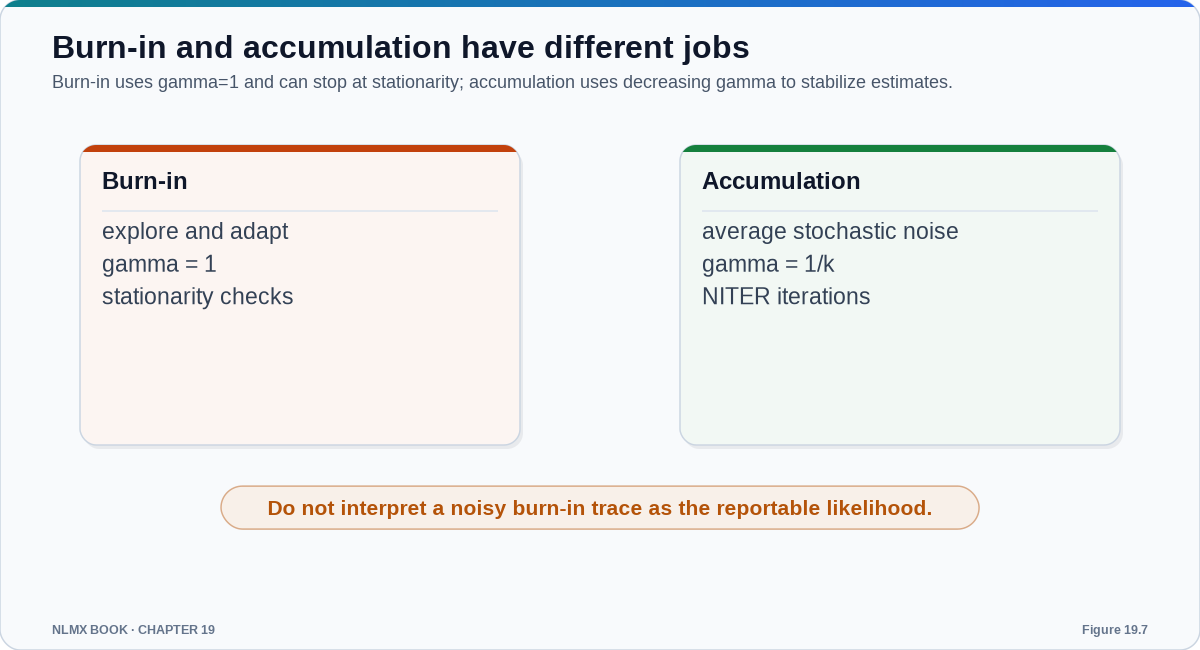
When neither explicit NBURN nor command override fixes the length, the stationarity test can end burn-in early after minimum evidence. If NBURN is explicitly set without positive CTYPE, nlmx runs exactly that many iterations, following NONMEM semantics.
Inspect parameter, OMEGA, objective, acceptance and scale traces. Burn-in ending at its cap without stationarity warning requires investigation; increasing the cap helps only when trends are plausibly settling.
Practical interpretation
Annotate trace plots with initialization, minimum burn, stationarity-check times and actual phase transition. Compare two starts and two seeds. If all enter the same stable region before transition, confidence increases; if trajectories remain separated, more burn-in may be needed or the model may have alternate basins.
Do not optimize burn length on the final dataset until a desired answer stabilizes. Develop a rule on simulations/reference fits, then apply it consistently and retain warnings when the rule is not met.
If fixed NBURN is used to mirror NONMEM, say so and do not claim stationarity-test passage. Conversely, when early stopping is used, archive the exact tested iteration and threshold evidence.
Minimum burn-in prevents a chance early flat window from ending exploration before proposal scales and OMEGA adapt. Verify this guard in short-run tests.
Common mistakes
Do not discard burn-in diagnostics merely because its samples are excluded from final averaging, or choose length solely from another model. Different likelihood geometry mixes differently.
Checklist
- Record initialization and maximum burn.
- Plot all parameter/objective traces.
- Inspect kernel scales/acceptance.
- Note stationarity versus fixed-length exit.
- Repeat with independent seed when pivotal.
Further reading
Next: stationarity test and accumulation.