36A.9 Code blocks and footnotes
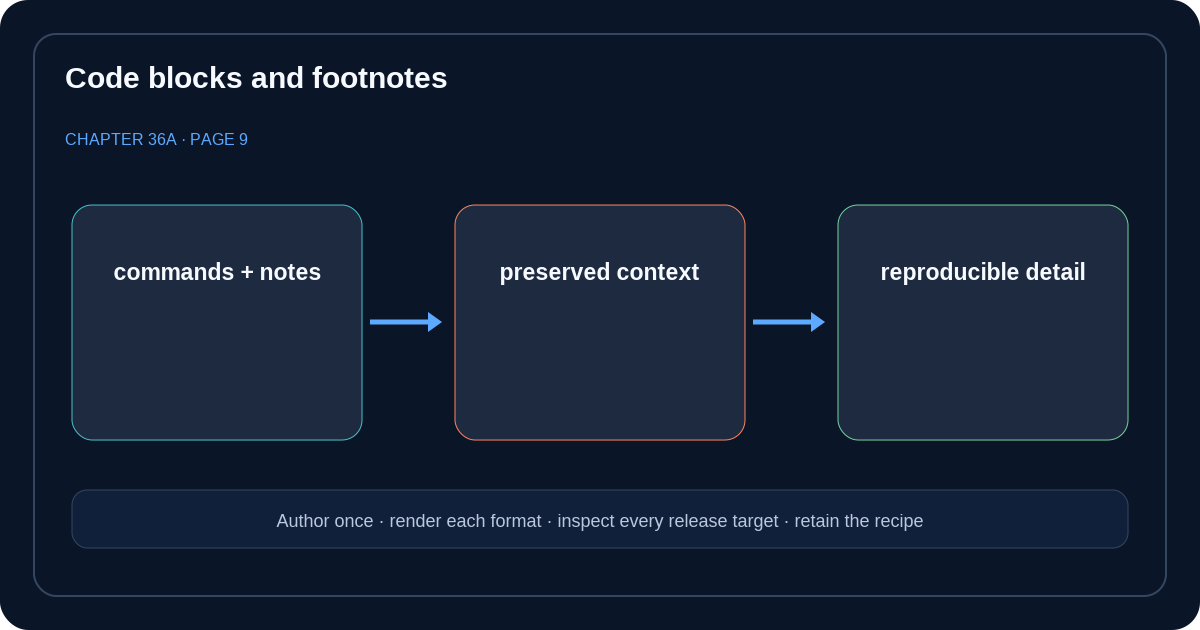
nlmx report publishes one Markdown source into retained Markdown, Word and PDF by default, with optional HTML. The command solves document generation; it does not validate the scientific analysis or approve its interpretation. Treat the source Markdown and .report file as the controlled recipe, and treat every released format as a separate review target.
Commands and literal output
Fenced code blocks preserve line breaks and monospaced text in every format. Use them for exact commands, configuration fragments, model code and short diagnostic excerpts. Label the fence language when useful for HTML styling, but do not depend on syntax highlighting for meaning.
Keep command blocks executable: show the working-directory assumption, quote paths when required, and avoid prompt characters or ellipses in a block presented as a rerun recipe. Long single-line commands can overflow fixed pages; split shell commands only with syntax appropriate to the stated shell or present settings instead.
Footnotes use [^id] references and matching definitions. Word receives real footnotes, while PDF/HTML present notes according to their renderer. Use footnotes for secondary qualification, citations or implementation detail—not to hide a primary limitation. Inspect numbering and whether the note remains near enough to its claim.
The executed fixture contains both a command block and a footnote. PDF text extraction confirms the note and command remain searchable. Structural inspection confirms the DOCX contains a footnotes part.
Reproduction-block test
Copy a command block into a fresh shell only after removing prompt symbols and confirming its working directory. If a command is too long, move options into a versioned settings file and show that shorter invocation. Footnotes should add context without changing the main conclusion. Check that every footnote reference has one definition, numbering is stable, and the note is readable in Word/PDF/HTML. Do not place a required safety limitation only in a footnote. Retain the exact report log instead of pasting a partial console excerpt as the sole record.
Practical review questions
- Does the released content answer the stated question without exceeding the evidence?
- Can every number, table, figure and decision be traced to a retained native file and run?
- Were all generated targets—not merely the source—inspected after the latest change?
- Are warnings, failed runs, limitations and unverified steps visible rather than silently omitted?
- Could another qualified analyst rebuild the same document from the retained recipe?
Navigation
See the previous page, next page, and complete report reference.