40.14 Simulation, SSE, FIM power, and optimal design
What you will learn
- Separate design evaluation from design optimization
- Align stochastic and FIM assumptions
- Know where nlmx ends and PopED begins
Prerequisites: Chapter 39 troubleshooting, Chapter 36 command reference, and Chapter 38 output reference.
This page is scoped to nlmx 4.16.2 and an external-documentation snapshot of 2026-11-10. Product names describe different system boundaries; a blank or “outside role” is not a quality ranking. Treat every migration as a new implementation until model semantics, analysis population, objective definition, numerical behavior, outputs, and decisions have been independently reconciled.
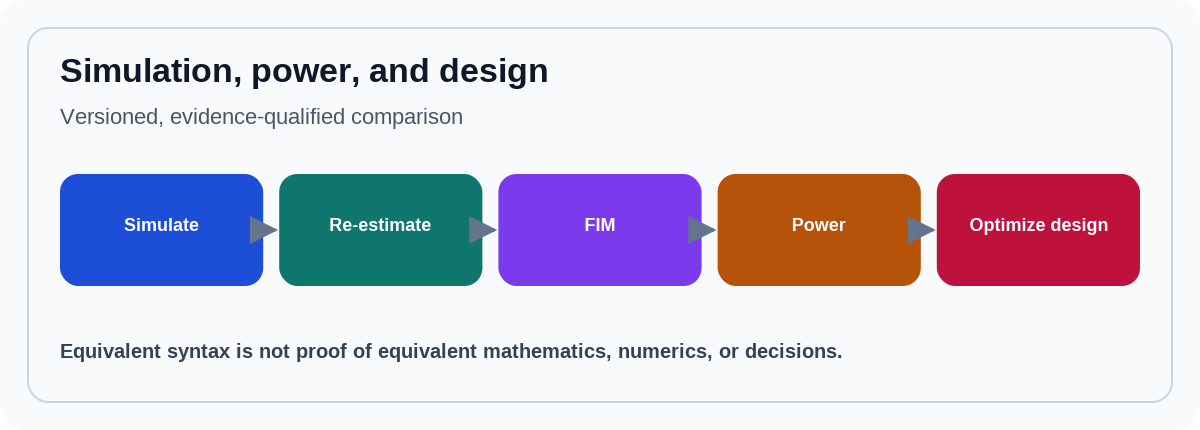
nlmx power evaluates declared sample-size/design scenarios by stochastic simulation and re-estimation (SSE), FIM, or both. PsN provides SSE and related NONMEM workflows. NONMEM supplies simulation/estimation building blocks. PopED's primary purpose is population/individual optimal design, commonly maximizing a FIM-based criterion over sample times, group sizes, doses, or other design variables.
These are related but not identical. nlmx does not optimize sample times/design variables; PopED does. PopED full versus reduced FIM and variance/SD conventions must align with nlmx's chosen FIM. nlmx notes design aspects its FIM does not represent (for example, some dosing/BLQ/dropout mechanisms) while SSE can implement more of the simulated trial.
For FIM comparison freeze model, parameter scale, OMEGA/SIGMA convention, design groups/times/doses, fixed/free parameters, full/reduced matrix, approximation, and criterion. Compare FIM elements/eigenvalues, expected SE/RSE, and power formula. For SSE compare simulated population, fit method, failure policy, test, denominator, confidence interval, and Monte Carlo error.
Use PopED when the question is “which design is optimal within this space?” Use nlmx power when the question is “what power/precision does this declared scenario have under these assumptions?” A handoff should evaluate the PopED-proposed design in an independent SSE before protocol adoption.
PopED-to-SSE handoff
After PopED proposes sampling times, round them only according to the feasible clinical window and record both versions. Evaluate the final practical design with the same parameter assumptions in nlmx FIM, then simulate and re-estimate it with nlmx SSE. Add parameter uncertainty, dropout, BLQ, adherence, and fit-failure sensitivity where relevant. The optimized FIM is a local model-based prediction; SSE exposes nonlinear estimation and operational failure mechanisms that the FIM may omit.
Primary source note: PopED's role and FIM variants are documented in the official overview and htmlFIM/objective reference.
Review checklist
- Are the exact product versions, task boundaries, inputs, methods, and settings named?
- Were semantics and frozen-parameter results aligned before optimized outputs?
- Is the comparison using a method-appropriate deterministic or stochastic tolerance?
- Are unsupported or analogous features described without implying equivalence?
- Can every claim be reproduced from retained primary evidence?
Navigation
See the previous page, next page, and complete comparison reference.