Worked example: forward and backward comparison
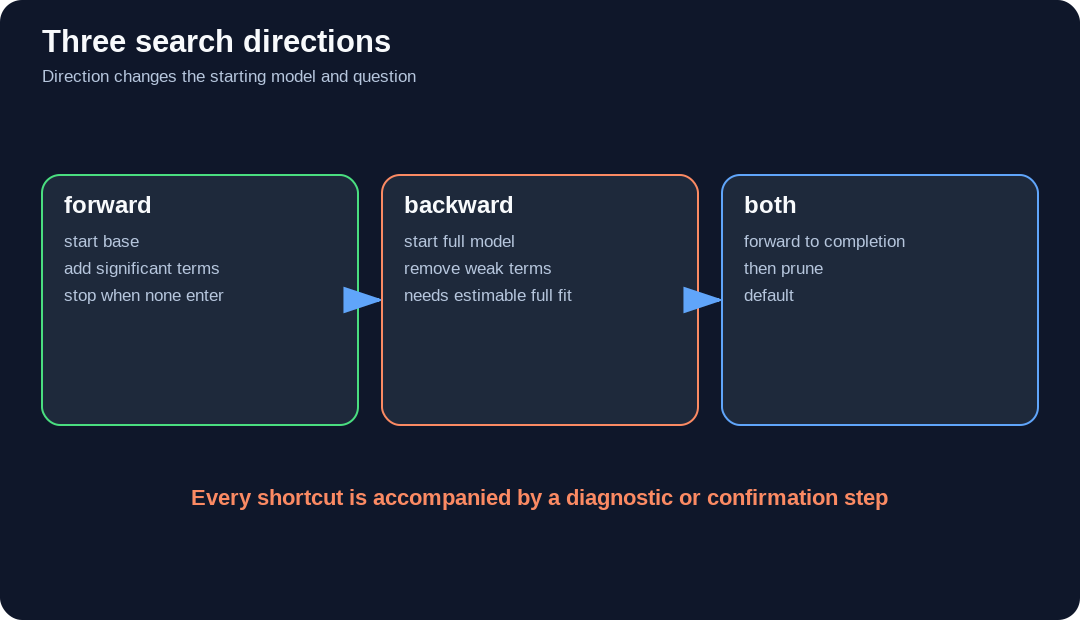
The zero-cap forward-only run selected V–WT, CL–WT, and CL–EGFR in that order and ended at OFV −1157.8135. It did not perform a backward stage. The backward-only run began from all five relationships at OFV −1158.649, removed CL–SEX first and V–SEX second, then retained the same three-effect endpoint.
Agreement is informative because the algorithms approached the endpoint from opposite model sizes. It also shows why the paths cannot be compared by row number alone: forward evidence tests additions to sparse models, while backward evidence tests deletions from richer models. The final exponents agreed to the displayed precision apart from negligible optimization differences.
When directions disagree in real work, inspect full-model convergence, correlated candidates, near ties, form selection, and failures. Report both endpoints and define the primary one prospectively rather than choosing after seeing clinical appeal.
Common mistakes
- Treating a stepwise p-value as clinical importance or causal proof.
- Reading a candidate comparison without its active model, convergence state, degrees of freedom, and exact threshold.
- Reporting only the terminal relationship list while discarding failed models, path decisions, configuration, and provenance.
Page checklist
- The scientific question, model identities, and comparison direction are explicit.
- Numerical validity is reviewed before interpreting statistical evidence.
- The result is linked to the complete trace and final joint-model diagnostics.