24.30 Correlated features, proxies, and cluster switching
Correlated features may substitute across resamples. A renal-function cluster can be stable even while EGFR and CRCL individually fall below 0.80. nlmx computes cluster probability and cluster_switching.csv to show how often members replace one another.
An ambiguous member becomes uncertain rather than being named a unique winner. Scientific adjudication should compare biological meaning, assay standardization, missingness, transportability, expected clinical availability, and final-model behavior. A small frequency advantage is not proof of causal superiority.
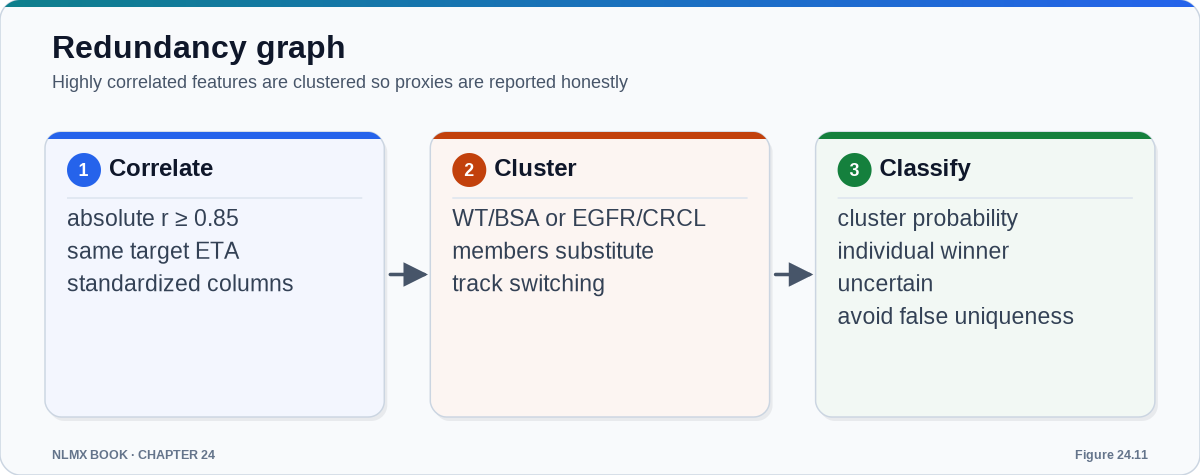
Competition groups can explicitly define known alternatives. Preserve cluster decisions in the analysis plan and sensitivity outputs.
Common mistakes
- Reporting only the most frequent proxy.
- Interpreting switching as random software instability.
- Combining proxies in a final model without identifiability review.
- Changing cluster threshold to create a unique winner.
- Ignoring missingness-driven switching.
Checklist
- Review member correlations and support.
- Report member, pair, and cluster probabilities.
- Inspect switching by resample/study.
- Adjudicate with scientific and operational criteria.
- Confirm candidate choices by joint refit.
Further reading
Revisit redundancy clusters and Chapter 22's correlated-covariate page.