16.22 initial_estimates.csv and parameter sources
initial_estimates.csv is the primary machine-readable result. Each row has:
| Column | Meaning |
|---|---|
GROUP |
Currently the pooled estimate set, normally all. |
PARAMETER |
CL, V, KA, ALAG, F1, V1/Q/V2, Q3/V3, or SIGMA row. |
NCA, NLS, ML |
Method-specific values when run/available. |
RECOMMENDED |
Proposed start after combination/exception rule. |
OMEGA, OMEGA_CV_PCT |
Log-variance start and CV presentation. |
N |
Supporting subject count where applicable. |
SOURCE |
Exact method combination or fallback source. |
NOTE |
Route, structure, identifiability, or interpretation. |
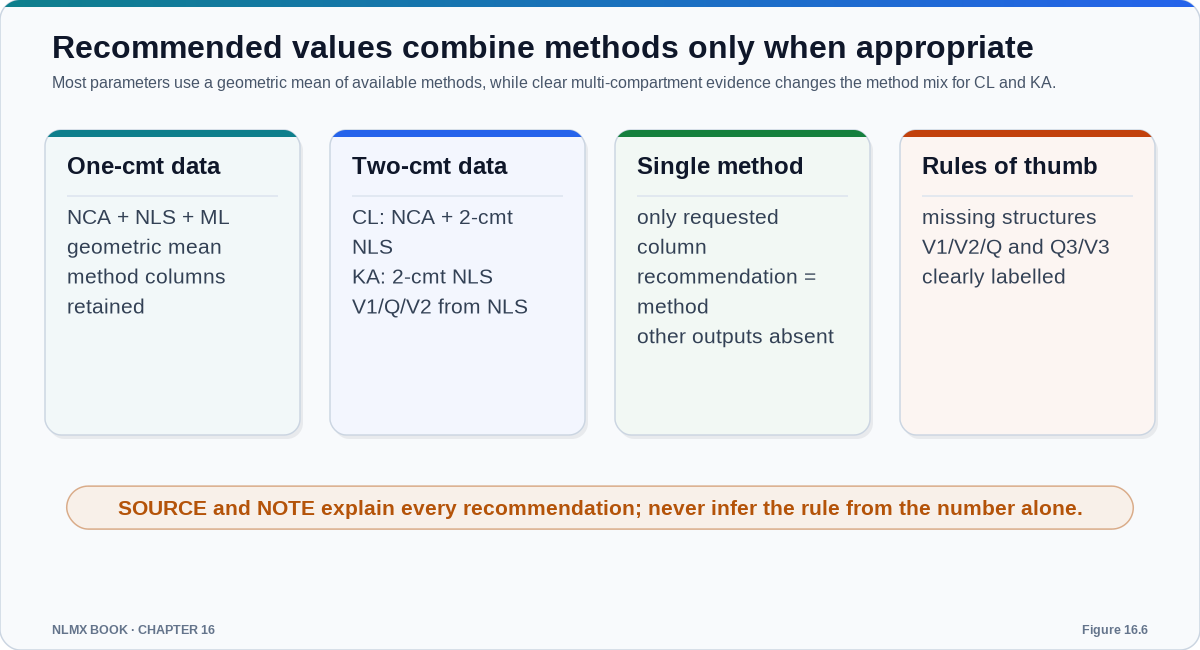
Blank is not zero. A blank ML cell can mean ML was not selected, unavailable, or structurally excluded from a recommendation. A populated rule-of-thumb row remains a proposal rather than direct evidence.
SIGMA_PROP and SIGMA_ADD appear as parameter rows with RECOMMENDED values and residual-error source text. They do not have OMEGA.
Safe downstream use
Filter by PARAMETER, but carry SOURCE and NOTE into review tables. Keep full precision until generated blocks or presentation formatting. Do not choose method columns programmatically without applying structural logic; use RECOMMENDED for the default proposal, then document justified overrides.
When comparing runs, align parameter names and source categories before numeric differences. A changed recommendation can result from a different method becoming available even if each common method is unchanged.
A robust import should parse numeric columns as nullable numbers and preserve text exactly. Validate that each expected parameter appears no more than once per group, that finite recommended values are positive where required, and that every populated OMEGA has a plausible source. These checks catch spreadsheet coercion and partial-file joins before values enter a model.
Common mistakes
- Importing blanks as zeros.
- Dropping SOURCE/NOTE during a spreadsheet join.
- Comparing recommendations without comparing method availability.
- Treating GROUP as regimen-specific estimates.
Checklist
- Preserve every column.
- Distinguish missing, fixed, rule and estimated values.
- Review method availability and N.
- Verify OMEGA scale versus CV display.
- Document any override to RECOMMENDED.
Further reading
Continue with individual/NCA evidence, parameter availability, and using generated blocks.