24.8 Curvature repairs, failed subjects, and point-EBE mode
Posterior covariance must be positive semidefinite. nlmx examines Hessian eigenvalues and permits only small repairs up to posterior.max_repair_relative (default 1e-6). Larger defects indicate that the local posterior approximation is not trustworthy.
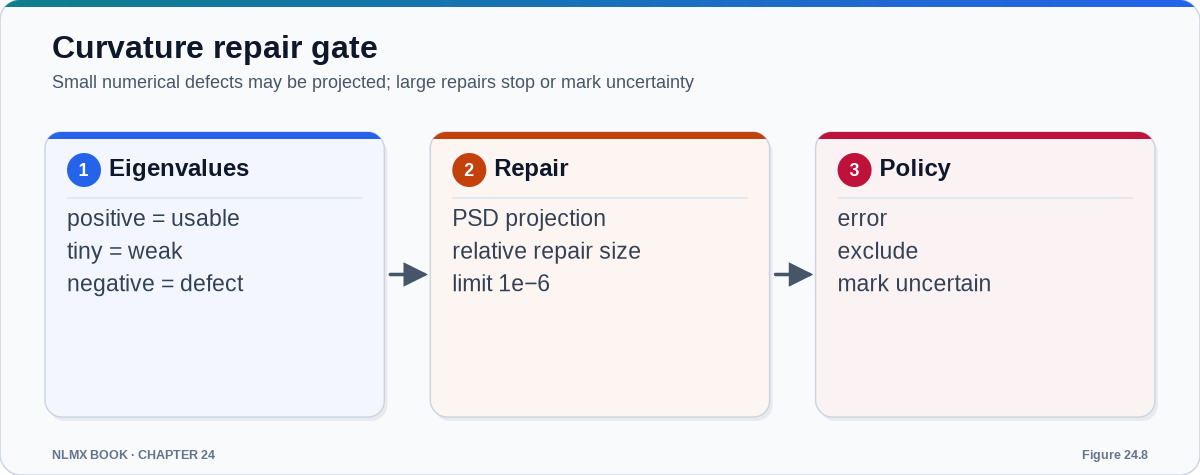
failed_subject_policy can be error, exclude, or mark_uncertain. Error is safest for development. Exclusion changes the population and requires bias assessment. Mark-uncertain permits continuation but prevents an apparently clean retained conclusion. --allow-point-ebe 1 admits subjects with point estimates but no curvature; every output is labeled EXPLORATORY because uncertainty propagation is incomplete.
Report counts, IDs or hashed IDs, stages, repair magnitudes, and covariate patterns. A failure concentrated among high-EGFR subjects can directly distort an EGFR relationship. Never lower standards merely to reduce the failure count.
Common mistakes
- Treating PSD projection as scientifically neutral.
- Excluding failures without comparing their covariates.
- Omitting the EXPLORATORY label from point-EBE output.
- Raising repair limits until the run completes.
- Counting failed subjects as ordinary successful draws.
Checklist
- Review eigenvalues and relative repair size.
- Use a prespecified failure policy.
- Assess failure patterns and population impact.
- Preserve exploratory labeling end to end.
- Reconstruct or refit problematic subjects where feasible.
Further reading
Next read moment consistency and failure gates.