16.30 Worked example: pooled mixed regimens
Real development programs rarely contain one perfectly uniform regimen. This fixture demonstrates the distinction between regimen description and parameter estimation. It contains 24 oral subjects: 12 have a rich single-dose schedule and 12 have a sparser steady-state-style schedule. autoinit records both regimen patterns, but it intentionally pools the concentration information into one population-level set of starts.
Files:
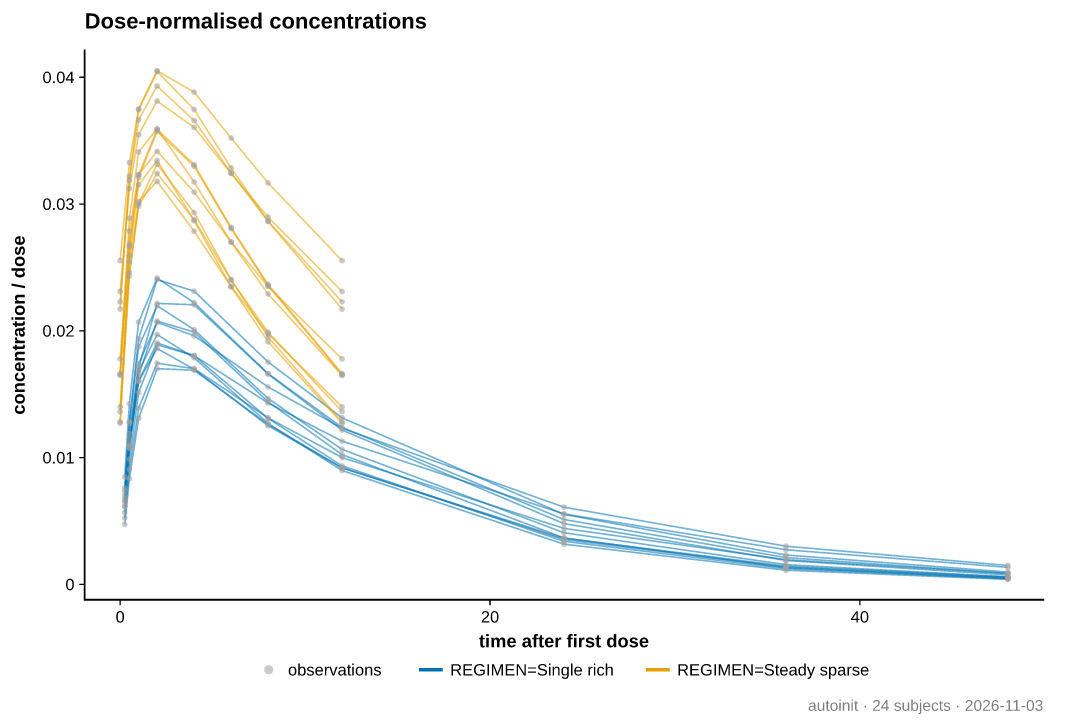
Pooling is deliberate
The regimens.csv file has separate descriptions of the dose and sampling patterns. The initial_estimates.csv file nevertheless has one all group for the parameter results. The recommended values are CL/F = 3.060, V/F = 40.297, and KA = 1.265. They combine NCA, NLS, and ML on the geometric scale. The generated truth used typical values near 3, 40, and 1.2, so the fixture gives an interpretable accuracy check without implying that future mixed designs will behave identically.
Do not read the two regimen rows as two independently fitted populations. Grouping in autoinit is used for regimen summaries and consistency checks, not for creating separate parameter sets. If the study requires separate populations, covariate effects, interoccasion variability, or regimen-dependent parameters, those belong in the subsequent population model and comparison workflow.
A novice review sequence
First, open regimens.csv and make sure the detected dose amount, interval, route, and repeat pattern make clinical sense. Second, look for scale or route mismatches between the two subsets. Third, compare subject-level estimates by design using individual_estimates.csv; large separation may warn that pooling hides a data issue or a real population difference. Finally, check that the single recommended vector is a sensible neutral starting point for the model you intend to estimate.
The proportional residual error reaches its 0.03 floor in this deterministic fixture. It should not be presented as the residual variability of either regimen. Likewise, V1, Q, V2, Q3, and V3 are rules generated from the one-compartment result; they are not evidence that the mixed design identified extra compartments.
Common mistakes
- Assuming each row in
regimens.csvhas its own parameter fit. - Comparing apparent CL/F with intravenous CL without considering bioavailability.
- Interpreting deterministic simulation recovery as real-world precision.
- Ignoring a regimen that was detected with the wrong route or interval.
- Treating structural rule rows as fitted multicompartment parameters.
Checklist
- Confirm both intended regimen patterns appear.
- Confirm one pooled parameter set is expected.
- Compare the subsets for unit, route, and sampling differences.
- Review individual estimates before accepting the pooled start.
- Model true regimen or population differences downstream when scientifically justified.
Further reading
See regimen pooling, route detection, output evidence, and troubleshooting disagreement.