Complete nlmx 4.16.2 error, warning, and troubleshooting reference
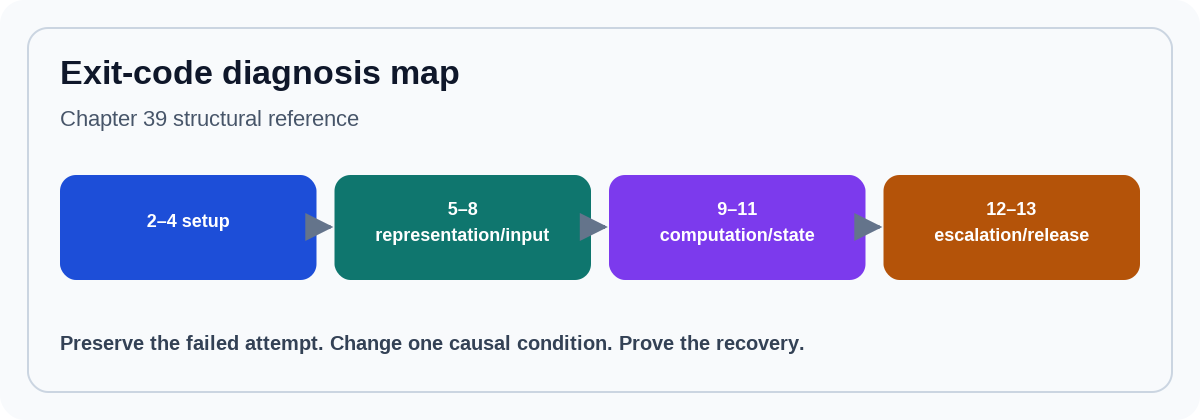
This searchable reference maps stable process exit classes and common normalized message fragments to a first response. Dynamic values are shown as fragments, not exact regular expressions. Always trust the complete current message, stage, hint, and transcript. The machine-readable jsonerror inventory contains 67 signatures, 910 source error-class sites, and SHA-256 hashes for 144 implementation files.
Exit-code table
| Code | Class | Meaning | First response |
|---|---|---|---|
| 0 | success | Process completed | Inspect the command-native verdict; zero is not scientific acceptance. |
| 2 | invalid CLI usage | Invocation cannot be interpreted | Correct command grammar, option spelling, value syntax, or incompatible invocation. |
| 3 | file discovery or I/O failure | A resource cannot be found, read, contacted, created, or written | Resolve paths and permissions; preserve existing output. |
| 4 | invalid configuration | Settings cannot be parsed or validated | Use the command template/schema; correct key, type, range, relationship, or extension. |
| 5 | unsupported model feature | The requested representation is outside implemented support | Do not force an approximation; redesign or use a qualified alternative. |
| 6 | inconsistent NONMEM artifacts | Files in a model family disagree | Reassemble one run family and check dimensions, labels, hashes, and covariance consistency. |
| 7 | data validation failure | Dataset or document content violates required structure | Correct source data or a declared interpretation; never patch a result silently. |
| 8 | posterior reconstruction failure | Individual posterior information cannot be used | Identify subjects/source/ETA mapping and account for exclusions. |
| 9 | numerical or learner failure | Estimation, matrix, simulation, or learner computation failed | Diagnose before retrying; retain every attempt and compare endpoints. |
| 10 | no evaluable relationships | Filtering or eligibility leaves nothing analyzable | Review population, candidates, filters, information, and study design. |
| 11 | resume/checkpoint incompatibility | Saved state does not belong to this run identity | Restore the exact version/input/settings/RNG identity or start a fresh run. |
| 12 | internal invariant violation | nlmx detected an internal bug or caught a panic | Do not work around silently; preserve evidence and report a minimal reproduction. |
Code 1 is not assigned by the shared taxonomy. Unknown/unclassified codes must fail closed and be investigated; do not assume they mean usage or success. Code 12 is the named internal class even though exit_code_name maps any unknown shared code to its fallback text.
Searchable message-and-fix catalogue
| Code | Message fragment | Likely cause | First response |
|---|---|---|---|
| 2 | unknown argument / unexpected argument |
Option is misspelled or belongs elsewhere | Open nlmx <command> --help; use the canonical option exactly. |
| 2 | required arguments were not provided |
A positional input or required value is absent | Read the Usage line; supply the named item once. |
| 2 | --config <FILE.covar> is required |
Covariate scope was not supplied | Provide a .covar file or command-line covariate relationships. |
| 2 | both a Markdown file and --markdown text were given |
Two report input modes conflict | Choose file, inline text, stdin, or settings input—not two. |
| 2 | needs Markdown |
No report content source was selected | Supply a Markdown path, --markdown, -, or [input] in .report. |
| 2 | uses https, which nlmx does not support |
Assistant server URL uses an unsupported transport | Use the documented local HTTP endpoint and policy. |
| 2 | not on this computer |
Assistant policy blocks a remote server | Use loopback or explicitly qualify and enable remote-server policy. |
| 2 | is incomplete / is not a number |
A mini-language such as scenario/test/covariate is malformed | Compare the exact grammar in command help; quote the entire value. |
| 3 | dataset ... was not found |
$DATA or an override resolves to a missing file | Remember that $DATA is relative to the control stream; use --data when needed. |
| 3 | no dataset was given and $DATA is absent |
No data source can be discovered | Pass --data or configure [input.files] data. |
| 3 | cannot read |
Path exists but content cannot be opened | Check path, sharing/lock state, permissions, encoding, and filesystem health. |
| 3 | cannot create |
Directory or file creation failed | Check parent existence, access, illegal characters, path length, and disk capacity. |
| 3 | cannot write |
An output write failed | Stop; preserve partial output; check space, quota, locks, and access before a fresh target. |
| 3 | already exists |
Overwrite protection is active | Prefer a fresh output; use --overwrite only after inventorying the old folder. |
| 3 | cannot reach the model server |
Assistant backend is unavailable | Verify endpoint, server process, model load, timeout, and local firewall. |
| 3 | model server answered |
Backend returned an HTTP error | Preserve status/body excerpt; inspect server logs and compatible endpoint. |
| 4 | config ... not found |
Named settings file is absent | Check the working directory and exact extension/path. |
| 4 | unknown field / unknown key |
Settings contain a key not accepted by this version | Generate a fresh template and migrate deliberately; do not guess a synonym. |
| 4 | invalid type |
TOML value type differs from the schema | Use quoted string, number, Boolean, array, or table exactly as the template shows. |
| 4 | must lie in / must be > 0 / must be at least |
A setting violates a validated range | Correct the scientific or computational setting; do not merely widen a guardrail. |
| 4 | accepted values |
An enumeration value is invalid | Use one of the hint's values with exact spelling. |
| 4 | settings file ... must end in |
Settings extension does not match the command | Rename to the command-specific extension after confirming its content. |
| 4 | no learners configured |
Posterior method has no usable learner | Add and qualify at least one learner in the posterior configuration. |
| 4 | parameter must carry an ETA |
Posterior relationship cannot explain a parameter without IIV | Change scope or use a method consistent with the model structure. |
| 5 | control stream uses records ... nlmx cannot represent |
Likelihood-changing records are unsupported | Remove only in a scientifically justified alternate model or use another engine. |
| 5 | unsupported ADVAN / TRANS |
Model subroutine/translation is outside coverage | Use a supported equivalent only after confirming mathematical identity. |
| 5 | verbatim / user-supplied subroutine |
Compiled/user code cannot be interpreted | Translate to supported abbreviated code or use the originating software. |
| 5 | $MIX / $PRIOR / $LEVEL / $AES |
Unsupported control-stream record changes the model | Do not ignore it; retain the original model in an appropriate engine. |
| 5 | not supported |
Requested model, endpoint, record, or mode has no implementation | Read the full boundary and Chapter 40; choose a qualified alternative. |
| 6 | model code uses THETA ... but .ext has |
Parameter dimensions disagree | Pair the control stream and final estimates from the same run. |
| 6 | model code uses ETA ... but OMEGA ... dimension |
Random-effect dimensions disagree | Check $OMEGA, .ext, and run-family provenance. |
| 6 | no parameter in the .cov maps onto the model |
Covariance labels cannot be aligned | Verify labels/version/run; do not reorder a matrix by assumption. |
| 6 | covariance diagonal ... is not positive |
Covariance artifact is invalid | Review covariance-step status and source; do not use it for uncertainty propagation. |
| 6 | covariance condition number ... exceeds |
Covariance is too ill-conditioned | Diagnose identifiability; raise the gate only with documented justification. |
| 6 | covariance and correlation matrices disagree |
.cov and .cor likely come from different runs | Restore a single family or intentionally omit the .cor as the hint permits. |
| 6 | require_phi but no .phi was readable |
Required posterior source is absent | Supply the matching .phi or change the declared source policy. |
| 6 | ambiguous |
Discovery found multiple plausible files | Name files explicitly or isolate one run family; never accept arbitrary selection. |
| 7 | has no data rows / no observations |
Dataset is empty after parsing/filtering | Inspect delimiter, header, IGNORE/ACCEPT, filters, MDV/EVID, and population. |
| 7 | required column ... is missing |
A role cannot be mapped | Correct $INPUT/column names or explicit role options; preserve source names. |
| 7 | not UTF-8 text |
Text input encoding is unsupported | Save as UTF-8 and verify characters before rerunning. |
| 7 | non-numeric / cannot parse |
A numeric role contains text or malformed tokens | Locate exact rows; define legitimate missing tokens, otherwise correct upstream. |
| 7 | duplicate / repeated subject rows |
Row grain is incompatible with endpoint assumptions | Choose the documented subject-row policy or reshape explicitly. |
| 7 | missing covariate |
Required relationship has absent subject values | Apply a prespecified missingness policy and report exclusions/imputation. |
| 7 | dose / EVID / CMT / RATE / ADDL / II |
Event record is internally invalid | Correct event semantics against source records; do not fabricate a dose history. |
| 8 | posterior reconstruction |
Conditional mode/Hessian or source posterior cannot be reconstructed | Identify failing subjects and the numerical/model cause. |
| 8 | subject ... posterior |
A subject-specific posterior failed | Retain subject ID under privacy policy; quantify excluded subjects and impact. |
| 8 | ETA columns / PHI columns |
Posterior source columns cannot be mapped safely | Use a matching .phi/table with explicit, verified labels. |
| 9 | matrix is not positive definite / factorisable |
Hessian, covariance, or information matrix is invalid | Investigate identifiability, boundaries, scaling, and model/data support. |
| 9 | singular / ill-conditioned |
Numerical inversion is unreliable | Examine correlations and parameterization before changing tolerances/ridges. |
| 9 | mode did not converge / maximum iterations |
Individual or population optimization stopped | Inspect gradients, boundaries, subjects, initial values, and algorithm trace. |
| 9 | non-finite / NaN / infinity |
Model or objective produced invalid arithmetic | Find the first stage/record/parameter; check transforms, domains, units, and doses. |
| 9 | covariance step failed |
Uncertainty calculation failed after estimation | Separate parameter-estimation status from covariance status; do not report invalid SEs. |
| 9 | learner failed |
Posterior learner could not fit | Inspect feature scaling, sample size, learner diagnostics, and fallback accounting. |
| 9 | retry ... failed |
A controlled fit retry also failed | Retain all retry folders; compare causes rather than launching unbounded retries. |
| 10 | no evaluable relationships |
No covariate candidate survived eligibility | Check scope, variability, ETA mapping, missingness, filters, and base-model suitability. |
| 10 | no candidate has status = test |
Covariate configuration contains no relationship eligible for testing | Mark at least one justified relationship status = "test" or revise the analysis question. |
| 10 | Markdown is empty |
Report input contains no content | Supply substantive Markdown; an empty artifact is not a report. |
| 10 | no rows are left to plot / tabulate |
Data steps or object-level filters emptied a custom output | Trace row counts through filters and data steps; do not weaken them without justification. |
| 11 | checkpoint ... version |
Checkpoint software/schema differs | Resume with its exact qualified build or start fresh under the new build. |
| 11 | configuration hash / input hash |
Inputs or settings changed since checkpoint | Restore exact files or begin a new run; never edit identity metadata. |
| 11 | RNG derivation |
Random-stream contract differs | Start fresh unless exact RNG derivation is restored. |
| 11 | checkpoint is incomplete / corrupt |
Saved state cannot be trusted | Preserve it for forensics, then restart from controlled inputs. |
| 12 | internal error (a bug in nlmx) |
A panic was caught | Preserve the first message/source location, log, command, version, and minimal safe reproduction. |
| 12 | built-in schema does not parse |
Packaged internal resource is inconsistent | Report the build; do not edit generated output to mask it. |
| 12 | internal invariant |
A condition assumed by the implementation failed | Escalate with evidence; a different exit class should have handled user input. |
Page index
| Page | Topic |
|---|---|
| 39.1 | Reading an nlmx error |
| 39.2 | The first five minutes: a safe triage |
| 39.3 | Warnings, notes, and the meaning of exit 0 |
| 39.4 | Exit code 2: invalid command-line usage |
| 39.5 | Exit code 3: discovery, files, output, and server I/O |
| 39.6 | Exit code 4: invalid settings |
| 39.7 | Exit code 5: unsupported model or method feature |
| 39.8 | Exit code 6: inconsistent model artifacts |
| 39.9 | Exit code 7: data validation failure |
| 39.10 | Exit code 8: posterior reconstruction failure |
| 39.11 | Exit code 9: numerical or learner failure |
| 39.12 | Exit code 10: nothing evaluable remains |
| 39.13 | Exit code 11: checkpoint or resume incompatibility |
| 39.14 | Exit code 12: internal invariant violation |
| 39.15 | After an upgrade: version changes and requalification |
| 39.16 | Troubleshooting files, paths, permissions, and partial outputs |
| 39.17 | Troubleshooting settings, command-line precedence, and versions |
| 39.18 | Troubleshooting data from raw file to analysis population |
| 39.19 | Troubleshooting the control stream and run family |
| 39.20 | Troubleshooting fit, covariance, and controlled retry |
| 39.21 | Troubleshooting covariate selection, posterior stability, and resume |
| 39.22 | Troubleshooting plots, reports, and Maxson |
| 39.23 | Frequently asked troubleshooting questions |
| 39.24 | Reporting a problem that can be reproduced |
Automation contract
- Capture the executable/version, argv, CWD, stdout/stderr, and process code.
- Stop on every nonzero code and every unknown code.
- On zero, require the command-native verdict and expected evidence inventory.
- Reject unknown material warnings until dispositioned.
- Preserve failed/partial attempts; rerun into a new identity.
- Never auto-delete options, subjects, records, model statements, or checkpoint metadata.
- Archive checksums and reviewer disposition with accepted output.
Source and stability statement
The shared classes and log form, and the command-specific examples, were checked against the program's implementation and its documentation. Messages may gain context or dynamic values. Build automation around stable exit class plus structured/native output, not exact console prose alone.
Return to the chapter overview or start the controlled recovery loop.