22.30 Base uncertainty, selection bias, and stability
The base-model parameters, OMEGA, EBEs, and covariate coefficients are estimated with uncertainty. A selection path that treats them as exact can be unstable. Frozen analysis can draw base parameters from COV; posterior analysis samples/resamples individual information; SCM can be repeated across perturbations or bootstrap datasets when warranted.
--uncertainty enables frozen parameter propagation, while --no-uncertainty disables it. --draws, seed, covariance conditioning, and admissibility affect pass probabilities. A poor covariance matrix cannot support credible uncertainty propagation simply because the command accepts it.
Posterior threshold, uncertain-lower bound, sign threshold, replicate count, base-parameter draws, and learner agreement define stability evidence. Sensitivity to seeds and settings should be reported for borderline decisions.
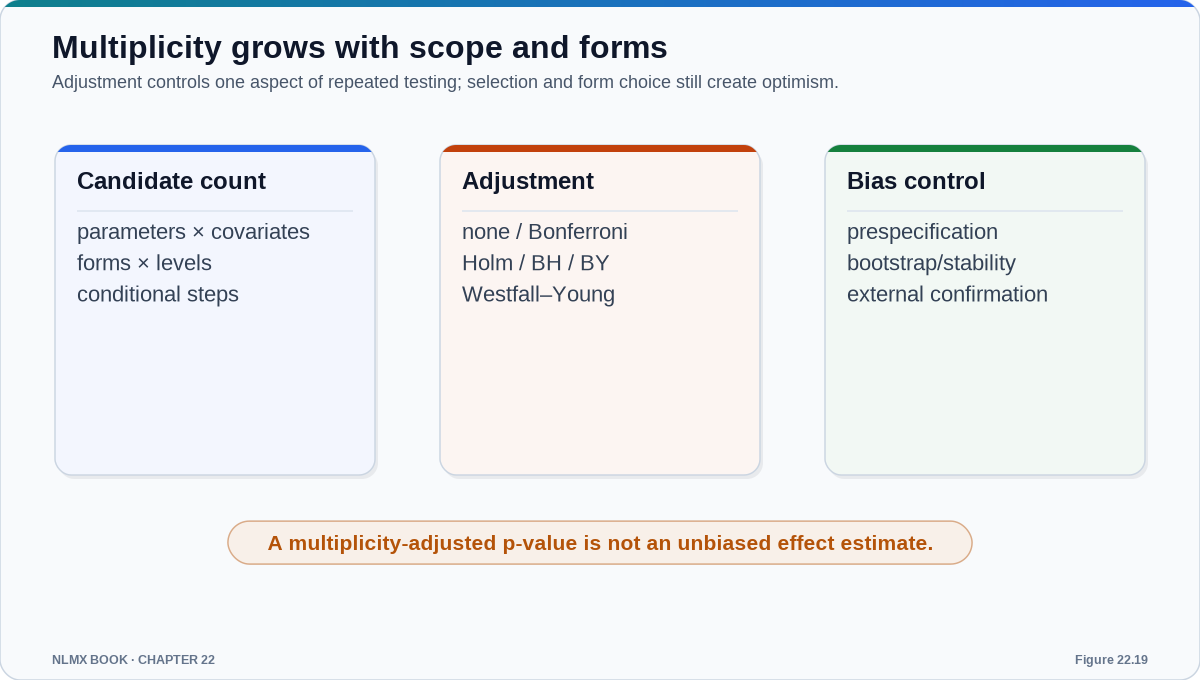
Selection bias inflates retained coefficients and underrepresents rejected uncertainty. Joint refitting does not fully account for having chosen the model. Bootstrap, model averaging, external validation, or full-model estimation may be needed for decision-critical inference.
Stability is not truth. A consistently selected proxy can be stable but noncausal; a clinically important rare effect can be unstable because data are limited. Combine stability with science and effect magnitude.
What uncertainty should be reported
Separate at least four sources: parameter uncertainty within a selected model, uncertainty about which model should be selected, Monte Carlo variability from draws/resamples, and data-design uncertainty caused by sparse or unbalanced covariates. Standard errors from the final fit usually address only the first and are conditional on selection, so they can be too optimistic after a large search. Report near-threshold alternatives, stability across seeds or resamples, sensitivity to policies and forms, and clinically important effects that were not retained. Bootstrap or simulation-based workflows may characterize the full selection procedure, but they must repeat selection—not merely refit the chosen model—to reflect selection variability.
Common mistakes
- Treating COV draws as valid when covariance is ill-conditioned.
- Reporting selection probability as effect certainty.
- Ignoring seed/tuning sensitivity.
- Presenting post-selection intervals as unconditional.
- Rejecting clinically important effects solely for instability.
Checklist
- Validate covariance/posterior inputs.
- Record draws, seeds, resampling, thresholds, and learners.
- Run sensitivity for borderline relationships.
- Qualify post-selection uncertainty.
- Combine stability with effect size and mechanism.
Further reading
See posterior method, clinical relevance, and Chapters 23–24.