38.23 Maxson session and audit outputs
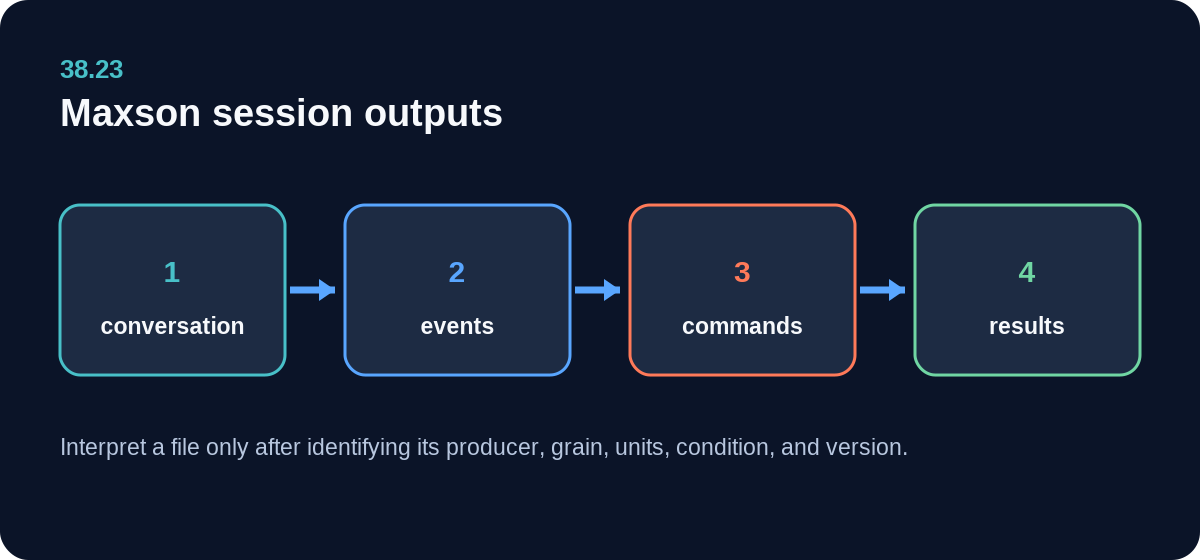
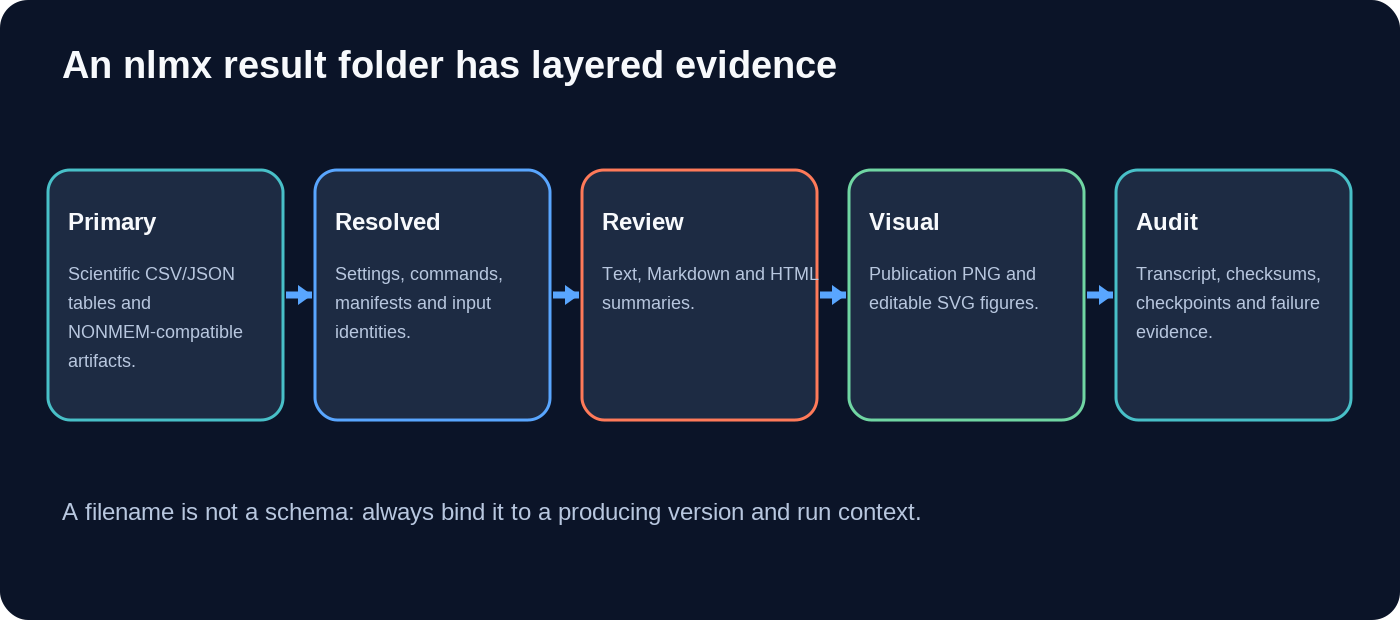
Maxson's session is an audit container around native nlmx runs. The conversation is human-readable; JSONL is the event stream; commands and settings are the reproducible recipe; numbered result folders are the scientific evidence. Language-model prose is never a substitute for the native output files.
Files produced by ask
The table is a versioned contract for nlmx 4.16.2. “When present” is part of the schema: absence can mean disabled, not applicable, no qualifying rows, an earlier failure, or a defect. Distinguish those states with the summary/log and expected configuration.
| File or pattern | Format | When present | Row/object grain | Purpose | Key fields or structure | Units | Role |
|---|---|---|---|---|---|---|---|
transcript.md |
Markdown | every session | one chronological conversation | requests, answers, proposals, decisions, command status and result summaries | speaker/event sections | not applicable | audit |
ask_log.jsonl |
JSON Lines | every session | one JSON object per event | machine audit of greeting, request, model reply, tools, confirmation, run, result, correction and end | event type, timestamp, payload | not applicable | audit |
commands.txt |
text | commands ran | one line per executed command | ordered rerun recipe without the assistant | nlmx command lines | not applicable | reproduction |
ask_settings.ask |
TOML | every session | one resolved assistant recipe | backend, model, policy and limits used | ask settings | setting-specific | reproduction |
system_prompt.txt |
text | every session | one model instruction document | exact assistant instructions and context policy sent to the model | prompt text | not applicable | audit |
templates/** |
TOML templates | templates fetched | one versioned template per command | real settings templates used to guide/save commands | command settings | setting-specific | interface |
settings_history/** |
TOML | a settings file is revised | one prior version per edit | preserves correction history | command settings | setting-specific | audit |
NN_<command>.<ext> |
TOML | assistant creates/uses settings | one settings file per step | step-specific command recipe | command settings | setting-specific | reproduction |
NN_<command>/ask_console.txt |
text | command runs | one console capture per step | full child command console output | console lines | mixed | audit |
NN_<command>/** |
command result tree | command runs | one output subtree per step | native command evidence copied beside session settings | producer-specific | mixed | primary |
Reading sequence
- Confirm the command, nlmx version, exit status, output root and settings/CLI overrides.
- Open the text/JSON summary to understand status, warnings, counts and conditional branches.
- Validate the primary table headers and expected row grain before parsing values.
- Reconcile row counts and identifiers across related files.
- Trace important estimates, classifications or decisions to the native model/data evidence.
- Inspect HTML and figures after verifying their source tables.
- Verify checksums and retain the complete tree, including failures relevant to denominators.
Common parsing mistakes
- treating an optional missing file as an empty successful result;
- grouping at subject level when the table is subject-by-occasion, replicate or simulation;
- using displayed text/plot rounding as the analytical value;
- joining dynamic files by row position;
- losing exclusions, failed fits or warnings while copying only the selected result;
- assuming units from a familiar column name rather than the run's data/model/settings;
- parsing a cache/checkpoint as if it were a stable final-results API.
Review questions
- Does every row have a clearly stated grain and candidate primary key?
- Are denominators and failure states retained?
- Are units and transformations traceable?
- Is the file a primary result, reproduction recipe, presentation, or operational state?
- Can a second analyst reproduce the reported value from retained inputs and settings?
Navigation
See the previous page, next page, and complete output reference.