The parameter-effect ratio and model evaluation
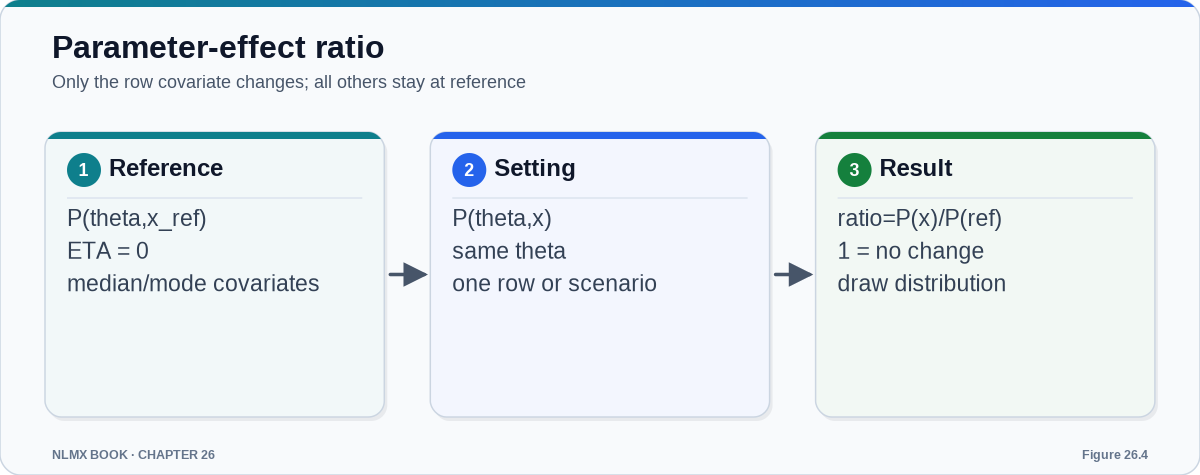
For parameter P, fitted parameters theta_hat, covariate setting x, and reference setting x_ref, the point estimate is P(theta_hat,x) / P(theta_hat,x_ref). All ETAs are zero, so the row describes the typical parameter rather than an individual prediction. Ratio 1 means no change from the reference.
For an ordinary single-covariate row, only that covariate changes; every other covariate stays at reference. For a scenario, all listed covariates change together. The numerator and denominator are computed by executing the control stream's own parameter code, allowing power, exponential, linear, categorical, piecewise, conditional, and custom equations.
This execution-based definition is stronger than reconstructing effects from labels, but it requires the code and estimates to match. A parameter that does not change when the selected covariate is altered is omitted with a note, rather than displayed as fabricated ratio 1.
Common mistakes
- Treating a forest ratio or reference-band class as covariate-selection evidence, causality, or an automatic dosing recommendation.
- Omitting the reference subject, uncertainty source, regimen, subgroup denominator, data support, or fitted-model diagnostics.
- Confusing parameter-uncertainty intervals, BSV ranges, and subject-bootstrap intervals because they share one graphic.
Page checklist
- The numerator, denominator, fitted model, covariate settings, and units are explicit.
- The interval source and clinical meaning are distinguished from BSV and selection uncertainty.
- Tables, resolved settings, commands, diagnostics, limitations, and confirmation evidence are retained.