17.30 Worked example: BIC versus LRT
The second run reuses the exact oral distribution dataset and candidate/estimation settings but changes the selection criterion from BIC to LRT with alpha 0.01. This controlled change demonstrates how decision rules differ without confounding data or optimization.
lrt_tests.csv reports a one-to-two-compartment ΔOFV of 258.00 with two degrees of freedom and a very small p-value. The two-to-three comparison has ΔOFV 25.82 with two degrees of freedom and p about 0.00000247. Both steps pass alpha 0.01, so the stepwise LRT path selects 3cmt_abs.
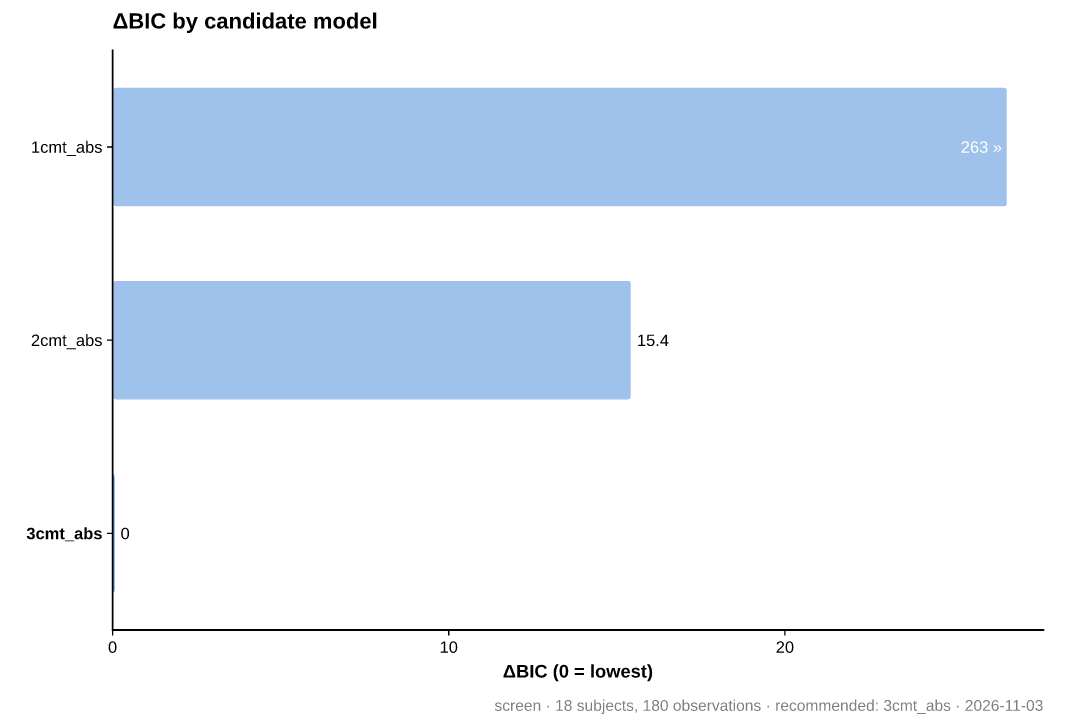
BICc also selected 3cmt_abs, but for a different reason: it had the lowest penalized criterion among eligible candidates. Agreement does not make the methods interchangeable. BIC ranks all comparable eligible candidates under its penalty; LRT requires recognized nesting and follows a test order. A different dataset could stop at two compartments under LRT while BIC ranks another candidate first.
The numerical fit rows match across the two frozen runs, which is an important QC check. Only the recommendation explanation changes. Both summaries retain the same ill-conditioning warning for the winner, proving that selection criteria do not replace reliability review.
An auditor can diff the two settings files and summaries: the data checksum, model names, approximation, starts and fit values should agree, while the criterion line and rationale differ. This paired-run design is more informative than comparing unrelated studies because it isolates the rule itself.
Common mistakes
Do not run both criteria and report whichever gives the desired answer, or call their agreement independent confirmation when both use the same data and likelihood. The p-value is not a posterior probability.
Checklist
- Hold all settings except criterion fixed.
- Verify identical OFV and parameter-count rows.
- Confirm recognized nested edges and alpha.
- Compare the rationale, not only the winner.
- Preserve common warnings in both interpretations.
Further reading
Open the txtLRT summary, then revisit AIC/BIC and LRT nesting.