29.4 Structural models, routes, lag, and $DES
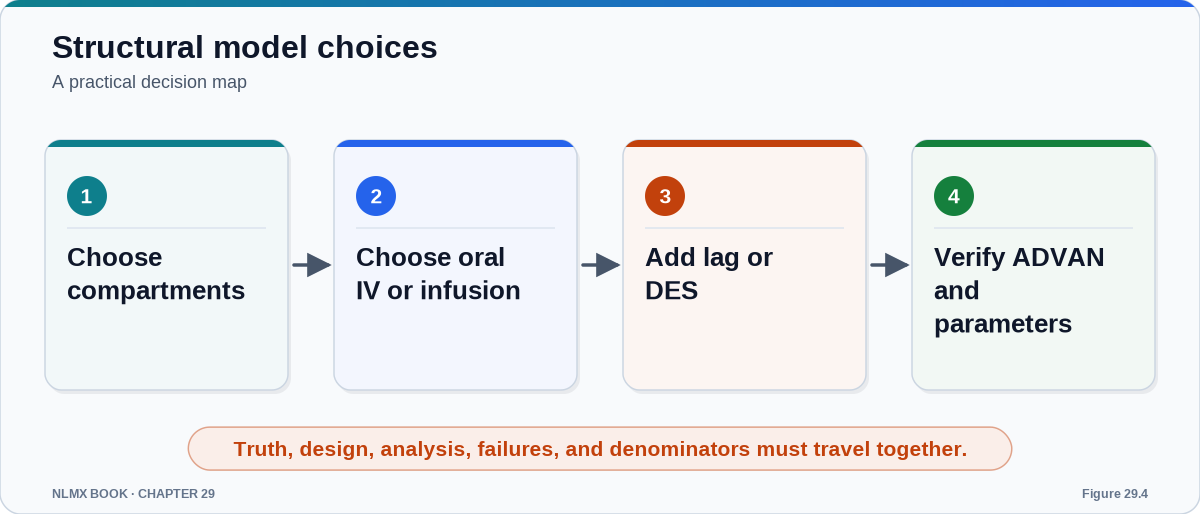
Design mode supports one-, two-, and three-compartment structures; oral, IV bolus, and infusion routes; and an oral absorption lag. Compound strings such as 2cmt-oral-lag are the clearest interface, while shared --compartments, --route, and --lag can set the parts. --ode writes ADVAN13 $DES; otherwise nlmx selects the matching analytic ADVAN/TRANS.
Why this matters
The choice on this page changes either the generated truth, the information available to the fit, the analysis decision rule, or the denominator of an operating characteristic. A novice should be able to point to the corresponding setting and output column. A reviewer should be able to trace every aggregate back to a generated project, completed engine run, and relationship-level row.
Detailed behavior
- Analytic mappings include ADVAN1/2/3/4/11/12 with appropriate TRANS records.
- Oral models add KA and dose into a depot; lag adds ALAG1. IV and infusion models dose the central compartment.
- Infusion designs require a positive duration and generate RATE; a lag is refused for non-oral routes.
- Parameters use generic names CL, V, Q, VP, Q2, VP2, KA, and ALAG, mapped to structure-specific names such as V1/V2/V3.
Keep four layers separate: design truth defines what was generated; realised data contain finite random variation; fitted artifacts estimate the model from those data; and analysis decisions classify relationships under a method and threshold. Mixing these layers is the most common source of incorrect recovery claims.
Example command or settings fragment
nlmx generate -o oral --structure 2cmt-oral-lag
nlmx generate -o infusion --structure 3cmt-infusion --infusion-duration 2 --ode
Begin with an inexpensive smoke run, inspect every generated artifact and warning, and only then increase subjects, scenarios, engines, or replicates. Use a new output directory for each analytical run. In a regulated or validation setting, preserve both the command as issued and the resolved settings or generated configuration because defaults and precedence are versioned behavior.
Interpretation and quality control
Choose the structure for the scientific or training purpose, not simply because it is supported. A validation fixture should state whether simulation and fitting use the same structure; same-model recovery is a useful numerical check but not a test of structural misspecification.
At minimum, verify subject/record counts, truth coefficients and forms, fit convergence, covariance status, relationship scope, classifications, completed denominators, and checksums. Read the row-level result before trusting a scenario metric. A graph is a compact diagnostic view; numerical tables remain authoritative.
Common mistakes
- Adding lag to IV dosing
- Confusing V with the central-volume label in oral ADVAN4
- Claiming analytic and ODE implementations are independent scientific models
Also avoid describing a failed or skipped cell as a zero rate. Missing, undefined, failed, rejected, and uncertain are different states and must remain distinguishable.
Evidence to retain
- nlmx version, command, configuration, seed behavior, threads, and runtime environment;
- generated truth/control stream, data, group/design definition, base and optional covariate fits;
- engine settings, relationship scope, row-level results, summaries, metrics, report, failures, and completed denominators;
- checksums, scripts used to regenerate figures, tolerances, acceptance rules, and scoped interpretation.
Navigation
See the previous page, next page, and complete command and settings index.