35.11 Writing settings from real templates and running them
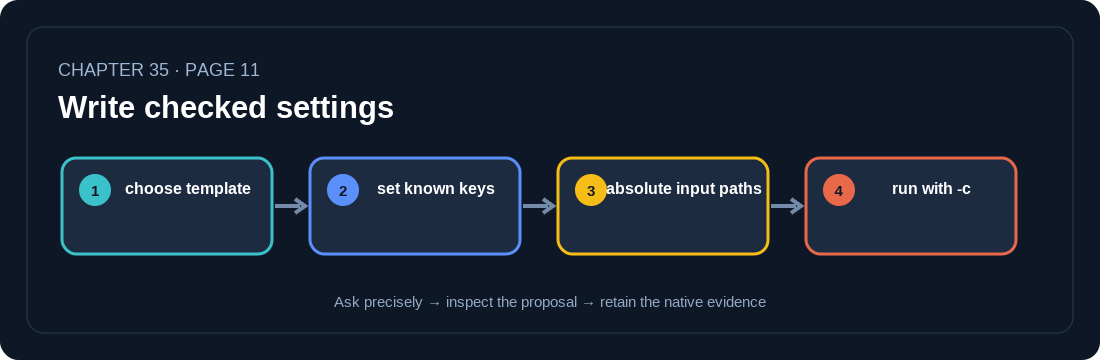
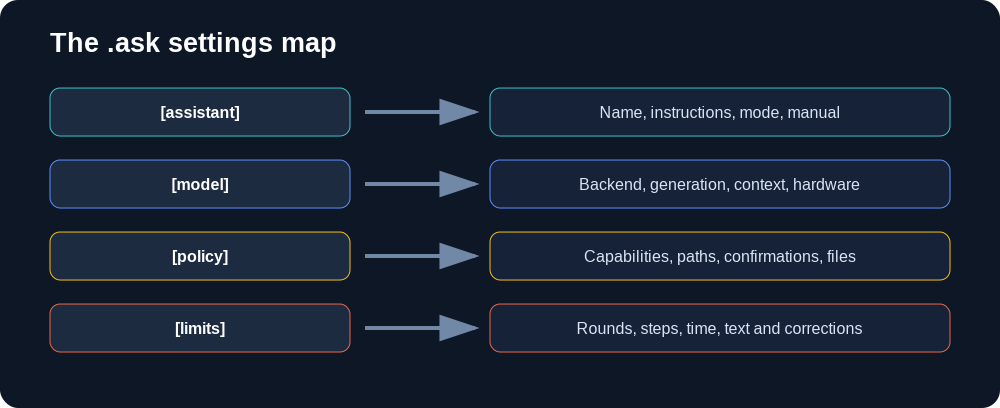
A save reply names a template, plain output filename, and section.key = value assignments. nlmx fetches the actual template, checks section/key names, writes valid TOML into the session, converts user-file paths to absolute paths, and preserves all commented defaults.
How to use it
Unknown keys or sections are rejected and no invalid file is written. Existing names receive safe alternatives or, during corrections, earlier versions enter settings_history. When execution follows, policy checks the settings contents and a copy goes beside outputs.
Practical interpretation
The executed save-er session set six known keys in study.er, converted the source dataset to an absolute path, ran er --config study.er, and produced an Emax result. The bad-key session rejected analysis.nonexistent and printed valid keys.
Executed/reference evidence: Saved-settings session.
From template to runnable settings
The safest sequence is template, edit, validate, inspect, run. Request docs: template COMMAND, then save only keys that appear in that template or installed help. Supply absolute input paths when a session-owned settings file would otherwise resolve a relative path against the session directory. After saving, open the file and check endpoint, columns, reference group, models/methods, exclusions, uncertainty controls, seed, and output choices.
Unknown keys are rejected rather than silently ignored. That protects against fabricated settings but cannot detect a real key carrying the wrong scientific value. When the same filename is revised, preserve version history and compare it; do not inspect only the final copy. After execution, verify that the child command copied or reported its resolved settings and that results correspond to the reviewed version. The included ER demonstration is instructional evidence, not a conclusion for another dataset.
A safe novice workflow
- Start with the narrowest backend, policy, files and command set that can answer the request.
- Name exact inputs and decisions; use guide or plan-only before granting execution.
- Inspect the normalized command and complete settings file, not only Maxson’s explanation.
- Read request end state, native command result, warnings, outputs and checksums.
- Preserve the session and record the qualified person’s interpretation and disposition.
Review and pitfalls
Open the generated file before use. Confirm that path conversion, inherited defaults, units, endpoint coding and output choices match intent. A syntactically valid template can still encode the wrong analysis.
- A session exit code of zero does not prove that every proposal ran or succeeded.
- Model fluency, structured JSON, and policy approval do not establish scientific validity.
- Settings and commands are reproducibility inputs; they still require versioned software and frozen data.
What to retain
Retain .ask, backend/model identity, system prompt, request, raw/normalized replies, transcript, JSONL events, settings versions, commands, child logs/outputs, checksums, exceptions, and reviewer conclusions.
Navigation
See the previous page, next page, and complete ask command and settings index.