23.37 Troubleshooting and numerical failure recovery
Start from the first failing stage and exact candidate, not the final symptom. Common signals include high stationarity, failed conditional modes, nonfinite derivatives, rank deficiency, large ridge, non-positive efficient information, covariance factorization failure, invalid uncertainty draws, failed refits, and inconsistent artifacts.
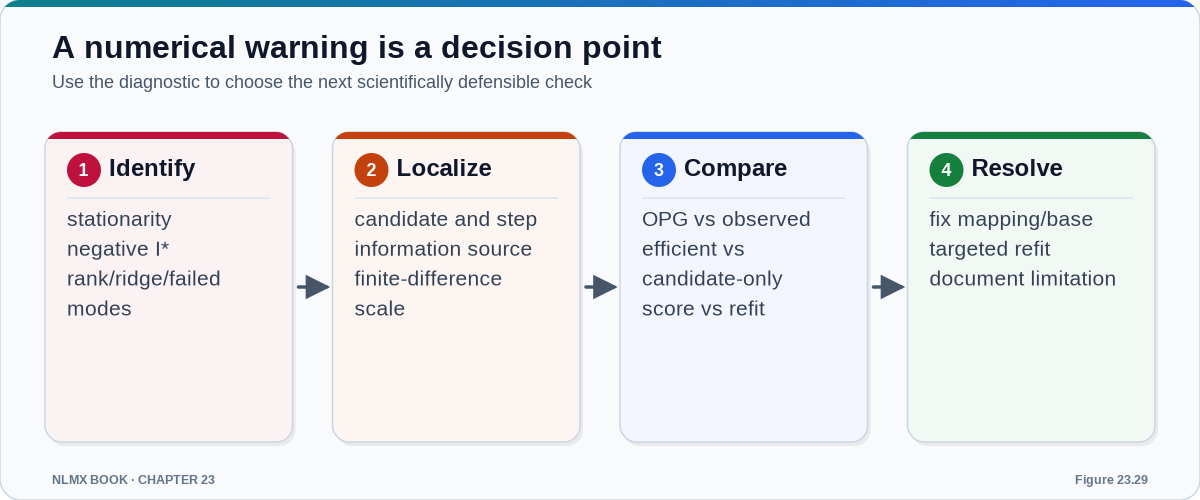
For high stationarity, verify approximation, input family, parameter labels, and base convergence. For derivative noise, inspect mode convergence and a global --fd-rel sensitivity. For negative efficient information, compare OPG with the observed sensitivity, inspect adjustment fraction/collinearity, and use candidate-only only as a labeled diagnostic. For covariance failure, verify .cov, repair size, labels, and whether uncertainty should be disabled until a qualified matrix exists. For failed refits, review bounds, starting coefficients, model code, and local versus global behavior.
Never overwrite the failed directory. Preserve transcript, exit code, partial diagnostics, command, and environment. Start a new output directory for each recovery attempt so the evidence chain shows what changed. If a workaround changes the inferential question, label it a sensitivity rather than a continuation.
Stop when the numerical issue prevents a valid statistic. A completed command is not more valuable than an explicit, interpretable failure.
Common mistakes
- Changing several settings simultaneously.
- Raising numerical limits without understanding the matrix.
- Deleting the original failure log.
- Reporting partial selection as final.
- Treating candidate-only as automatic recovery from efficient-information failure.
Checklist
- Identify stage, candidate, active set, and diagnostic.
- Change one justified setting at a time.
- Preserve separate output directories and commands.
- Compare with targeted likelihood refits.
- Document unresolved limitations.
Further reading
Review observed-Hessian failure, finite differences, and Chapter 39 when drafted.