17.13 Parent warm starts and peripheral initialization
After fitting a root candidate, screen can use its final estimates to start related children. A two-compartment oral model inherits CL, central volume, KA, error terms and retained random effects from the one-compartment oral model, then adds starts for Q and peripheral volume. A three-compartment model repeats the pattern. Lag and nonlinear children inherit their corresponding simpler parents.
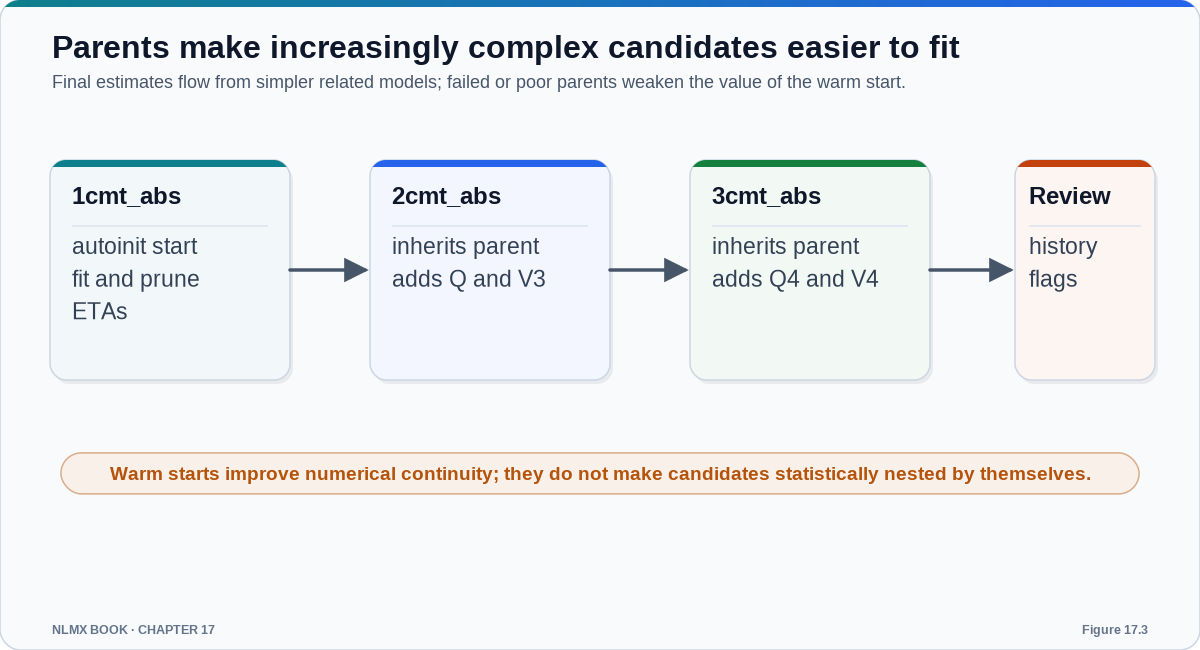
Peripheral starts need positive, scaled values. They may come from autoinit two-stage evidence or conservative structural rules. Their job is to place the optimizer in a plausible basin, not to assert the final distribution. When a new volume or clearance immediately reaches a bound, has extreme RSE, or creates a huge condition number, the data may not identify the added phase.
Warm starts create an audit trail and reduce arbitrary differences among candidates. They can also propagate a local optimum. If a scientifically plausible child fails, fit it from several independent, justified start sets. If these converge to different solutions, report multimodality rather than selecting the most attractive objective value without explanation.
The frozen summaries print the inheritance chain. In the distribution example, 2cmt_abs starts from 1cmt_abs, and 3cmt_abs starts from 2cmt_abs. In the nonlinear example, MM starts from linear and QSS starts from MM. This history is essential when reproducing the result.
Common mistakes
Do not assume warm-started candidates are independent repetitions, overwrite the recorded starts, or conclude structure is absent after one failed initialization. Conversely, endless start searches can become outcome-driven optimization.
Checklist
- Confirm the declared parent for every child.
- Record inherited and newly introduced values.
- Inspect new parameters for bounds and instability.
- Use a prespecified sensitivity grid when needed.
- Report multiple solutions and selection rules transparently.
Further reading
See candidate hierarchy, Chapter 16’s multicompartment rules, and troubleshooting.