15.2 Minimum dataset schema and record roles
nca reads a delimited text file with a header. The practical minimum is a subject identifier, time, concentration, and dose amount. Standard defaults are ID, TIME, DV, and AMT; every name can be remapped. Event columns improve classification and are required for complex designs.
Core columns
| Role | Default | Requirement |
|---|---|---|
| Subject | ID |
Identifies records belonging to one participant. |
| Time | TIME |
Numeric study time; dose-relative time is constructed. |
| Concentration | DV |
Numeric, or natural log when dv_log=true. |
| Amount | AMT |
Positive on dose records. |
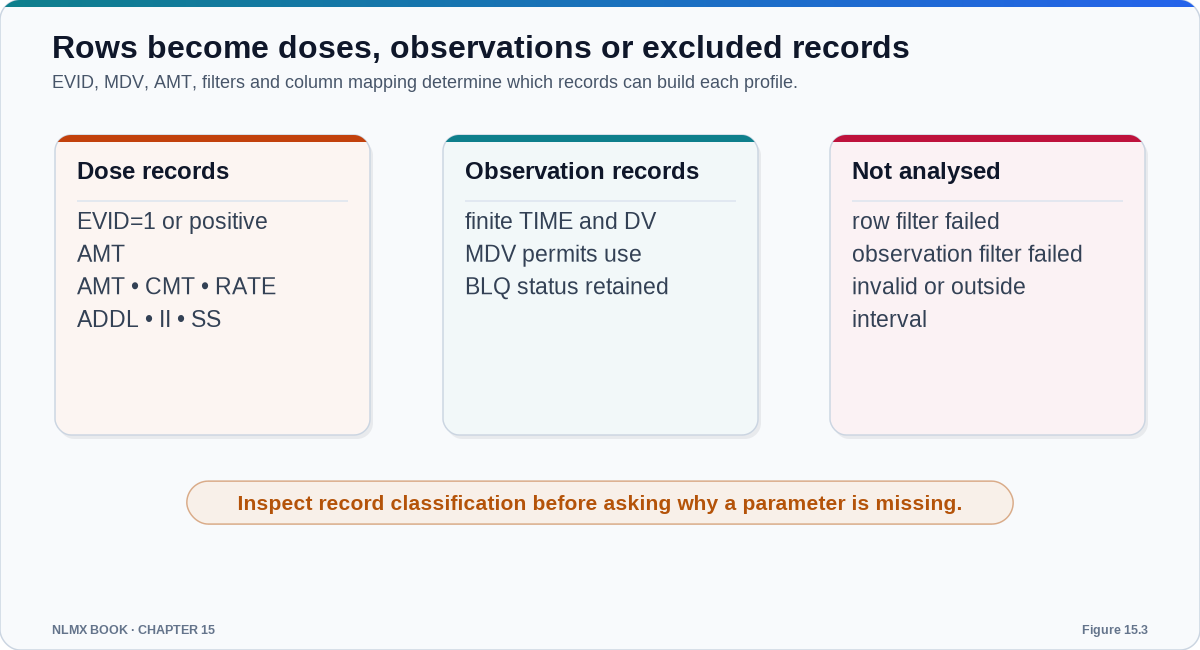
EVID normally marks doses with 1 and observations with 0. If absent, dose records are inferred from positive AMT. MDV marks rows without an analysable observation; if absent, it is inferred. Explicit columns reduce ambiguity and improve cross-software reproduction.
Design columns
CMT distinguishes dosing and observation compartments, which helps infer bolus versus extravascular dosing. RATE identifies infusion and supplies duration as AMT/RATE. ADDL and II describe repeated doses, while SS can identify an interval as steady state. Group columns can vary by dose in crossover data; the dose record's value assigns the interval.
Every usable time and numeric value must be finite. Headers are matched without case sensitivity by the reader, but relying on inconsistent capitalization makes review harder. Empty cells, text in numeric fields, duplicate times, and observations before the first dose need deliberate handling rather than silent spreadsheet repair.
Record classification before mathematics
A dose row starts an interval. An eligible observation contributes a concentration after MDV, filters, BLQ, time boundaries, and duplicate handling. Other rows can remain in source data yet not enter a profile. nca_profiles.csv is the audit representation of what survived.
NCA currently targets plasma concentration profiles. It does not turn sparse composite, urine, or pharmacodynamic records into appropriate specialist NCA merely because the columns can be mapped.
Common mistakes
- Treating every non-dose row as a usable observation.
- Omitting EVID/MDV when zero AMT or blank DV makes inference ambiguous.
- Mapping nominal time when actual time is required.
- Mixing analytes without filtering or grouping by the correct observation type.
Checklist
- Identify each required and optional column.
- Count doses and observations per subject.
- Confirm numeric parsing and actual time units.
- Verify CMT/RATE/II/SS semantics.
- Compare source roles with
nca_profiles.csv.
Further reading
See dose intervals and occasions, column mapping and filters, and route detection.