41.12 Case 3: from a recommendation with a caution to a fit
What you will learn
- Treat a screen's recommendation as a hypothesis for the fit stage, not a conclusion.
- Write the acceptance rule before comparing candidates, and apply it.
- Use the
best_model.ctlthe screen writes as the start of a fit.- Record a structural decision with its reason and its reversal condition.
Prerequisites: 41.11 Which structure does the data support? and Chapter 20, fitting.
The question: the screen of oral_distribution recommended three compartments with a warning. What goes to the fit stage?
The evidence: model_comparison.csv and screen_summary.txt of the oral_distribution bundle, and the best_model.ctl written beside them.
Step 1: write the rule first
A rule written after seeing the table is a rationalisation. Before comparing the candidates, write down what a more complex model must show to be accepted. A reasonable rule for an exploratory base-model decision, and the one used here, is:
A model with more parameters is preferred to a simpler one only if (1) the BIC improves by more than 10, and (2) the likelihood-ratio test is significant at 0.01, and (3) the larger model's maximum relative standard error is below 30 %, and (4) its condition number is below 1000 or no worse than the simpler model's by more than a factor of 10.
(The rule is the analyst's; nothing in the program imposes it. Page 41.2's decision log is where it would be recorded.)
Step 2: apply it
| Quantity | 1cmt_abs | 2cmt_abs | 3cmt_abs |
|---|---|---|---|
| OFV | −424.93 | −682.93 | −708.75 |
| Parameters (k) | 6 | 8 | 10 |
| ΔBIC from the lowest | 263.05 | 15.43 | 0.00 |
| Condition number κ | 10.1 | 2370 | 32 863 |
| Maximum RSE (%) | 3.1 | 4.6 | 42.8 |
| Maximum ETA shrinkage (%) | 4.9 | −1.3 | 6.7 |
Step from one to two compartments: BIC improves by 247.6 (263.05 − 15.43), the LRT is significant (ΔOFV 258.0, 2 df), the larger model's maximum RSE is 4.6 %, and its κ rose from 10 to 2370, a factor of 235. Criterion (4) is met only through its exception: the one-compartment model is structurally inadequate (the autoinit report found 18 of 18 subjects clearly biexponential), and the two-compartment model is the smallest that explains that shape. Accept 2 compartments, with κ = 2370 recorded as a caution.
Step from two to three: BIC improves by 15.4 (passes (1)), the LRT is significant at ΔOFV 25.8 (passes (2)), but the maximum RSE of the larger model is 42.8 % (fails (3)), and κ rises from 2370 to 32 863, far above 1000, with no structural inadequacy of the two-compartment model shown (fails (4)). Do not accept 3 compartments on this evidence.
The rule gives two compartments as the working base model, with the high κ recorded as a caution that the fit stage must examine. That differs from the program's recommendation, and the difference is deliberate and visible: the program recommended on BIC among models that passed its checks; the analyst's rule adds estimability to the evidence.
Step 3: what the handover file contains
Whichever model you choose, the screen has written a control stream per candidate (models/<name>.ctl) and, for its own recommendation, best_model.ctl: the structure, the final estimates as initial values, and the objective function value they came from. The Chapter 17 oral_lag bundle shows the layout:
$PROBLEM 1cmt_abs_lag — structural screen of oral_lag.csv
;; Recommended base model (nlmx screen, BIC); initial values = final estimates, OFV -534.874
;; 1 compartment, first-order absorption, lag time
$SUBROUTINES ADVAN2 TRANS2
$PK
CL = THETA(1)
V = THETA(2)
KA = THETA(3)*EXP(ETA(1))
ALAG1 = THETA(4)
...
$ESTIMATION METHOD=1 INTERACTION MAXEVAL=9999 PRINT=5
$COVARIANCE PRINT=E
Three details deserve a second look when this file becomes your base model.
- The random effects were pruned. Only KA keeps an ETA; the ETAs on CL and V were removed in the screen because their variances collapsed. (A screen note says so: "the ETA on CL, V was removed ... and the model refitted".) A base model with no ETA on CL is simpler than what you may intend. If your scientific model requires a clearance variance, add it back and check the fit.
- The residual error is parameterised by THETAs with
$SIGMA 1 FIX. This is common practice, and it matters when you read the fit report: the residual magnitudes are THETA 5 and THETA 6, not SIGMA. - The data are staged in the project (
$DATA data/data_abs.csv), so the file is portable, and it keeps the hash story intact.
Step 4: refit and compare on diagnostics
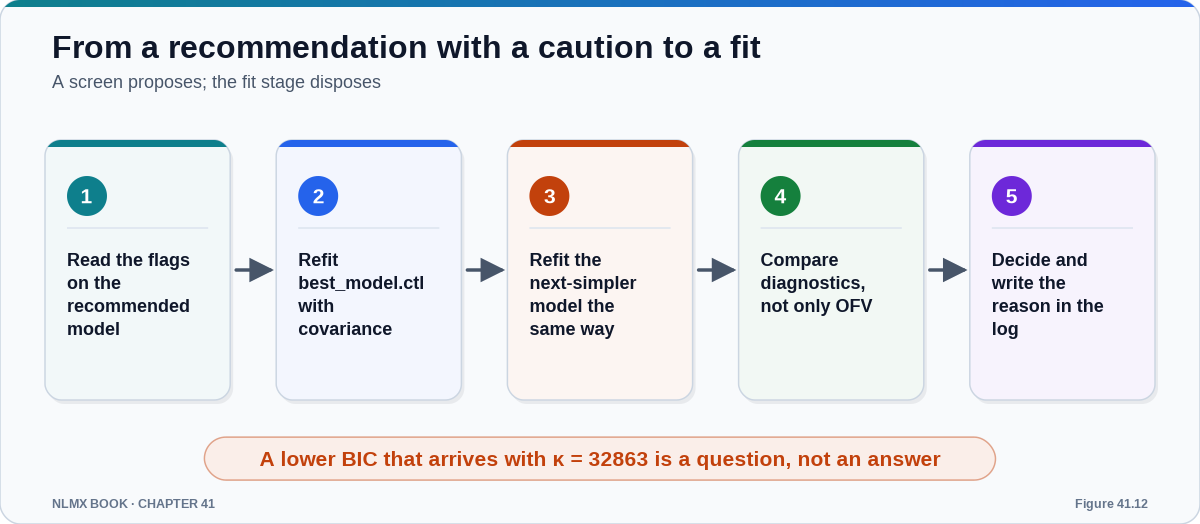
The screen is not the fit. Carry the chosen model into a standard fit with the covariance step and read its diagnostics (Chapter 21); carry the runner-up as well and compare them on the things a table of OFVs hides: shape of the residuals against time, ETA distributions, the number of parameters whose RSE exceeds 30 %, and the same condition number. If the three-compartment fit looks no better on diagnostics than the two-compartment fit, the evidence that appeared to support it was in the OFV alone.
The decision
| Question | Evidence | Decision | Reversible? |
|---|---|---|---|
| Which structure is the working base model? | 2→3: ΔBIC 15.4, but max RSE 42.8 % and κ ×13.9 | 2 compartments, first-order absorption, noting κ = 2370; run 3 compartments as a sensitivity fit | yes |
| What would change it? | — | If the 3-compartment fit gives max RSE < 30 % and κ < 1000 on refit (for example after fixing a peripheral volume or reparametrising), revisit | yes |
The point of the case is not that two is right and three is wrong. It is that the decision, its rule and its reversal condition are written down, so that a reader who disagrees knows exactly which premise to challenge.
What this case does not show
It stops before the fit: the next case (41.13) takes a model into estimation and reads what the fit reports. The two-compartment and three-compartment fits asked for above are not in any frozen bundle, so this page does not claim their results; it shows only how the decision is set up.
Review checklist
- Was the acceptance rule written before the candidate table was opened?
- Did you check RSE and condition number, not only BIC and the LRT?
- Do you know which random effects the screen pruned?
- Is the reversal condition written next to the decision?
Navigation
See the previous page, the next page and the complete case-study reference.