39.3 Warnings, notes, and the meaning of exit 0
What you will learn
- Separate process status from scientific status
- Classify warnings by impact
- Define command-specific acceptance gates
Prerequisites: Chapter 36 exit-code reference, Chapter 38 output completion, and the Chapter 39 overview.
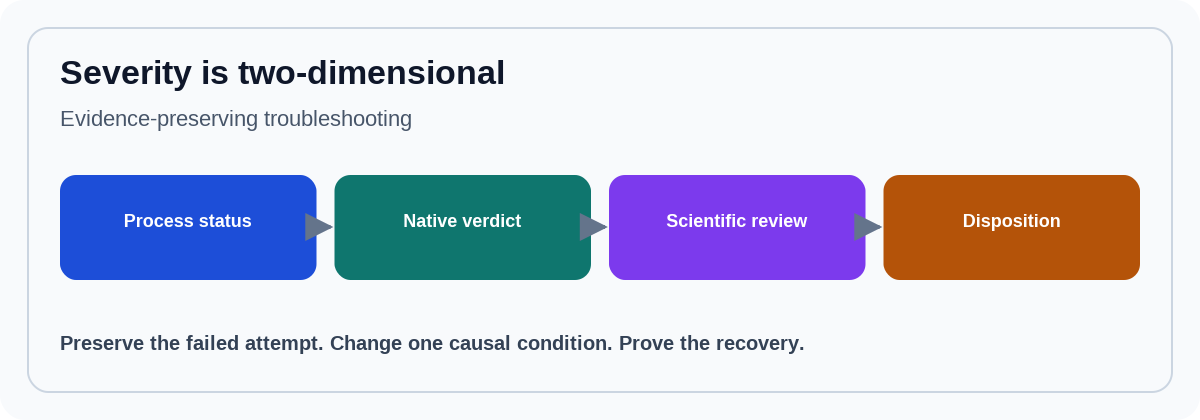
This page describes nlmx 4.16.2. Troubleshooting must preserve the failed attempt: keep its exact command, working directory, log, resolved settings, input/model identities, partial outputs, and process exit code. Correct one causal condition at a time and compare the new evidence with the failed run. Never convert a nonzero exit into success in a wrapper, and never interpret exit 0 as scientific acceptance without the command-native verdict.
nlmx logs levels such as stage, info, ok, warn, and error. A warning means the run can continue under an explicitly reported condition; it does not mean the condition is scientifically negligible. A note/info records behavior, fallback, omission, or interpretation. An error ends the current process or child task. Nested workflows can preserve failed child attempts while a parent summarizes them, so inspect both levels.
Use two mandatory gates and one human gate. Gate 1 is the process gate: did the command exit 0? Gate 2 is the native-result gate: did QC PASS under the intended policy, did estimation and covariance converge, did every required candidate/replicate complete, and were required files written? Gate 3 is scientific acceptance: are assumptions, exclusions, diagnostics, precision, sensitivity analyses, and intended use acceptable?
Warnings deserve disposition by category: identity/provenance; data population; model semantics; numerical reliability; incomplete branch/replicate; fallback/default; presentation; and performance only. Only the last category is usually operational. For every material warning record accepted, resolved, or not applicable, with justification and reviewer.
Examples of zero-exit conditions that still need review include an EDA plot omitted because no suitable data exist, a screening workflow with failed candidates, a fit whose parameter estimation completed but covariance did not, a report whose equation or image degraded with a warning, and a QC command run without a strict fail policy. Conversely, an expected nonzero result in a negative validation test is a test PASS only because the harness asserts the exact code/message.
Do not grep only for the word error: inspect the final completion line, structured summaries, convergence/status tables, nested failures, exclusions, and warnings. Automation should fail closed when required evidence is missing or an unknown warning appears.
Page checklist
- Did you retain the exact exit code, stage, message, hint, log, and partial output?
- Did you identify one causal layer before changing anything?
- Is the recovery a new, traceable attempt with the same intended estimand?
- Did you check command-native and scientific acceptance after process completion?
Navigation
See the previous page, next page, and complete error reference.