32.10 Comparing continuous models and identifiability
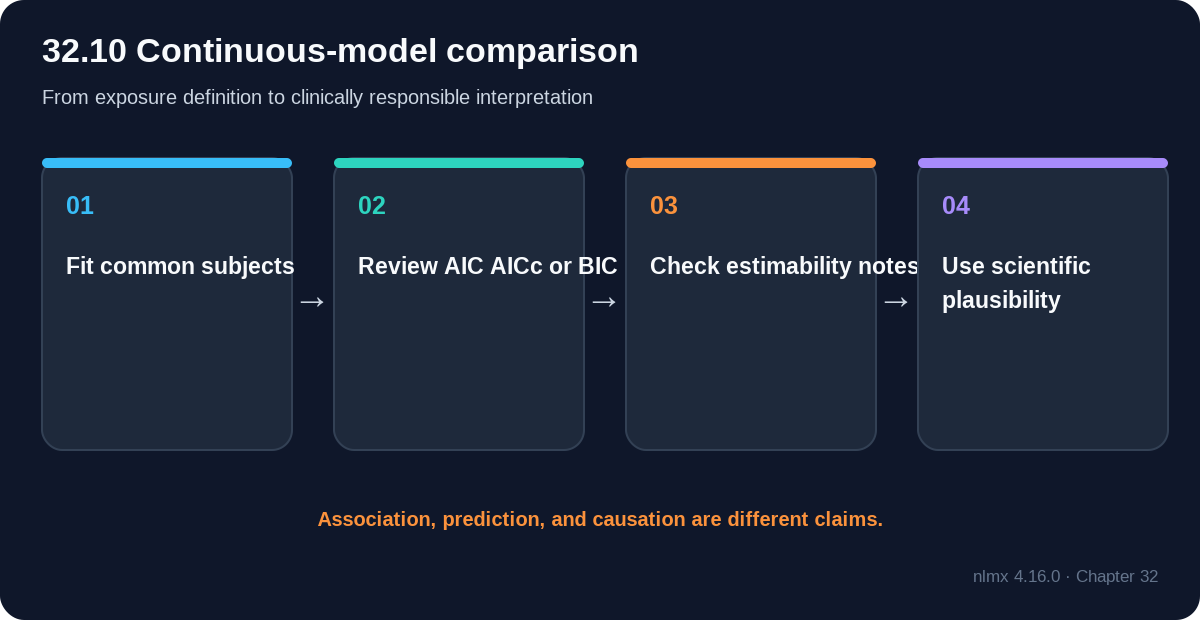
Model selection combines fit, estimability, residual diagnostics, data support, and scientific plausibility. AIC, AICc, or BIC ranks models only when fitted to the same observations and likelihood. A smaller criterion cannot rescue singular information or unsupported extrapolation.
Core concepts
- AIC emphasises predictive fit; AICc adds small-sample correction; BIC penalises complexity more strongly.
- Δ values describe relative support within the candidate set, not truth.
- Exposure-effect tests compare each model with a no-exposure model; they do not prove the chosen shape.
Keep five layers separate: the dose assignment, the individual exposure, the endpoint definition, the statistical estimand, and the clinical decision. A fitted curve connects exposure and endpoint within the analysed data; it does not automatically identify the effect of changing dose or exposure in another population.
Worked interpretation
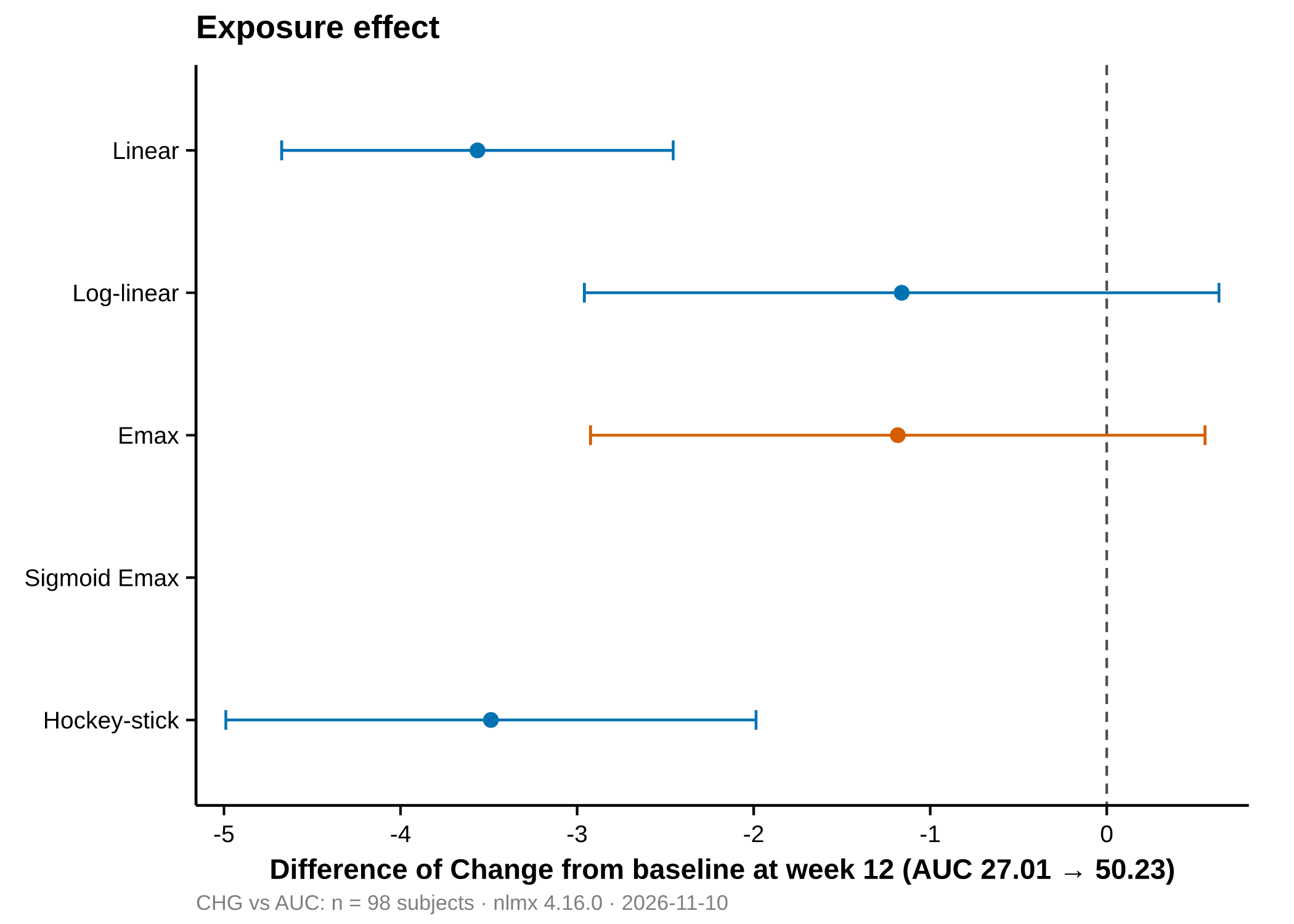
Executed AIC values were 640.4 linear, 615.1 Emax, and 657.5 hockey-stick. Sigmoid raw AIC 614.4 was excluded from ranking because its parameters were not estimable.
A defensible selection sequence
First confirm that candidate models use the same endpoint rows and likelihood. Second remove failed, singular, boundary, or scientifically impossible fits from ranking while retaining them in the audit trail. Third compare AIC/AICc/BIC and nested tests as prespecified. Fourth inspect parameter uncertainty, residuals, leverage, and prediction bands. Fifth ask whether the selected shape changes the clinical decision compared with simpler models.
ΔAIC is calculated relative to the lowest eligible AIC. Rough heuristics such as 2, 4, or 10 are not proof; they merely describe relative fit in the declared set. AIC favours out-of-sample prediction under assumptions, BIC imposes a stronger sample-size-dependent penalty, and AICc is safer when observations are limited relative to parameters. Model averaging may represent shape uncertainty better than announcing a fragile winner.
Always include the no-exposure model as a benchmark and report every candidate. In this chapter, sigmoid’s raw AIC was smallest but its singular information made it ineligible; Emax was the supported choice. That distinction prevents an optimiser artifact from becoming a pharmacological conclusion.
For a novice, translate every coefficient back to the endpoint scale. Name the starting exposure, ending exposure, predicted outcome at both, contrast, interval, and observed support. For categorical or survival endpoints, also show absolute probabilities or survival estimates because odds and hazard ratios can be hard to interpret clinically.
Quality control and scientific review
Inspect convergence, parameter intervals/RSE, warnings, subject count, residuals, and sensitivity to covariate adjustment.
Review sample size alone only after checking events, category cells, visit counts, placebo support, exposure overlap, exclusions, and missingness. A statistically precise curve can still be clinically irrelevant, confounded, extrapolated, or based on an endpoint definition that does not match the intended estimand.
Common mistakes
- Using one criterion as an automatic truth machine
- Comparing models fitted after different exclusions
- Treating a significant exposure term as proof that the selected shape or causal story is correct
Evidence to retain
- exposure definition, window, units, derivation, estimation uncertainty, and distribution by arm;
- endpoint derivation, time origin/visit, analysis population, missing/censoring rules, and exclusions;
- candidate models, covariate rationale, contrasts, selection criterion, diagnostics, failed/unstable fits;
- effect estimates with intervals, observed range, sensitivity analyses, software version, settings, and checksums.
Navigation
See the previous page, next page, and model and estimand catalogue.