29.22 Worked preset, existing-data, and ODE no-fit projects
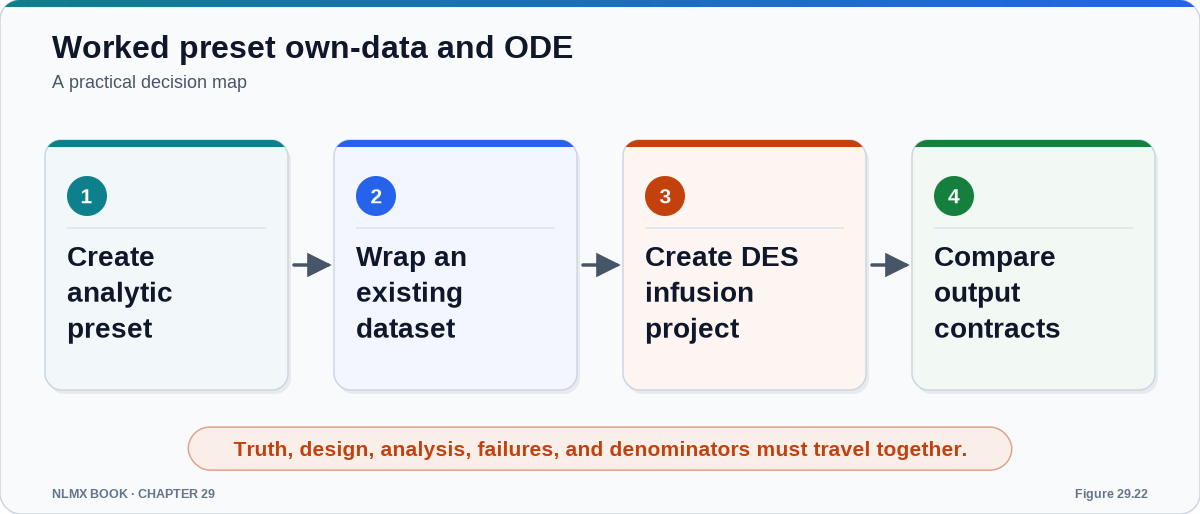
Three additional runs demonstrate mode-specific contracts. The analytic preset produced 200 subjects and a converged base fit at OFV -2880.2130. Existing-data mode normalised the Chapter 22 dataset, derived CL 3.98, V 41, and KA 1.45 starts, fitted run101 at -1082.5614, and fitted requested WT relationships in run102 at -1141.8668. The ODE design created a two-arm, 16-subject, three-compartment infusion project and intentionally skipped fitting.
Why this matters
The choice on this page changes either the generated truth, the information available to the fit, the analysis decision rule, or the denominator of an operating characteristic. A novice should be able to point to the corresponding setting and output column. A reviewer should be able to trace every aggregate back to a generated project, completed engine run, and relationship-level row.
Detailed behavior
- Existing-data mode wrote 60 missing values as
.and preserved the original source file. - Its fitted CL
WT and VWT values were 0.7505 and 1.0087; these are estimates, not known truth created bygenerate. - The no-fit project contains
$DEScontrol streams and simulated data but no final EXT/COV family. - The preset is useful for a stable tour, while the described modes expose explicit design assumptions.
- The executed preset and existing-data project did not emit
checksums.sha256; the described ODE design did. This mode-specific integrity difference must be handled explicitly during archival.
Keep four layers separate: design truth defines what was generated; realised data contain finite random variation; fitted artifacts estimate the model from those data; and analysis decisions classify relationships under a method and threshold. Mixing these layers is the most common source of incorrect recovery claims.
Example command or settings fragment
See documents/ch29/results/preset_analytic, own_dataset_project, and ode_infusion_nofit.
Begin with an inexpensive smoke run, inspect every generated artifact and warning, and only then increase subjects, scenarios, engines, or replicates. Use a new output directory for each analytical run. In a regulated or validation setting, preserve both the command as issued and the resolved settings or generated configuration because defaults and precedence are versioned behavior.
Interpretation and quality control
Compare each folder with the expected output contract before using it downstream. Missing truth in existing-data mode and missing final estimates in no-fit mode are intentional, not incomplete generation.
At minimum, verify subject/record counts, truth coefficients and forms, fit convergence, covariance status, relationship scope, classifications, completed denominators, and checksums. Read the row-level result before trusting a scenario metric. A graph is a compact diagnostic view; numerical tables remain authoritative.
Common mistakes
- Calling the existing-data fit a recovery study
- Expecting no-fit covariance files
- Assuming the preset reflects the custom design defaults
Also avoid describing a failed or skipped cell as a zero rate. Missing, undefined, failed, rejected, and uncertain are different states and must remain distinguishable.
Evidence to retain
- nlmx version, command, configuration, seed behavior, threads, and runtime environment;
- generated truth/control stream, data, group/design definition, base and optional covariate fits;
- engine settings, relationship scope, row-level results, summaries, metrics, report, failures, and completed denominators;
- checksums, scripts used to regenerate figures, tolerances, acceptance rules, and scoped interpretation.
Navigation
See the previous page, next page, and complete command and settings index.