19.10 Sufficient statistics S1 and S2
Let \(x_i=\eta_i+c\), where \(c_a=\mu_a\) for MU-linked effects and zero otherwise. SAEM tracks first and second moments:
S1 ← S1 + gamma [mean(x) − S1]
S2 ← S2 + gamma [mean(xx′) − S2].
Means include subjects and chains. S1 supplies population location for MU-linked effects; S2 and S1 supply OMEGA. They compress sampled conditional information needed for closed-form updates.
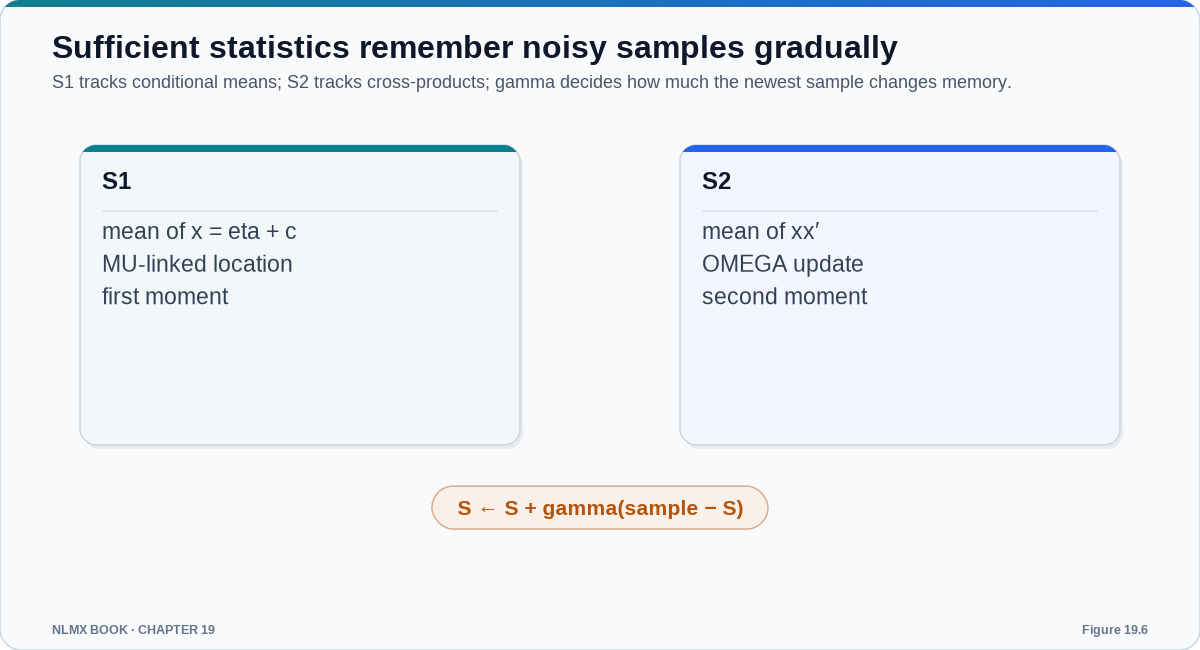
During burn-in gamma one makes S equal the newest batch statistic. During accumulation decreasing gamma averages batches. The generated trace shows the instantaneous chain mean staying noisy while S1 stabilizes.
Statistics depend on current parameterization and chain target. A stable S1 is not enough if chains explore the wrong region or OMEGA is invalid.
Practical interpretation
For the normal-normal evidence trace, recompute S1 manually: during burn-in it equals each iteration’s chain mean; during accumulation it becomes the arithmetic running mean of accumulation batches. Recompute S2 the same way and form variance (S2-S1^2) when no MU shift applies. These equalities are powerful deterministic tests of phase indexing and gamma.
For multiple ETAs, verify symmetry of S2 and consistent subject/chain denominators. A missing chain or mismatched coordinate order changes OMEGA silently even if traces look smooth.
Store enough trace information to reconstruct final statistics in a small validation run. Exact reconstruction is a strong release test for gamma, phase boundary, MU shift and deterministic reduction order.
Common mistakes
Do not interpret S1 as average EBE without MU shift, confuse S2 with covariance before centering, or average subjects/chain weights incorrectly.
Checklist
- Define x and MU shift.
- Average all subjects/chains correctly.
- Apply phase-specific gamma.
- Center S2 for covariance.
- Validate on analytic normal examples.
Further reading
Next read step-size schedule, MU updates, and OMEGA updates.