Correlated covariates and path dependence
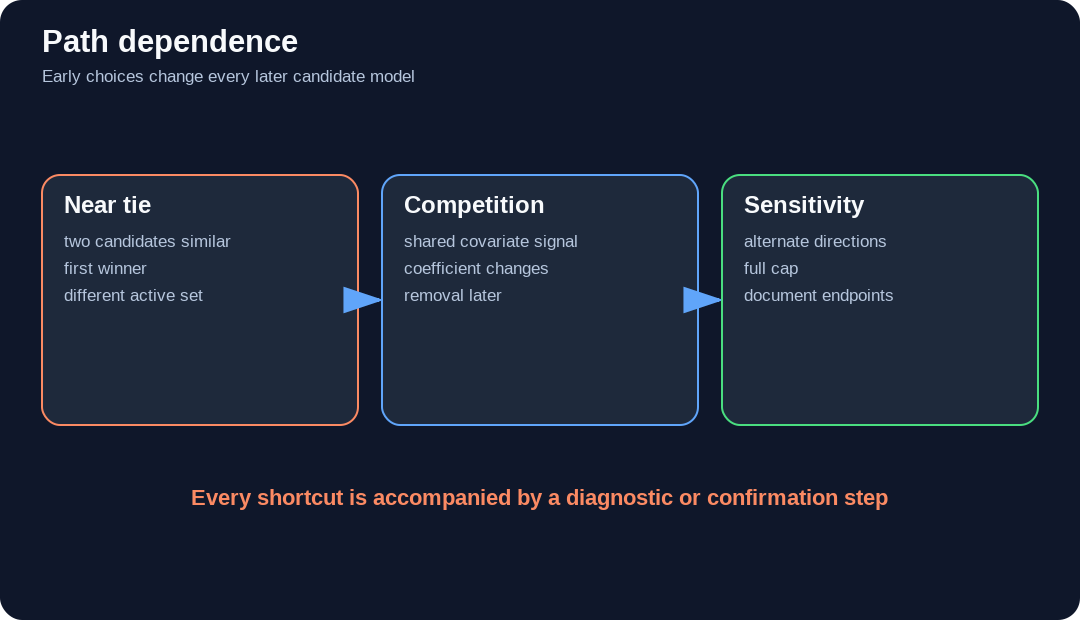
Correlated covariates compete for overlapping variation. If WT and body-surface area both explain CL, the first selected relationship may absorb evidence that would otherwise support the second. Their individual coefficients, signs, and p-values can change as the active set changes. SCM does not infer which correlated measurement is causal.
Path dependence follows directly: the first winner determines the next conditional models, and near-tie ordering can produce different terminal sets. Both-direction pruning can remove redundancy among entered terms, but it cannot guarantee exploration of every combination. Backward-only and full forward search provide useful, distinct sensitivities.
Before selection, inspect correlation, clinical meaning, missingness, scaling, and whether candidates represent competing measurements of the same construct. Use prespecified competition groups or alternative scopes when appropriate. Report endpoint stability and coefficient changes rather than reducing the analysis to retained/rejected labels.
Common mistakes
- Treating a stepwise p-value as clinical importance or causal proof.
- Reading a candidate comparison without its active model, convergence state, degrees of freedom, and exact threshold.
- Reporting only the terminal relationship list while discarding failed models, path decisions, configuration, and provenance.
Page checklist
- The scientific question, model identities, and comparison direction are explicit.
- Numerical validity is reviewed before interpreting statistical evidence.
- The result is linked to the complete trace and final joint-model diagnostics.