12.20 Input, data and subroutine corrections
Six correction names operate near the boundary between the control stream and its data: input_from_header, drop_text, ignore, ignore_numeric, and tol, plus the closely related correction of input semantics through the generated source. These edits can change which rows and values NONMEM sees, so treat them as high-impact even when the diff is short.
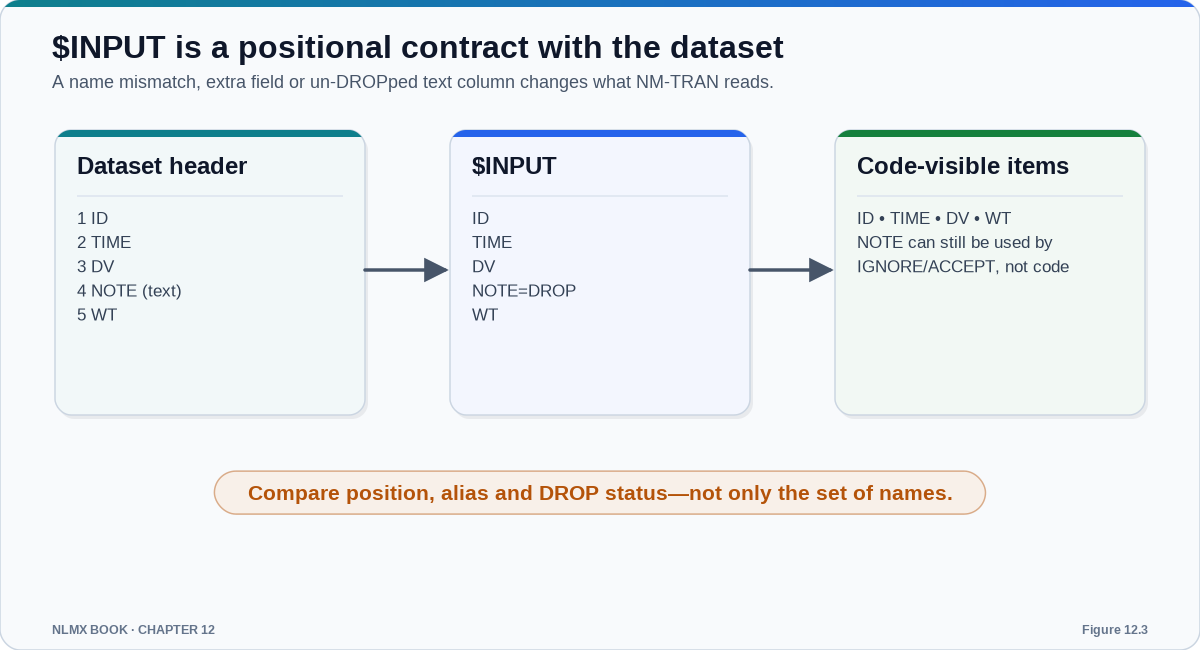
Header and input mapping
input_from_header is off by default. It can build $INPUT labels from the dataset header, but a header is not proof of NONMEM roles. Aliases, dropped columns, reserved names, and order must still be checked. drop_text marks text-bearing dataset columns so NONMEM does not parse labels as numbers. Confirm that no model code depends on a column before dropping it.
Which rows are read
ignore repairs a recognizable header-skipping problem. The example changes IGNORE=# to IGNORE=@ because its header begins with ID, not #. This makes the example read correctly, but IGNORE=@ also skips any later line starting with a letter or @. Inspect every nondata line and calculate retained record, subject, dose, and observation counts.
ignore_numeric is off by default. NONMEM condition comparison can be textual, so 0 and 0.0 may not behave as a novice expects. Rewriting a condition can change the analysis population; verify selected row IDs explicitly.
Tolerance
tol supplies tolerance information for general ADVANs where required. A tolerance is a numerical integration control, not a generic quality score. Confirm the appropriate record, scale, and value for the target NONMEM version and model stiffness.
Common mistakes
- Trusting header names without confirming column order and roles.
- Dropping a text column used in IGNORE/ACCEPT logic.
- Validating only total rows rather than subjects, doses, and observations.
- Treating an inserted tolerance as evidence of stable ODE integration.
Checklist
- Diff
$INPUTand$DATAcarefully. - List exactly which physical rows are included and excluded.
- Reconcile dataset header, aliases, and dropped columns.
- Test tolerance sensitivity for ODE models.
- Run NONMEM and compare record counts with qc-nm.
Further reading
See input checks, data checks, and subroutine checks.