19.1 Why SAEM exists
FO, FOCE and FOCE-I approximate the ETA integral by linearizing predictions; Laplace approximates conditional density by one local quadratic. Strong nonlinearity, sparse observations, many ETAs, censoring and skewed conditional densities can make those approximations fragile. SAEM approaches maximum likelihood by sampling latent ETAs instead.
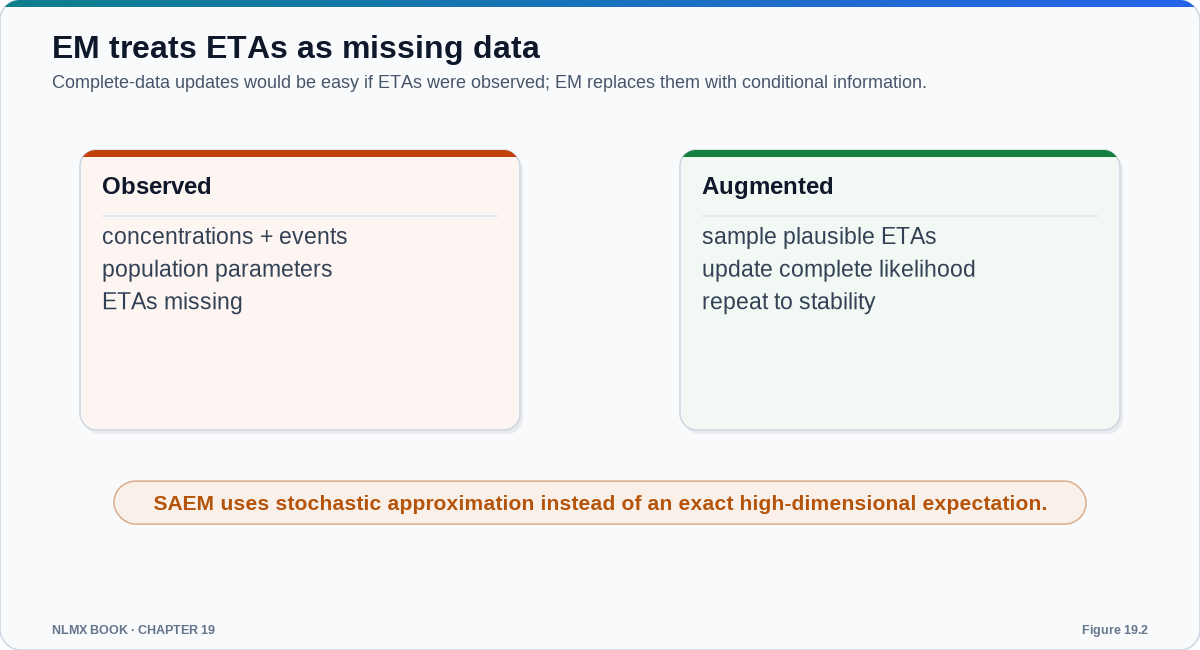
If every ETA were observed, maximizing the complete-data likelihood would be easier. EM replaces missing ETAs with their conditional expectation, but exact expectation is generally unavailable. SAEM uses Markov-chain samples and a decreasing stochastic-approximation step to learn the relevant expectation without exhaustive integration.
This does not make SAEM exact in finite time. It has MCMC mixing error, finite burn-in, stochastic-approximation error and final importance-sampling error. Its strength is avoiding a fixed local linearization of the marginal likelihood while retaining practical computation.
SAEM is an estimator phase, not the final objective calculation. The trace objective monitors algorithm stability. Afterward, nlmx estimates the marginal likelihood by importance sampling. Conflating those two numbers is one of the most serious reporting errors.
Practical interpretation
Begin method selection by drawing the expected conditional ETA density for representative subjects. If a single local Gaussian/tangent is plausible, FOCE-I or Laplace may be efficient. If density is skewed, broad, multimodal or shaped by censoring, sampling deserves consideration. Then ask whether the study contains enough information for MCMC to explore those features. SAEM changes the integration strategy; it cannot create identifiability absent from the data.
Common mistakes
Do not choose SAEM because it sounds more advanced, assume it always converges, or compare its trace objective with FOCE-I OFV. A stochastic path can look noisy and still be healthy; a smooth path can be stuck.
Checklist
- Identify why linearization/local Laplace may be inadequate.
- Plan MCMC, burn-in and accumulation diagnostics.
- Predeclare seed and settings.
- Use importance sampling for reportable OFV.
- Validate on representative model classes.
Further reading
Continue to EM and stochastic approximation and the method decision guide.