NONMEM confirmation and cross-software tolerances
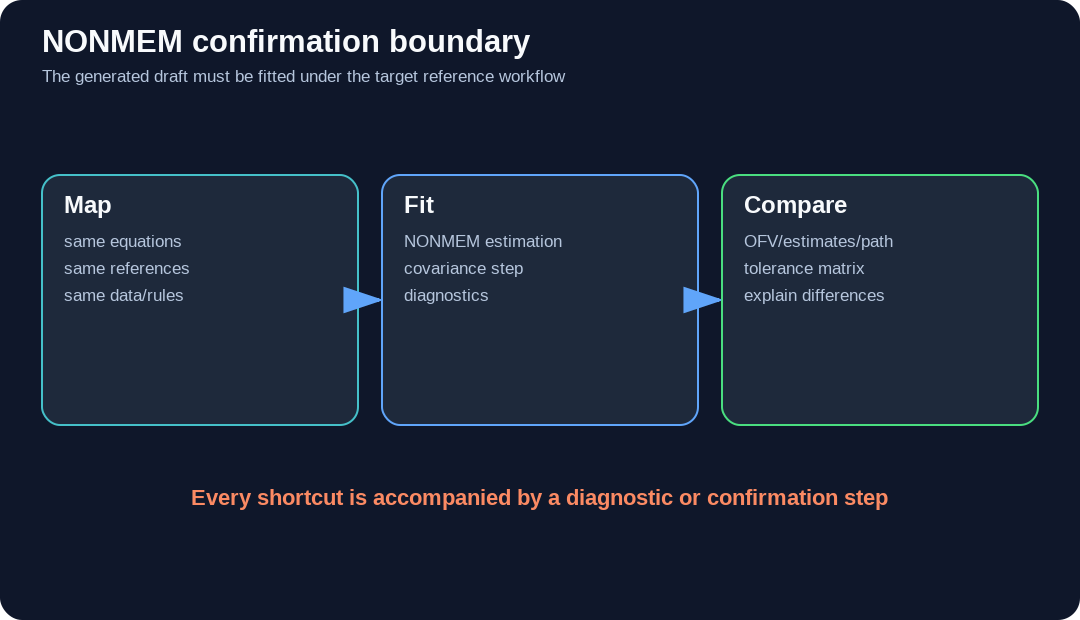
The nlmx draft model is an implementation aid, not evidence that NONMEM fitted it. To confirm a result, execute the mapped full and reduced models under the target NONMEM version, estimation method, data rules, initial values, bounds, and covariance settings. Preserve PsN/NONMEM logs and run directories independently.
Define acceptance criteria for convergence, objective differences, fixed effects, variance components, standard errors, predictions, ETAs, and selected path. Use absolute tolerances near zero and relative tolerances away from zero; include a rule for materially different minima. Candidate-level comparison is more diagnostic than endpoint-only agreement.
Differences can arise from likelihood approximations, conditional-mode optimization, parameter transformations, finite precision, boundary handling, and model translation. Classify each difference as expected, tolerable, unexplained, or blocking, and maintain a versioned validation matrix.
Common mistakes
- Treating a stepwise p-value as clinical importance or causal proof.
- Reading a candidate comparison without its active model, convergence state, degrees of freedom, and exact threshold.
- Reporting only the terminal relationship list while discarding failed models, path decisions, configuration, and provenance.
Page checklist
- The scientific question, model identities, and comparison direction are explicit.
- Numerical validity is reviewed before interpreting statistical evidence.
- The result is linked to the complete trace and final joint-model diagnostics.