10.19 Publication and regulatory quality control
Release QC is a sequence of gates. Visual polish is the last gate, not the first.
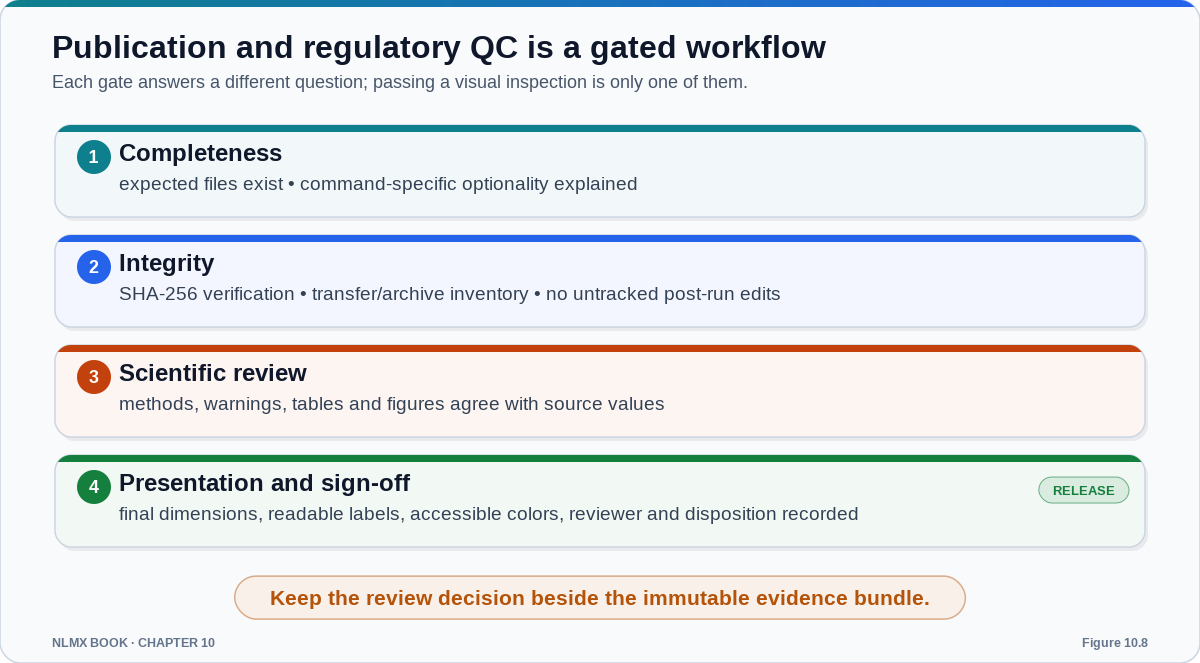
Figure 10.8. Completeness, byte integrity, scientific consistency and presentation/sign-off are distinct review gates.
Gate 1: completeness
Compare the directory with the versioned command output contract. Required machine tables, summary/report, provenance records and checksum manifest must exist. Explain optional omissions. Confirm the command completed successfully and that the directory contains no stale artifacts from an overwritten run.
Gate 2: integrity
Independently recompute every listed SHA-256 and check for unexpected files. Verify input manifest hashes against controlled inputs. If a figure or PDF was transformed after the run, treat it as a derived artifact with its own provenance and hash; do not imply it remains covered by the original checksums.sha256.
Gate 3: scientific consistency
Reconcile analysis population counts, methods, units, estimates and intervals across text, CSV/JSON, HTML and figures. Trace selected plotted statistics back to source values. Review warnings, non-finite/null fields, exclusions and convergence status. For comparison with NONMEM, Monolix or another package, predefine whether acceptance is byte identity, exact value identity, absolute/relative tolerance or qualitative diagnostic agreement.
Gate 4: presentation and approval
Place figures at their final physical size. Check base font, axis labels, units, legend, caption, panel labels, line weights, color accessibility and grayscale. Inspect HTML in light/dark modes and print preview. Confirm CSV/JSON remain available for exact values. Record reviewer, review date, issues and disposition in a controlled record.
A compact release record
| Field | Example content |
|---|---|
| Bundle ID | fit-base-r03 |
| nlmx build | version + immutable build/hash |
| Input identity | manifest hash/reference |
| Output identity | checksums.sha256 hash |
| Comparison basis | files, keys, tolerances and reference software |
| Deviations | expected platform/rounding/presentation differences |
| Reviewers | scientific and independent QC roles |
| Disposition | approved, conditional, rejected or superseded |
Accuracy and speed claims
When the project goal is to reproduce major pharmacometrics software while improving speed, report accuracy and performance from the same frozen case definition. Specify model, data, method, tolerances, initialization, thread count, hardware, warm-up, repetitions and measured scope. A faster run with different approximation, stopping criterion or output workload is not a like-for-like result.
Do not infer numerical equivalence from similar plots. Compare intermediate predictions, per-record likelihoods, parameters, uncertainty and diagnostics using predeclared tolerances. Preserve failures as evidence; they define the validated envelope.
Common mistakes
- Approving a visually attractive report before verifying machine values.
- Comparing runtimes without matching methods and workload.
- Claiming equivalence from rounded tables or figures.
- Editing a released bundle instead of issuing a superseding revision.
Checklist
- Pass completeness, integrity, science and presentation gates in order.
- Freeze comparison definitions and tolerances before looking at results.
- Verify final-size figures and accessible presentation.
- Record an immutable approval or supersession trail.
Further reading
See tolerance-based tests, performance measurement, archiving and the planned Chapter 42 validation framework.