Threads, determinism, seeds, and reproducibility
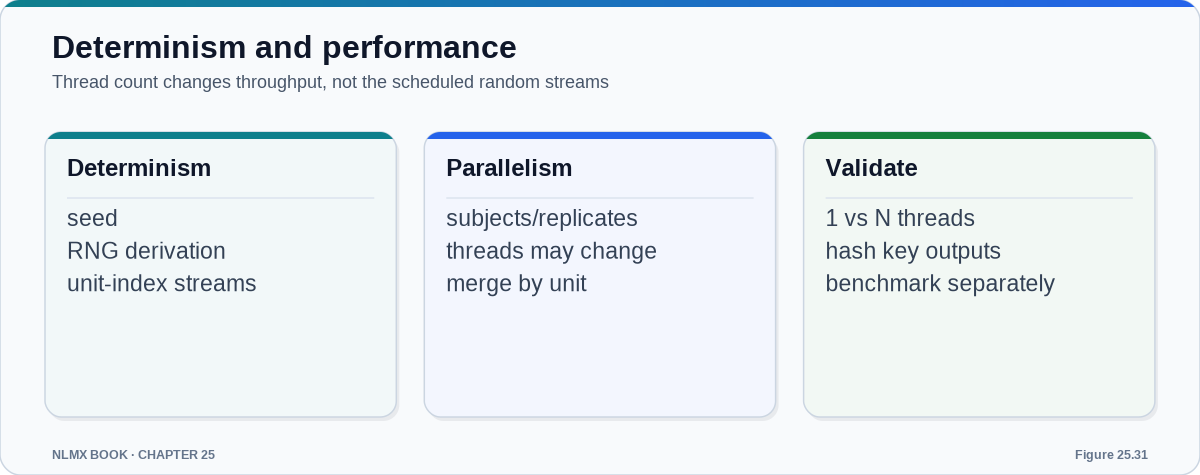
nlmx promises that worker thread count changes throughput, not results. Posterior stochastic streams derive from the master/configured seeds and stable schedule identities; completed units merge into stored aggregate state. Resume can therefore change --threads after verifying the same analysis hash.
Record every applicable seed: master CLI seed, uncertainty/calibration seeds, resampling seed, and any versioned RNG derivation. Same seed is not enough across engine or RNG-version changes, which is why resume refuses them. Determinism also requires identical input bytes, settings, and software.
Qualification should compare key machine-readable outputs for one versus many threads and uninterrupted versus resumed runs. Benchmark wall time separately from numerical equality. Avoid judging determinism from rounded reports when CSV/JSON/checksums provide stronger evidence.
Common mistakes
- Changing the scientific question after seeing the result while presenting it as the original run.
- Reading one engine's summary without checking its prerequisites, failures, normalized settings, and fitted endpoint.
- Treating a generated draft, comparison label, or completed checkpoint as a substitute for model diagnostics and reference-software confirmation.
Page checklist
- The exact command, version, inputs, resolved settings, and output directory are identifiable.
- Engine-specific evidence is interpreted on its own scale before cross-method comparison.
- Recovery state, final refit, diagnostics, and remaining confirmation work are explicit.