8.18 Worked analytic-versus-ODE verification
The Chapter 8 experiment represents the same one-compartment oral model as ADVAN2 TRANS2 and ADVAN13 $DES.
For dose \(D=100\), \(CL=5\), \(V=50\), \(KA=1.2\), and \(k=CL/V=0.1\), the closed-form concentration is
The analytic control stream is ctlanalytic.ctl; the ODE stream is ctlode.ctl. Both use the same csvengine.csv, parameters, scale and error model. The ODE sets TOL=10 ATOL=12.
Reproduce
python tools/ch08_examples.py `
  --nlmx ../nlmx/target/release/nlmx.exe `
  --output documents/ch08/results-recheck
Use a new output folder. The harness refuses non-empty destinations and refuses to replace changed fixtures.
Results
Eight observation times from 0.25 to 24 hours were compared. The retained csvanalytic_vs_ode.csv gives every value and error.
| Comparison | Maximum absolute discrepancy |
|---|---|
| ADVAN2 versus closed form | \(4.44\times10^{-16}\) |
| ADVAN13 versus closed form | \(1.19\times10^{-11}\) |
| ADVAN2 versus ADVAN13 | \(1.19\times10^{-11}\) |
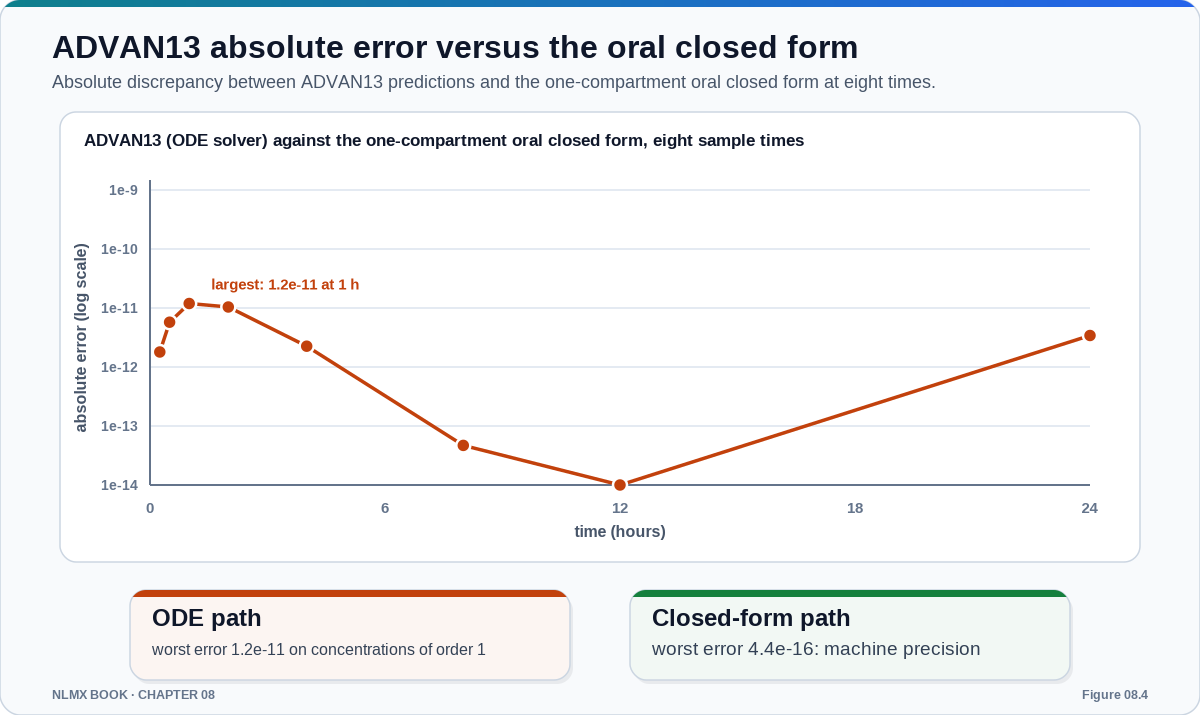
These are measured results for the 4.3.0 executable hash recorded in jsonexample_summary.json, not universal error bounds. The 4.4.0 source tree is documented separately.
Negative fixture
The same harness submits a $PK block containing verbatim Fortran. It exits 5 and reports that verbatim code is unsupported. Positive and negative fixtures together test agreement and refusal boundaries.
Extending the experiment
Add two/three compartments, coincident rates, fixed/modelled infusions, lags, ETA-dependent events, steady state, resets, stiff ODEs and nonlinear error models. Compare values and derivatives over a tolerance grid and against an independently implemented reference.
Common mistakes
- Presenting one linear fixture as full NONMEM equivalence.
- Hiding the executable/source version difference.
- Comparing rounded report values rather than CSV precision.
Checklist
- Freeze executable hash and fixture bytes.
- Predefine absolute and relative tolerances.
- Retain row-level discrepancies and expected failures.
Further reading
See ODE tolerance control, accuracy boundaries and Chapter 42's planned validation matrix.