Running the frozen method
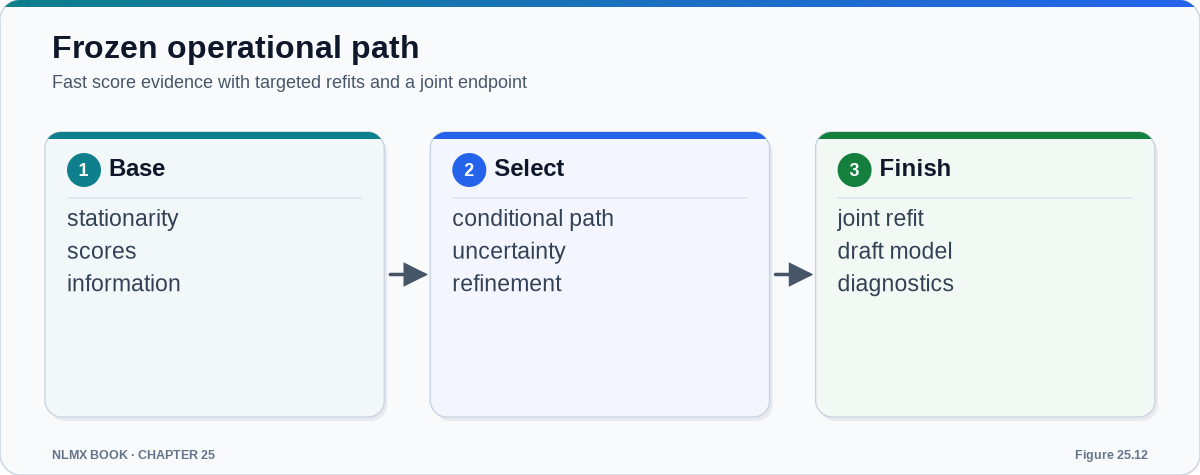
Use --method frozen for the efficient-score engine. Important controls include likelihood approximation, information estimator and nuisance source, selection mode, multiplicity adjustment, forward/retention thresholds, calibration, uncertainty draws, refinement, final refit, and optional subject-score/matrix outputs. Defaults are appropriate only after the base and scope are qualified.
The run produces candidate/equation evidence, selection trace, numerical diagnostics, refit cache when used, joint final refit by default, draft model, reports, normalized configuration, manifests, logs, and checksums. One-step coefficients describe local score behavior; the joint refit is the fitted endpoint. Uncertain classifications deserve targeted refits or SCM.
For reproducibility, record --approximation, .cov use, uncertainty/calibration seed and counts, information settings, adjustment, thresholds, and --refine. Chapter 23 supplies the mathematical interpretation and accuracy envelope; this chapter's both workflow uses frozen as one independent evidence layer.
Common mistakes
- Changing the scientific question after seeing the result while presenting it as the original run.
- Reading one engine's summary without checking its prerequisites, failures, normalized settings, and fitted endpoint.
- Treating a generated draft, comparison label, or completed checkpoint as a substitute for model diagnostics and reference-software confirmation.
Page checklist
- The exact command, version, inputs, resolved settings, and output directory are identifiable.
- Engine-specific evidence is interpreted on its own scale before cross-method comparison.
- Recovery state, final refit, diagnostics, and remaining confirmation work are explicit.