18.15 Comparing FO, FOCE, FOCE-I, and Laplace
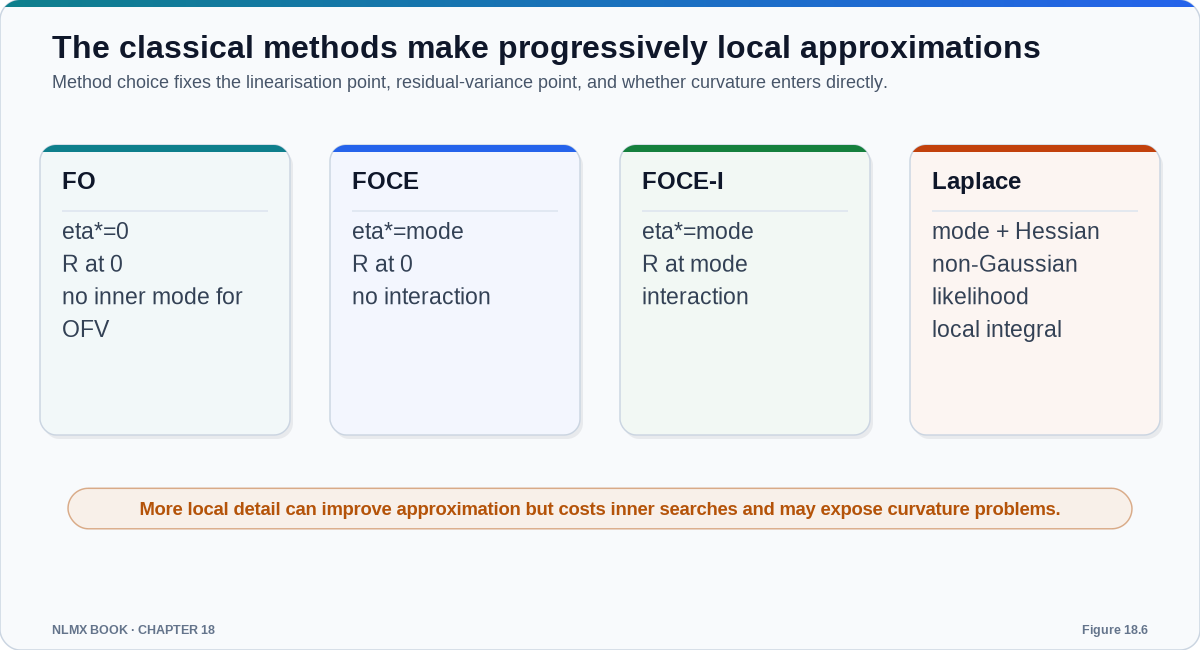
| Method | Expansion | Residual variance | Main strength | Main risk |
|---|---|---|---|---|
| FO | ETA zero | ETA zero | speed, simple reference | nonlinear/variability bias |
| FOCE | conditional mode | ETA zero | subject-local tangent | misses variance interaction |
| FOCE-I | conditional mode | conditional mode | ETA-dependent error | nested optimization |
| Laplace | conditional mode + Hessian | full conditional model | general likelihood records | local curvature approximation |
No row is universally best. In a linear Gaussian model they coincide. With constant additive error, FOCE and FOCE-I can be nearly identical. With strong nonlinear response or censored likelihoods, Laplace or SAEM may be needed. Method choice should precede model comparison.
Do not use differences among methods as an informal goodness-of-fit test. Large differences are a sensitivity signal: check prediction equivalence, conditional modes, error interaction, curvature and convergence.
Practical interpretation
Build a method-sensitivity table with identical data, starts, bounds and model: method, final OFV, estimates, inner failures, gradient, covariance status and runtime. Do not highlight only the lowest OFV because each row approximates the integral differently. Instead ask whether scientific conclusions and parameter scales remain stable and whether a more general method resolves a known approximation limitation.
A defensible primary method should be chosen from model features and validation evidence. Sensitivity methods then test robustness; they are not post hoc contestants for the most attractive result.
Record that choice before fitting candidates.
Common mistakes
Avoid selecting the method that gives the lowest OFV: objectives are different approximations and absolute values are not a competition. Do not mix methods across nested models for LRT.
Checklist
- State method and interaction explicitly.
- Keep method fixed across candidate comparisons.
- Match likelihood-record support.
- Investigate large method sensitivity.
- Use validation cases spanning nonlinearity and sparsity.
Further reading
Continue to failure conditions and the worked examples.